
AI agents for business are being presented as the next major change in how work gets done. Some descriptions make them sound like digital employees capable of running entire departments. Others use the word “agent” for what is essentially a chatbot with a new label. Business leaders need a more practical explanation.
An AI agent is software that can work toward an outcome by gathering information, deciding which permitted steps to take, using approved tools and checking what happened. Unlike a chatbot that normally responds to one request, an agent can continue through several steps until it completes the assigned work, reaches a boundary or needs a person to decide.
That does not make it an independent employee. An agent only knows what its instructions, available data and permitted tools allow it to know. It can misunderstand a request, use incomplete information or confidently choose the wrong step. The value comes from delegating routine coordination while preserving human authority where context, consequence and judgment matter.
My view comes from years of leading data, analytics, ERP, cloud and AI programs across complex organizations. New terminology appears frequently, but the underlying business questions remain familiar. What work are we trying to improve? What information does it require? Who owns the outcome? What happens when the system is wrong? Who has authority to intervene?
Those questions matter more than whether a vendor describes its product as an assistant, copilot or autonomous agent.
What are AI agents for business?
Imagine asking an experienced assistant to help with an upcoming meeting.
A simple question would be: “What is on the agenda?” The assistant finds the agenda and gives it to you. That resembles a chatbot interaction.
A fixed workflow might automatically send the agenda to every attendee twenty-four hours before the meeting. That resembles traditional automation. The trigger and steps were defined in advance.
A more agent-like assignment would be: “Prepare me for tomorrow’s supplier meeting.” The assistant may review the agenda, find the previous meeting notes, identify unresolved commitments, gather the latest supplier-performance information and prepare a briefing. If a required document is missing, the assistant might ask for it or flag the gap rather than pretending the preparation is complete.
The difference is not that one system is intelligent and the others are not. The difference is how the work moves from a request to an outcome.
A useful AI agent usually has five elements:
- A defined goal
- Relevant information
- Approved tools or actions
- Boundaries governing what it may do
- A way to check results or request human help
The agent does not need unlimited autonomy. In fact, the most useful business agents will often have deliberately limited authority. They may gather evidence, recommend a decision or prepare an action while leaving approval to a person.
Chatbot, automation and AI agent compared
Businesses already use chatbots and automation extensively. Agents do not make those approaches obsolete. They add another option for work that cannot be completed reliably through one answer or one completely predetermined path.
The following comparison shows the practical difference.
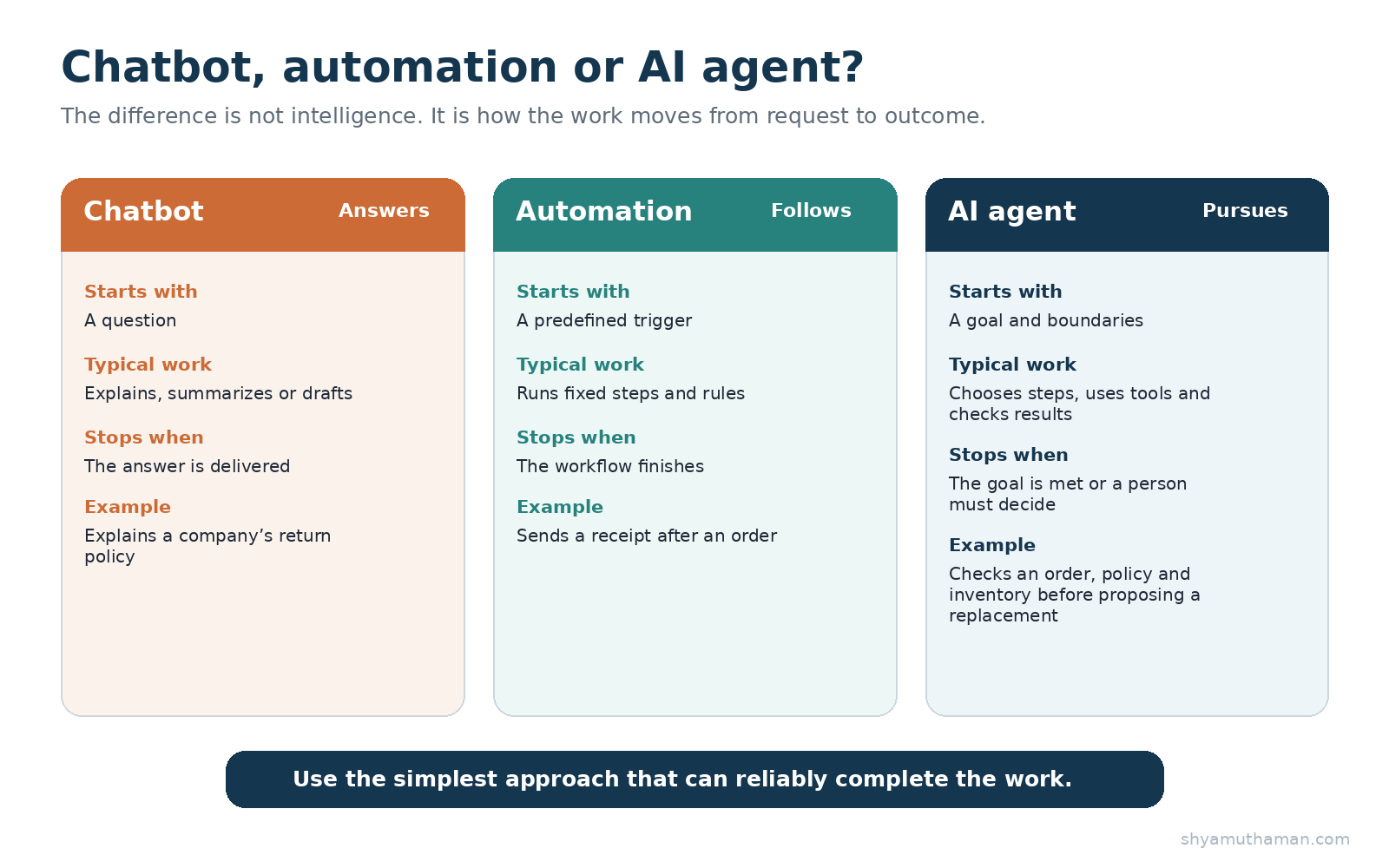
| Approach | What it does well | Example | Main limitation |
|---|---|---|---|
| Chatbot | Explains, summarizes, drafts and answers questions | Explains a company’s return policy | Usually stops after delivering the response |
| Traditional automation | Runs consistent, predefined steps | Sends a receipt after an order is placed | Struggles when the path changes or information is ambiguous |
| AI agent | Chooses among permitted steps, uses tools and checks progress | Checks an order, policy and inventory before proposing a replacement | Can make plausible but incorrect decisions when context or controls are weak |
The correct objective is not to turn every workflow into an agent. It is to use the simplest approach that can complete the work reliably.
If a receipt must always be sent after a confirmed payment, ordinary automation is likely the better choice. It is predictable, inexpensive and easy to test. Adding an AI agent would introduce unnecessary uncertainty.
If the work requires interpreting a request, gathering information from several places, choosing among permitted options and escalating exceptions, an agent becomes more relevant.
Why AI agents are receiving so much attention
Organizations have automated work for decades. Traditional automation performs particularly well when the inputs are structured and the rules are stable. A transaction arrives, the system checks a condition and the next predefined step occurs.
Much of everyday work is less orderly. Requests arrive through email, meetings, documents and conversations. Policies contain exceptions. Important information sits in several systems. Employees spend time gathering context, transferring information and following up with other people.
Generative AI changed what software could interpret. Tool use changed what it could do after interpreting the request. An agent combines those capabilities into a continuing workflow.
That is the opportunity. The agent can handle some of the coordination between intention and outcome instead of requiring a person to prompt it separately for every step.
The same capability creates the risk. A chatbot that gives an incorrect answer may confuse one person. An agent that can change a customer order, send a message or update a financial record can turn an incorrect interpretation into an incorrect action.
Agent value and agent risk both increase with authority.
Three everyday AI agents for business
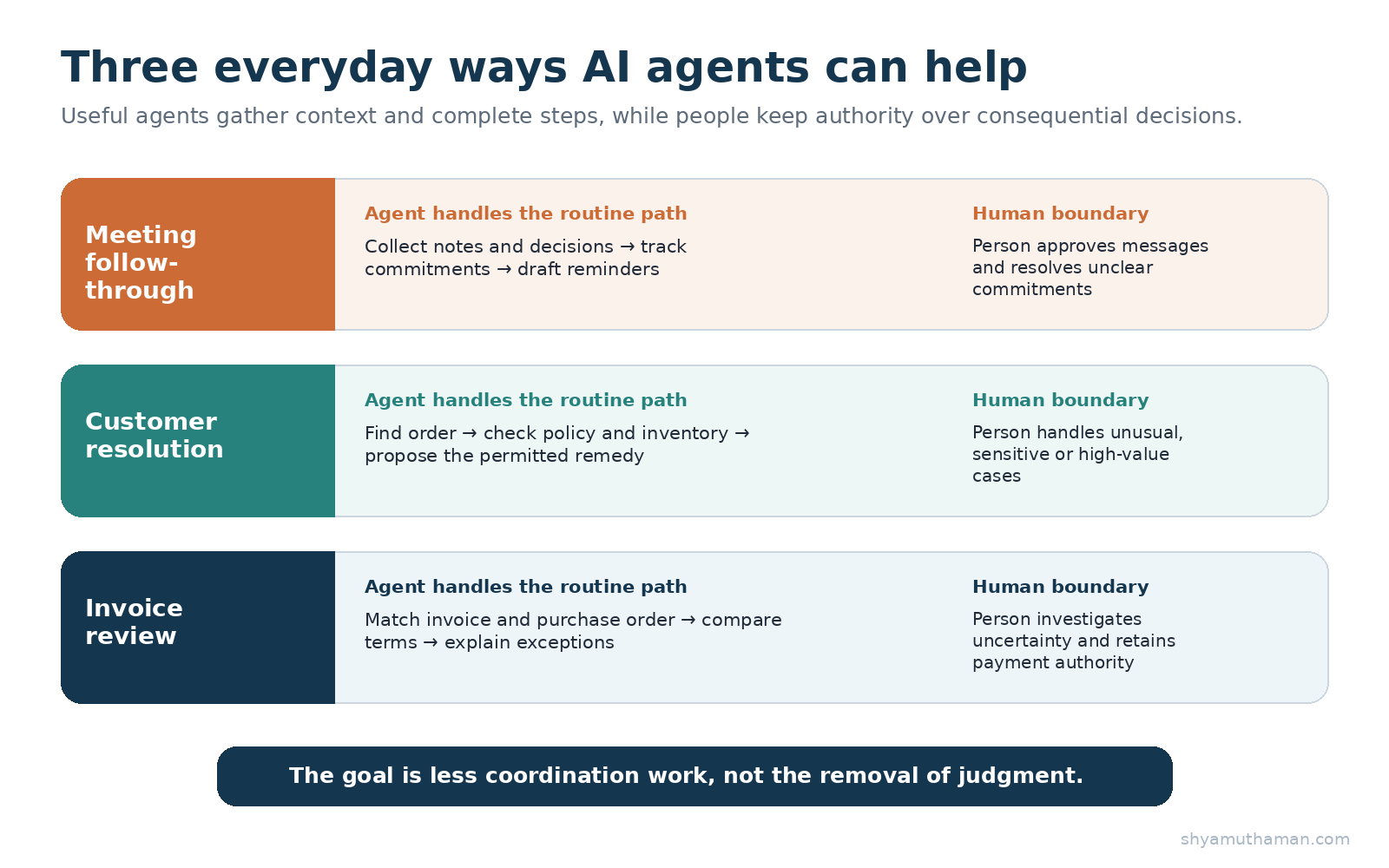
The easiest way to understand agents is to examine familiar work. These three examples involve activities that already consume time in many organizations: following up after meetings, resolving customer requests and reviewing invoices.
1. A meeting and follow-through agent
Meetings produce decisions, commitments and questions, but those outcomes are often distributed across notes, recordings, email and people’s memories. The summary is rarely the hardest part. The harder problem is maintaining continuity after everyone leaves.
A meeting agent could prepare a briefing by reviewing the agenda, earlier notes, related documents and outstanding commitments. After the meeting, it could organize decisions, identify owners, draft follow-up messages and track approaching deadlines.
The value comes from closing the gaps between meetings. Managers spend less time reconstructing what happened, team members receive clearer follow-up and unresolved decisions remain visible.
Human review still matters. A conversation may contain disagreement that a transcript does not capture. Someone may discuss an idea without accepting responsibility for it. A sensitive decision may not belong in a broadly distributed summary.
The agent can prepare the work, but a person should approve important messages and resolve unclear commitments. Otherwise, the system can transform an ambiguous conversation into an incorrectly documented decision.
2. A customer-resolution agent
Suppose a customer reports that an order arrived damaged and requests a replacement.
A chatbot can explain the return policy. A customer-resolution agent can go further. It could locate the order, confirm the product and delivery date, check the applicable policy, determine whether replacement inventory is available and prepare the permitted resolution.
For an ordinary low-value case that satisfies every rule, the business might allow the agent to create the replacement. For an expensive product, conflicting account information or a customer with repeated claims, the agent should route the case to a person.
This example reveals an important truth: the model is only one part of the agent. The agent also needs reliable order data, current inventory, the correct policy, customer identity and carefully limited permissions.
A sophisticated model working with an outdated policy can produce a polished mistake. A fast agent using inaccurate inventory can promise a replacement that does not exist. Better language does not compensate for unreliable business context.
3. An invoice-review agent
Accounts-payable teams compare invoices with purchase orders, receiving information and business rules before deciding whether an invoice requires attention. Much of the work involves finding evidence across documents and systems.
An invoice-review agent could find the matching purchase order, compare quantities and prices, examine freight and payment terms, look for a possible duplicate invoice and explain discrepancies to a reviewer.
The agent could separate routine matches from exceptions that need investigation. It could also say that it cannot verify a result when an important document or date is missing.
That final behavior is more important than it sounds. AI systems often appear helpful because they complete an answer even when the available evidence is insufficient. In financial work, recognizing that something cannot be verified is often safer and more valuable than producing a confident conclusion.
The agent should not approve payment merely because it completed the comparison. Payment authority remains with the appropriate person and business process. The agent prepares evidence and reduces repetitive review; it does not silently inherit financial authority.
I have already used controlled document and data experiments to examine how AI handles invoice matching, contract rules and inventory decisions. The results were promising, but the harder cases consistently involved missing information, conditional rules and business context. Those are exactly the conditions that a real agent must handle instead of avoiding.
How AI agents can help employees
The most immediate benefit is not replacing an entire job. It is reducing the amount of coordination surrounding the job.
Many experienced employees spend significant time gathering information, copying it between systems, checking routine conditions, composing standard follow-ups and reconstructing earlier decisions. Agents can compress portions of that work.
This can create several practical benefits:
- Less time spent searching for information
- Fewer routine handoffs between people and systems
- Faster preparation for decisions
- More consistent use of policies and checklists
- Earlier identification of missing information
- More attention available for exceptions and judgment
The best result is often that the AI becomes unremarkable. In AI to ROI for Business Leaders, I describe successful AI as infrastructure that becomes part of daily work. People should not need to admire the model. They should notice that an important task became easier, faster or more dependable.
That perspective changes how leaders evaluate an agent. The question is not “How many steps did the agent perform?” It is “Did people complete the work more effectively without creating unacceptable errors, risk or hidden effort?”
What AI agents still get wrong
Agents can fail at several points in a workflow, and their answers may still look professional.
They can misunderstand the goal
“Resolve the customer complaint” could mean issuing a replacement, explaining a policy, retaining an important customer or finding the source of a recurring product problem. If the goal is vague, the agent may optimize the wrong result.
They can use incomplete or outdated information
An agent might use an expired policy, stale inventory or an incomplete customer record. The reasoning can appear sound even though the information underneath it is not.
They can choose an inappropriate action
An agent may correctly identify that an invoice differs from a purchase order but incorrectly treat every difference as an error. The contract may allow a tolerance, freight may be handled separately or the purchase order may have been amended.
They can continue when they should stop
Software is often rewarded for completing the request. Business processes sometimes need the opposite behavior. When a required document is missing or two sources conflict, the correct action may be to stop and ask for review.
They can hide uncertainty behind fluent language
A well-written explanation can create more confidence than the underlying evidence deserves. This is one reason human judgment becomes more important as organizations generate more plausible-looking output.
The agent therefore needs explicit stop conditions, not only success instructions.
Where people should remain involved
“Human in the loop” is a popular phrase, but it is often too vague to be useful. A person can technically appear in the workflow without having enough time, evidence or authority to challenge the agent.
Meaningful human review requires answers to several questions:
- Which cases require approval before action?
- What evidence does the reviewer receive?
- Can the reviewer change or reject the recommendation?
- How are corrections and overrides recorded?
- Who examines patterns in those corrections?
- When must the agent be restricted or stopped?
The appropriate boundary depends on consequence. Drafting a meeting summary has different stakes from issuing a refund, changing a supplier record or approving a payment.
A useful progression is:
| Agent authority | What the agent does | Human role |
|---|---|---|
| Gather | Finds and organizes relevant information | Interprets the evidence |
| Recommend | Proposes a decision and explains why | Accepts, changes or rejects it |
| Prepare | Completes the steps needed before an action | Approves the final action |
| Act within limits | Executes approved low-risk actions | Reviews exceptions and monitors outcomes |
| Act autonomously | Completes decisions and actions without prior approval | Sets boundaries, monitors and intervenes |
Businesses should earn higher autonomy through evidence. They should not begin with the most powerful permissions merely because the product supports them.
When a business should not use an AI agent
An agent is not automatically the best solution for a complicated process.
Use ordinary automation when the rules and sequence are stable. A deterministic workflow will usually be cheaper, easier to test and more predictable.
Avoid adding an agent when the organization cannot define the desired outcome. Software cannot resolve a business disagreement that leaders have chosen not to settle.
Do not give an agent authority over information that is too unreliable to support the decision. AI can make bad data move faster, but it does not make the data trustworthy.
Be cautious when mistakes create serious legal, financial, safety or human consequences. An agent may still gather evidence or prepare a recommendation, but its action authority should reflect the risk.
Finally, do not automate a broken workflow merely because the current process is slow. The organization may need to remove unnecessary approvals, clarify ownership or correct source data before adding AI.
How to identify a useful agent opportunity
Start with work rather than technology. Ask an employee to walk through an ordinary day and explain where progress slows.
Look for a workflow with these characteristics:
- A clear outcome
- Repeated information gathering
- Several routine steps
- Rules that can be explained
- Exceptions that can be routed to a person
- Accessible and reasonably reliable data
- A measurable difference between the current and improved process
Then ask what happens when the agent is wrong. If the answer is unclear, the use case is not ready.
The initial version should have narrow authority. Let it gather, compare and recommend before allowing it to change records or communicate externally. Observe where people correct it and what information it repeatedly lacks.
This aligns with the pilot approach in my AI strategy framework: use real workflows and representative cases, but keep the stakes controlled while the organization learns where the system succeeds and fails.
How AI agents fit into an operating model
Even a small agent eventually raises ownership questions. The business owns the outcome and workflow. Data owners remain responsible for meaning and source quality. Technology teams operate integrations and reliability. Risk, security and legal functions define controls appropriate to the use case.
An AI operating model clarifies those decision rights. Without it, a pilot can appear successful while nobody accepts responsibility for its production behavior.
The organization’s current capability also matters. An AI maturity assessment can reveal whether the limiting issue is business direction, data, delivery, governance, adoption or value measurement.
Governance should follow the agent’s actual authority and consequence. My AI governance framework explains why a system that drafts text should not receive the same controls as one that changes a financial or customer record.
What we will test next
Definitions are useful, but agents become easier to understand when we watch them encounter actual business rules, documents, data and exceptions.
In the practical work that follows, I will build and test agents rather than rely only on product demonstrations. The experiments will show the complete business context, instructions, source information, expected results, failures and human-review limits.
Some approaches may not work. Platform limits, unreliable outputs or unnecessary complexity are legitimate results. I will not present an experiment as production-ready merely because it produces an impressive demonstration.
The objective is to answer more useful questions:
- Can the agent complete the routine path consistently?
- Does it recognize missing information?
- Can it explain the evidence behind its conclusion?
- What happens when business rules conflict?
- Where does a person need to remain involved?
- What would be required before the workflow could operate reliably?
As those experiments are completed, this guide can connect to the results. The sequence will follow what we learn rather than a list of articles promised in advance.
Free official resources about AI agents
The NIST AI Risk Management Framework provides a free foundation for thinking about AI governance, measurement and risk management. Its principles become increasingly important as an agent receives more access and authority.
The NIST AI RMF Core describes outcomes across govern, map, measure and manage. It also emphasizes documented roles, accountability and human-AI oversight.
For a deeper discussion of selecting business problems, designing safe pilots, fitting AI into workflows, driving adoption and measuring value, AI to ROI for Business Leaders on Amazon provides the broader execution roadmap behind this approach.
AI agents for business will be useful when they reduce routine coordination, operate within clear boundaries and help people make or execute better decisions. They will be dangerous when fluent output is mistaken for understanding and access is granted faster than accountability.
What are you considering building with an AI agent? Share the workflow, the data it would need and the decision or action you would not want it to take without human review.