
AI GOVERNANCE FRAMEWORK FOR BUSINESS LEADERS
An AI governance framework becomes real when an output can change a payment, a contract decision, an inventory order or an executive metric. Before that point, governance can look like policy work happening somewhere outside the project. After that point, it becomes part of whether the system is safe enough to use.
My view comes from years of leading data, analytics and AI work across complex business environments. I have seen how unclear ownership, weak data definitions and poorly designed controls can undermine a technically impressive solution. I develop the leadership and governance side of these problems in The Data-Driven Executive and the execution and investment side in AI to ROI for Business Leaders.
The four experiments in this article are practical additions to that experience. I used them to make several governance problems visible with examples readers can inspect. The tests covered invoice and purchase-order matching, contract review, inventory decisions and Databricks Genie business questions.
None of the experiments involved a dramatic science-fiction failure. Instead, the more useful problems were quieter. An answer could be numerically wrong while looking normal. A missing date could make a recommendation impossible to verify. A contract clause could be different without being unacceptable. Even an automated benchmark could reject a response that answered the user’s question correctly.
These examples reinforce a broader lesson from real delivery work. The organization must decide what evidence is required, which errors matter, when a person must review the result and who has authority to stop the system. An AI governance framework must answer those questions because a policy that says “use AI responsibly” does not.
What is an AI governance framework?
An AI governance framework is the operating structure an organization uses to decide which AI systems it will use, what those systems may do, how they will be tested, who owns the resulting decisions and how problems will be detected after deployment.
I think of it as a combination of internal controls, product management and quality assurance. Internal controls define authority and evidence. Product management connects the system to a real business outcome. Quality assurance tests expected behavior and failure conditions. AI governance brings those disciplines together because an AI system can produce variable outputs even when the software around it has not changed.
For comparison, the closest familiar analogy is a new employee joining a sensitive business process. You would not give that person unrestricted access on the first day because they completed one successful task in a training room. Instead, you would define the role, limit permissions, review early work, measure performance and expand authority only after the evidence justified it. AI deserves the same discipline.
How the AI governance framework developed
Organizations did not start from nothing. Data governance had already established concepts such as ownership, quality, lineage, access and retention. Model-risk practices added validation, documentation and independent review. Cybersecurity contributed identity, permissions, threat testing and incident response. Privacy programs added rules about purpose, consent and sensitive information.
AI widened the problem. A traditional application normally executes logic that engineers explicitly wrote. A generative AI system interprets instructions and creates a response at runtime. Its answer can change with the wording, context, model version, retrieved data or surrounding conversation. Therefore, reviewing the source code alone cannot prove that the business outcome will remain acceptable.
The NIST AI Risk Management Framework, released in 2023, organized AI risk work around Govern, Map, Measure and Manage. The OECD AI Principles were adopted in 2019 and updated in 2024. ISO published ISO/IEC 42001 for AI management systems in December 2023. These resources give organizations a serious foundation, although they still have to be translated into controls that fit a specific business process.
What this AI governance framework adds
Official frameworks are the right place to understand established principles, terminology and management-system expectations. My purpose here is narrower. This article shows how those ideas change the design of ordinary business AI use cases.
This AI governance framework does not replace the work of security, privacy, legal, compliance, audit or enterprise risk teams. Instead, I am translating governance into the questions a product owner, data leader or business sponsor must answer before asking those teams to approve something meaningful.
The difference matters because governance often enters a project too late. A team builds a demonstration, proves that the model can produce an impressive answer and then asks reviewers to approve the design. By then, the data flow, user experience, permissions and automation boundaries may already be difficult to change.
Therefore, I would start governance when the use case is selected. A team should understand the affected decision, plausible harm and required evidence before choosing how much autonomy to give the system.
Four experiments that put the AI governance framework into practice
To make the controls concrete, I applied them to four previously published experiments: AI invoice and purchase-order matching, AI contract review, AI inventory management and my Databricks Genie business-context benchmark. Each experiment used fictional data and compared the AI output with defined business rules or independently verified answers.
| Use case | Information supplied | AI task | Business consequence if wrong |
|---|---|---|---|
| Invoice matching | Vendor invoices, purchase orders and notes | Identify matches, discrepancies and possible duplicates | An incorrect finding could delay a valid payment or allow an incorrect one to proceed |
| Contract review | Vendor agreement and internal contract playbook | Compare clauses with preferred and acceptable positions | A missed difference could expose the company to a term it did not intend to accept |
| Inventory review | Inventory workbook, policy, demand, open orders and operational notes | Flag reorder, overstock and unverifiable cases | A bad recommendation could increase stockouts, excess inventory or operating cost |
| Databricks Genie | Six sales tables, relationships, business definitions and benchmark questions | Translate business questions into SQL and return calculated answers | An incorrect metric could enter management reporting and influence a decision |
In practice, the same AI governance framework should not treat these four systems as identical. Their data, users, failure modes and possible actions differ. However, the same control questions can be applied to each one.
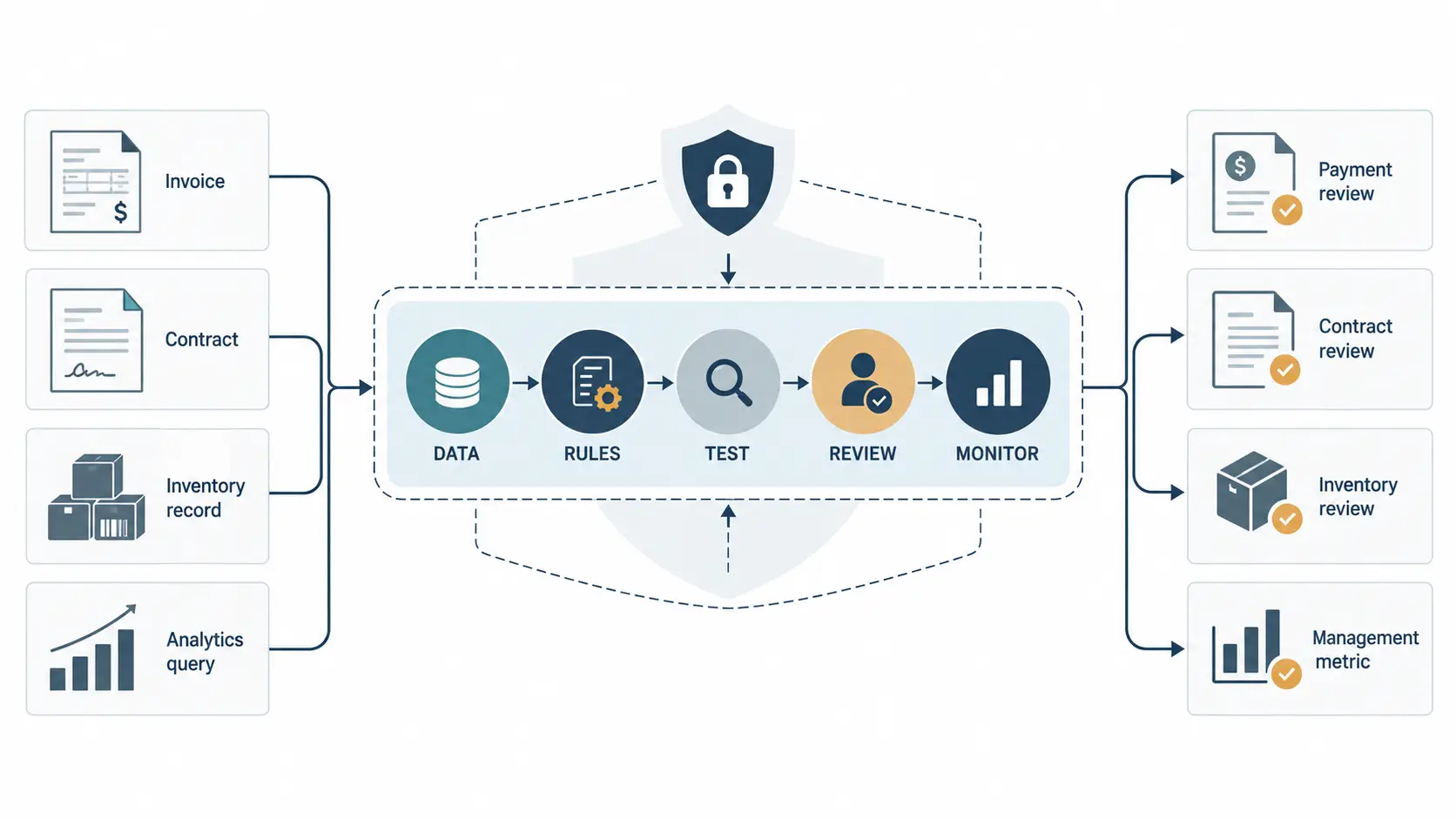
The illustration below shows how these examples fit into a common operating structure. Although the source material changes, each use case still needs approved data, explicit rules, testing, human review and production monitoring before its output influences a business decision.
My practical AI governance framework
For that reason, I would organize the AI governance framework around eight controls. They are deliberately operational. Each control should produce evidence that another person can inspect instead of relying on a project team saying that it considered the issue.
| Control | Question it must answer | Evidence I would retain | Primary owner |
|---|---|---|---|
| 1. Use-case definition | Which business decision or task will the AI influence? | Scope, intended users, expected outcome and prohibited uses | Business owner |
| 2. Accountability | Who owns the business result, system behavior and control decisions? | Named owners, review responsibilities and escalation authority | Executive sponsor and product owner |
| 3. Data boundaries | What data may the system access, and what data must remain outside it? | Source inventory, classification, lineage, permissions and retention rules | Data owner and security |
| 4. Risk classification | How much harm could an error cause, and how independently can the system act? | Impact, autonomy, affected population and reversibility assessment | Business risk owner |
| 5. Behavioral boundaries | What must the AI do, refuse to do or send for clarification? | Business rules, instructions, decision limits and refusal conditions | Product owner and subject-matter expert |
| 6. Evaluation | What evidence proves the system is acceptable for this use? | Known-answer tests, edge cases, ambiguity tests and acceptance thresholds | Technical owner and independent reviewer |
| 7. Human oversight | Which outputs require review, approval or an override? | Review standard, reviewer qualifications, decision log and override reasons | Business process owner |
| 8. Production monitoring | How will the organization detect deterioration, misuse or changed conditions? | Outcome metrics, incident log, change triggers and stop criteria | Product and operations owners |
In my opinion, the evidence column is what separates a working AI governance framework from an attractive diagram. If nobody can show the test cases, approval decision, system boundaries or monitoring history, the organization has a set of intentions rather than a functioning control.
Control 1: Define the use case around a decision
“Use AI in Finance” is not a use case. “Compare an invoice with its purchase order and identify fields that require an accounts-payable reviewer” is specific enough to govern.
A useful AI governance framework identifies the user, the business task, the affected decision and the boundary of the AI’s authority. It also states what success means in business terms. For example, time saved can matter, but it cannot be the only measure if the tool can introduce incorrect payments, contract risk or inventory decisions.
This is also where a team should record prohibited uses. The contract experiment could identify clauses that differed from the playbook. It could not approve the contract or give legal advice. The invoice experiment could identify discrepancies. It could not authorize payment. Those boundaries belong in the original product definition, not in a disclaimer added after development.
Control 2: Assign accountability that survives a failure
AI projects often have many participants and surprisingly little ownership. The business funds the use case. A technology team builds it. A vendor supplies the model. Security reviews access. Legal reviews terms. Operations inherits the production system.
When the result is wrong, that structure can produce a circular conversation: the model behaved unexpectedly; users should have checked; the business rule was unclear; data was incomplete; or the vendor changed something.
I would name at least two accountable roles. The business owner owns the affected decision and acceptable error. The technical owner owns implementation, evaluation, monitoring and incident response. Other functions advise or approve within their authority, but they should not become substitutes for ownership.
This follows a broader leadership principle from The Data-Driven Executive: governance fails when responsibility is distributed so widely that nobody can make a decision or fix a recurring problem.
If your AI program has technology owners but no clear business accountability, that gap will become more expensive as adoption grows. The Data-Driven Executive examines how leaders establish ownership, decision rights, governance and executive alignment before recurring delivery problems weaken confidence in the data or the team.
Control 3: Govern the data before debating the model
A model cannot repair an undefined business meaning. In the Genie experiment, access to six related tables did not tell the agent what “sales,” “active customer” or “best-performing region” meant. Those definitions came from the business.
Data governance for an AI use case should identify approved sources, ownership, sensitivity, lineage, quality expectations and permitted use. It should also document the grain of important datasets. The incorrect Genie return-rate calculation came from combining detailed rows at the wrong grain. The SQL was syntactically valid, but the result was wrong.
In turn, missing information deserves equal attention. In the inventory experiment, an open purchase order without a usable arrival date could not reliably reduce stockout risk. The correct response was “Cannot Verify,” not an invented assumption. A mature AI governance framework gives the system permission to stop when evidence is insufficient.
My data-readiness framework for AI covers the source, quality and ownership questions in more depth. The governance decision is whether the remaining gaps are acceptable for the specific use case and risk level.
Control 4: Classify risk using impact and autonomy
I would not classify a system only by whether it uses machine learning, generative AI or an agent. The more important questions are what happens when it is wrong and how far it can act without another person.
| Risk tier | Typical role of AI | Human involvement | Example |
|---|---|---|---|
| Tier 1: Assist | Draft, summarize or organize low-impact information | Sampling and normal user review | Drafting an internal meeting summary |
| Tier 2: Advise | Recommend an action or interpret business information | A qualified person reviews material outputs | Flagging invoice or inventory exceptions |
| Tier 3: Decide | Influence a consequential decision using defined limits | Recorded approval or strong exception controls | Prioritizing cases for investigation |
| Tier 4: Act | Execute an action that changes money, access, rights or operations | Strict authorization, monitoring, reversal and stop mechanisms | Releasing a payment or changing a production order |
For that reason, autonomy should be earned with evidence. A system that performs well as an assistant has not automatically proved that it should take action. The evaluation must match the authority being requested.
The decision-rights ladder below captures the relationship I care about most. As AI moves from assisting a person to acting on the organization’s behalf, an AI governance framework must increase the evidence and oversight around it. Therefore, the final level should contain the strongest authorization and stopping controls, not the fewest obstacles.

Control 5: Convert business policy into behavioral boundaries
In practice, written instructions are part of the control environment, but only when they are specific enough to test. “Be accurate” cannot be evaluated. By contrast, “Use completed orders, recognize returns by return date and use order date unless the user requests ship date” can be evaluated.
The same principle appeared in the other experiments. The contract reviewer needed to recognize both the preferred position and an acceptable fallback. Otherwise, it could flag a permitted clause merely because the wording differed. The inventory reviewer needed to separate normal demand from a one-time promotion. The invoice reviewer needed to distinguish a mismatch from information that was not available.
I would document three kinds of boundaries: calculation and decision rules, conditions requiring clarification, and actions the system may never take. Then I would test all three.
Control 6: Evaluate business behavior, not only model accuracy
A generic model benchmark says little about whether a system can perform your company’s task. Therefore, evaluation data in an AI governance framework should represent the decisions, terminology, exceptions and incomplete information the system will encounter after deployment.
I would include ordinary cases, boundary conditions, alternate wording, missing inputs, conflicting evidence and requests that should trigger clarification. For calculated answers, I would independently verify the expected results. For document review, I would retain the source passage and policy evidence behind the expected classification.
The Genie experiment also showed why a single score can mislead. Databricks reported 79% accuracy after business instructions were added. My review found that two rejected responses gave the correct result requested by the user but omitted supporting columns in the benchmark answer. Business correctness was 93%, while one genuinely wrong calculation remained.
I would preserve both views. The platform score shows whether the output matched the benchmark exactly. Human review explains whether the business conclusion was correct and whether the difference matters. Changing the score after the fact without retaining the original would hide useful information.
Control 7: Make human review specific
“A human remains in the loop” sounds reassuring, but it is incomplete. Which human? What must that person inspect? What evidence will be visible? How much time will the review receive? What happens when the reviewer disagrees?
A reviewer who sees only the final answer may confirm a convincing mistake. In the Genie experiment, the incorrect 56.89% return rate looked like an ordinary numeric result. The correct value was 4.11%. Finding the problem required examining the generated SQL and its join grain.
Review design should therefore match the failure mode. An accounts-payable reviewer needs invoice and purchase-order evidence. A contract reviewer needs the agreement clause and the corresponding playbook rule. An inventory manager needs current stock, demand, lead time and incoming-order timing. A data analyst reviewing Genie needs the generated SQL, source grain and expected metric definition.
I would also monitor override behavior. A very low override rate can mean the AI is excellent. It can also mean reviewers are approving outputs mechanically. A very high rate can mean the system is poor, or that users are applying a business rule the team never documented. The reasons matter more than the headline percentage.
Control 8: Monitor business outcomes and material changes
Production monitoring in an AI governance framework must extend beyond uptime and response time. After all, an AI system can be technically healthy while producing worse business decisions.
| Measure | What it reveals | Example trigger |
|---|---|---|
| Business outcome | Whether the use case is improving the result it was funded to change | Invoice cycle time improves while payment errors do not increase |
| Confirmed error rate | How often reviewed outputs contain material mistakes | Error rate exceeds the approved threshold |
| Override rate and reason | Where users disagree and which rules may be missing | Overrides rise for one supplier, region or question type |
| Cannot-verify rate | Whether missing information is blocking useful work | A required source or field becomes unreliable |
| Clarification behavior | Whether the system asks before applying an ambiguous definition | The system begins silently choosing among reasonable meanings |
| Material change | Whether prior evaluation evidence still applies | Model, prompt, data source, policy, user group or authority changes |
| Incident and near miss | Where controls failed or caught a problem before harm occurred | A recommendation crosses a prohibited boundary |
Therefore, material changes should trigger reassessment. Replacing the model, adding a data source, changing a prompt, expanding the user population or allowing the system to take a new action can invalidate earlier testing. Version control without re-evaluation records what changed but does not prove the changed system remains acceptable.
The operating discipline here connects directly with my AI pilot with guardrails and analysis of why AI projects fail. A pilot should discover failure conditions and operating requirements before the organization expands authority or scale.
Applying the AI governance framework to four experiments
| Use case | Impact | Autonomy in the experiment | Governance position | Required human review |
|---|---|---|---|---|
| Invoice matching | Medium to high | Advisory only | Tier 2 while flagging exceptions | Accounts-payable reviewer checks evidence before any payment decision |
| Contract review | High | Advisory only | Tier 2 with strict scope boundaries | Legal or procurement reviewer evaluates every material finding |
| Inventory review | Medium | Advisory only | Tier 2 while recommending review | Inventory manager checks timing, exceptions and supplier constraints |
| Databricks Genie | Varies by question | Returns answers but takes no operational action | Tier 1 for exploration, Tier 2 for management analysis | Important metrics require verified logic or analyst review |
However, the classifications would change if autonomy changed. An invoice tool that only highlights mismatches is different from one that releases payments. Likewise, an inventory assistant that recommends review is different from one that sends purchase orders. A Genie answer used for exploration is also different from the same answer copied into an executive operating review.
This is why I would classify the deployed use case rather than the underlying model. The same model can support a low-impact drafting tool and a high-impact decision system. Governance must follow what the organization allows the system to influence.
What the experiments reinforced
Clearer instructions helped, but they did not remove implementation errors
Business definitions transformed the Genie results. However, one generated SQL query still combined rows incorrectly. I would never treat prompt quality as a substitute for testing, verified calculations or controlled functions where the metric matters.
The ability to stop was often more valuable than the ability to answer
“Cannot Verify” is a useful outcome when required evidence is missing. Asking for clarification is useful when a term has several reasonable meanings. Systems become dangerous when they interpret every incomplete request as an instruction to make a confident assumption.
Automated evaluation also required governance
The benchmark score was valuable, but it reflected a particular expected result shape. Two answers were rejected despite returning the requested business result. Evaluation logic needs ownership, versioning and human interpretation just like the AI system it measures.
Human review can become ceremonial
A person approving a result does not automatically make the process safe. The reviewer needs the right expertise, source evidence, time and authority to disagree. Otherwise, the human becomes the last click in an automated process rather than an effective control.
A minimum viable AI governance framework
I would not begin with a large committee or a library of policies. For one production use case, I would require six pieces of evidence before deployment.
- Use-case record: purpose, users, affected decision, business owner, technical owner and prohibited uses.
- Risk classification: business impact, autonomy, data sensitivity, reversibility and affected population.
- Source and rule inventory: approved data, business definitions, important relationships, permissions and retention.
- Evaluation set: normal cases, edge cases, missing-information cases, ambiguity tests and independently verified answers.
- Human-review design: reviewer, evidence shown, approval conditions, override process and escalation path.
- Production control plan: monitoring measures, thresholds, incident response, change triggers, stop criteria and retirement owner.
That is enough to force the important decisions into the open. As the number and risk of AI systems increase, the organization can add common policies, reusable control patterns, a central inventory and formal review bodies. Starting with excessive ceremony can drive teams around the process. Starting with no evidence creates a different problem that appears only after something goes wrong.
Implementing the AI governance framework in 90 days
| Period | Work | Output |
|---|---|---|
| Days 1 to 30 | Inventory active use cases, name owners, define decisions and classify preliminary risk | AI inventory with accountable owners and initial priorities |
| Days 31 to 60 | Document data boundaries, business rules, evaluations, human review and prohibited actions for the highest-priority use cases | Control records and known-answer test sets |
| Days 61 to 90 | Run controlled pilots, test failure cases, set monitoring thresholds and record deployment decisions | Approved scope, operating controls and stop criteria |
The sequence is intentionally use-case driven. A central framework becomes useful when it makes delivery safer and more repeatable. It becomes harmful when teams spend months designing an enterprise process without testing whether anyone can use it on a real project.
The expensive moment is not when an AI demonstration fails. It is when an impressive demonstration reaches production without clear ownership, measurement or stopping conditions. AI to ROI for Business Leaders provides the wider operating model for selecting, testing, governing, adopting and measuring AI investments before that gap becomes a production problem.
Where I think organizations get AI governance wrong
The first mistake is treating governance as the team that says no. If every low-risk experiment requires the same review as an autonomous high-impact system, teams will avoid the process or stop reporting early work.
The second mistake is assigning governance entirely to technical teams. Engineers can explain implementation and testing, but the business must define the decision, acceptable error and operational consequence. A data scientist cannot decide whether a contract deviation is acceptable or whether an inventory risk justifies a purchase.
Another mistake is believing that purchasing a governed platform governs the use case. Platforms can provide access controls, lineage, monitoring and audit records. They cannot decide what “sales” means in your company, which contract fallback is acceptable or when an inventory manager should ignore temporary promotional demand.
Finally, many organizations focus on model selection because it is visible and technically interesting. The difficult work sits around the model: data, business rules, workflow design, evaluation, user behavior, accountability and operating discipline.
Would I use this framework in a real organization?
Yes, but I would keep the first version small and evidence based. The eight controls provide a review structure, while the required evidence should scale according to impact and autonomy. I would not ask every project to produce the same amount of documentation.
Governance should also sit inside normal product and delivery work. The use-case record belongs with product scope. Data boundaries belong with architecture and access design. Evaluation belongs with acceptance criteria. Human review belongs in the workflow. Monitoring and stop criteria belong in production operations.
A separate governance function can define minimum expectations, challenge weak evidence and provide independent oversight. However, it cannot own every business decision on behalf of the teams deploying AI.
Choose your next step
You do not need to implement the entire framework at once. The right next step depends on whether your immediate gap is technical evidence, business ownership or a repeatable path from investment to value.
- If you need a practical example, review the related invoice, contract, inventory and Databricks Genie experiments linked earlier in this article.
- If your challenge is ownership, governance, executive alignment or building a data-led operating model, continue with The Data-Driven Executive.
- If you are selecting AI opportunities or moving pilots toward production, adoption and measurable value, continue with AI to ROI for Business Leaders.
Waiting does not keep the risk unchanged. As more employees adopt AI and more pilots connect to business data, undocumented decisions become harder to reconstruct and weak controls become more expensive to redesign. A small governance record created now is more useful than a large policy created after an incident.
Official AI governance resources
These official resources provide the broader standards and risk-management foundation. Organizations should also evaluate the laws, regulations, contractual requirements and industry obligations that apply to their locations and use cases.
- NIST AI Risk Management Framework, including the framework, playbook, profiles and use-case resources. NIST currently notes that AI RMF 1.0 is being revised.
- OECD AI Principles, covering trustworthy AI, transparency, safety and accountability.
- ISO/IEC 42001 AI management systems, an international management-system standard for organizations developing or using AI.
The result I want from AI governance
I do not want governance to guarantee that an AI system will never be wrong. That promise would not survive contact with a real business process. I want governance to make the important failures easier to anticipate, detect, contain and learn from.
The organization should know what the system is allowed to do, what evidence supports that authority, who owns the outcome and what conditions will cause the system to stop. If those answers are clear, governance can support faster decisions because teams are not renegotiating basic controls during every deployment.
What are you trying to build with AI? I would be interested in the decision it affects, the data involved and where your team is getting stuck. Share the use case in the comments, especially if the difficult part is deciding how much human review or autonomy is appropriate.