
PRACTICAL AI EXPERIMENT
Inventory reports have a habit of looking simple until you actually have to decide what deserves attention. A product can be below its reorder point and still be fine because stock is already arriving. Another can look healthy today while a long supplier lead time means it will run out before replacement stock could reach you. Then there are promotions, discontinued products, supplier holds and purchase orders with missing dates.
I wanted to see how well ChatGPT could work through those situations using nothing more than an Excel workbook. I created two synthetic inventory datasets, added the business rules directly into an Inventory Policy sheet, and asked ChatGPT to tell me which SKUs needed a reorder review, which were overstocked, which required no action, and which could not be verified from the available data.
I kept this experiment deliberately approachable. There was no ERP integration, forecasting system or custom inventory application. I uploaded the workbook and used a prompt that an inventory manager could realistically write. The interesting part was seeing whether ChatGPT would apply the business rules together instead of reacting to a single number such as the reorder point.
Download the inventory experiment
The package contains the synthetic inventory workbooks for both rounds along with the prompts used in the experiment. You can download the files, start fresh ChatGPT conversations and run the same test yourself.
Download the AI Inventory Management Experiment
The inventory records and policies in these files are fictional and were created specifically for this experiment.
Problem Statement
A normal inventory report can contain plenty of data while still leaving the manager with the real work of deciding what to do with it. On-hand quantity, reorder points, incoming purchase orders, supplier lead times and demand all affect the decision, and those numbers do not always point in the same direction.
Take an item with 20 units on hand and a reorder point of 30. A basic rule would immediately flag it for replenishment. If another 60 units are already confirmed to arrive next week and current stock will last two weeks, that reorder flag may be unnecessary. Change the purchase-order arrival date to three weeks from now and suddenly the same inventory position deserves attention.
I also wanted the review to respect business context. A temporary promotion should not automatically become the new demand forecast. A discontinued item should not receive a replenishment recommendation just because it falls below a reorder point. A supplier hold should be mentioned without making the inventory shortage disappear. Missing information should produce Cannot Verify when the decision genuinely depends on that missing value.
Those are the kinds of situations I wanted the model to work through.
Plan of Approach
Round 1 was designed as a baseline. The workbook contained eight products with straightforward reorder, overstock and no-action situations. I also included confirmed incoming inventory and one product with a missing reorder point to see whether ChatGPT would stop instead of inventing a threshold.
Round 2 introduced timing and business context. The inventory policy required ChatGPT to calculate projected stockout timing, compare that with purchase-order arrival dates, use normal weekly demand when a recent sales spike came from a one-time promotion, account for supplier lead time, respect discontinued-product rules, identify incoming inventory that would create overstock, and return Cannot Verify when an open purchase order had no ETA.
I knew the expected classification for every SKU before running either test. That gave me seventeen controlled decisions across the two rounds and made it possible to judge the reasoning rather than simply looking at whether the final table appeared convincing.
Round 1: Can ChatGPT handle a basic inventory review?
The first workbook contained eight SKUs. The policy defined four allowed outcomes: No Action, Reorder Review, Overstock Review and Cannot Verify. Confirmed incoming inventory could be counted when the policy allowed it, while missing thresholds had to remain unresolved.
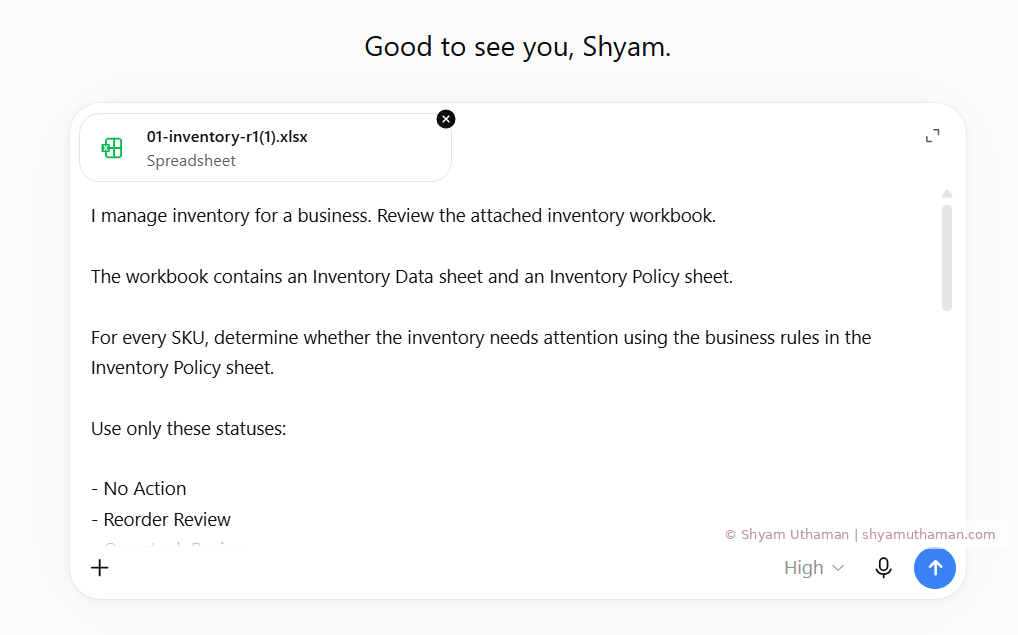
I manage inventory for a business. Review the attached inventory workbook.

The workbook contains an Inventory Data sheet and an Inventory Policy sheet.

For every SKU, determine whether the inventory needs attention using the business rules in the Inventory Policy sheet.

Use only these statuses:

- No Action
- Reorder Review
- Overstock Review
- Cannot Verify

Read the Inventory Policy sheet before assigning a status.

Consider confirmed incoming inventory when the policy allows it.

Do not place purchase orders.
Do not change inventory records.
Do not invent demand, lead times, incoming quantities, thresholds, or business rules that are not in the workbook.

Return a simple table with:

- SKU
- Product
- Status
- What needs attention
- Evidence from the workbook
- Suggested action for inventory review

If the workbook does not contain enough information to determine a status, say Cannot Verify.

Show me only what an inventory manager would need to know.
What happened in Round 1
The straightforward cases came back as expected. Industrial Safety Gloves and Shipping Cartons were below their reorder points with no incoming inventory, so both received Reorder Review. Heavy Duty Packing Tape and the Aluminum Laptop Stand were above their maximum stock levels and received Overstock Review.
The Adjustable Monitor Stand was more useful as a test. Only 30 units were currently on hand against a reorder point of 60, which initially looks like a reorder problem. Another 50 units were confirmed to arrive within seven days. ChatGPT added the incoming quantity to the current inventory, recognized that 80 units would be available, and returned No Action.
The Desktop Label Printer had only 20 units on hand, but the reorder point was missing from the workbook. ChatGPT returned Cannot Verify and recommended confirming the missing threshold before reviewing the item again. That was the expected behavior because the workbook did not provide enough information to decide whether 20 units represented a shortage.
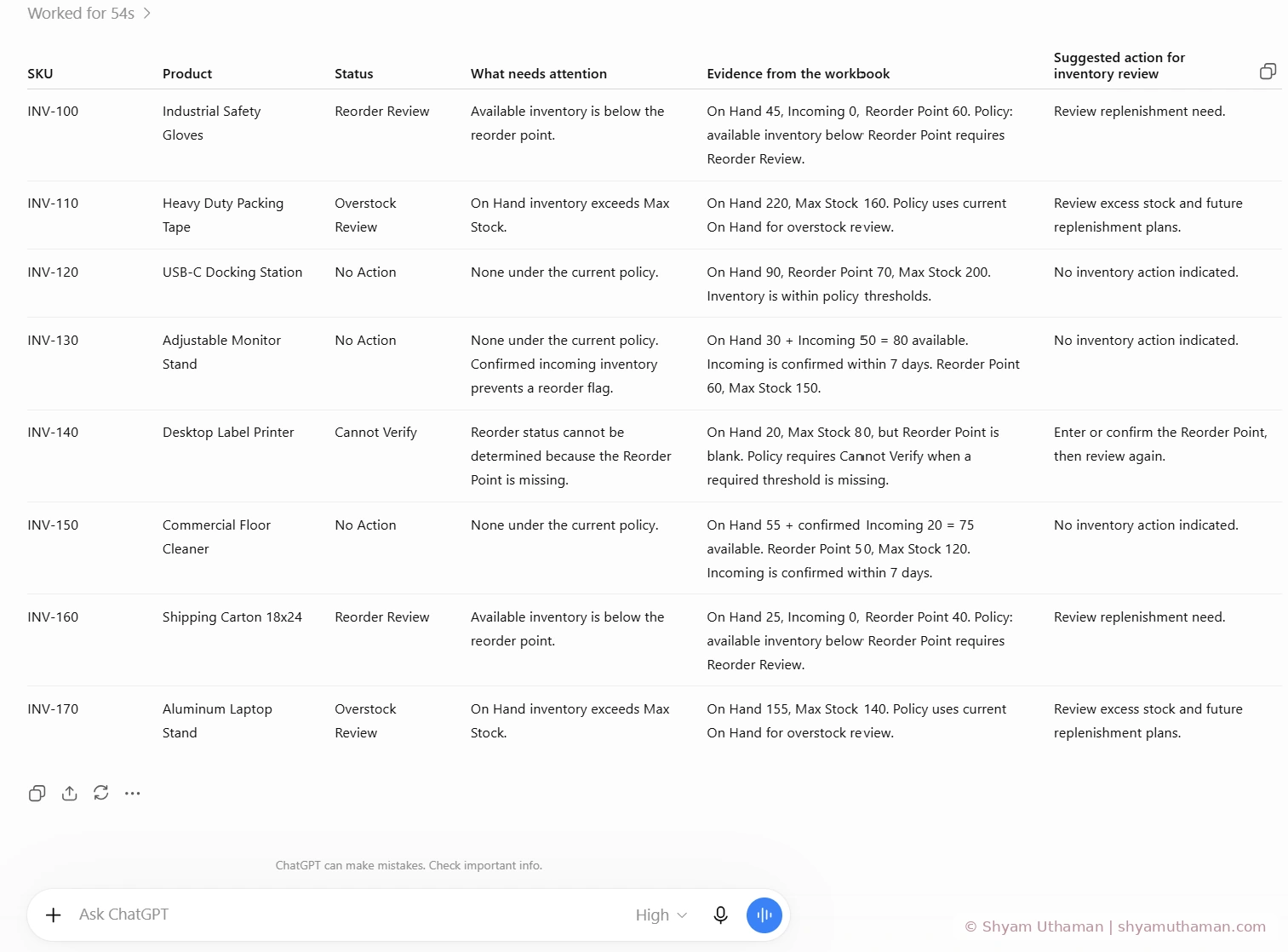
| SKU | Scenario | Expected | ChatGPT |
|---|---|---|---|
| INV-100 | Below reorder point | Reorder Review | Correct |
| INV-110 | Above maximum stock | Overstock Review | Correct |
| INV-120 | Normal inventory position | No Action | Correct |
| INV-130 | Low on hand with confirmed incoming stock | No Action | Correct |
| INV-140 | Missing reorder point | Cannot Verify | Correct |
| INV-150 | Healthy inventory with incoming stock | No Action | Correct |
| INV-160 | Below reorder point | Reorder Review | Correct |
| INV-170 | Above maximum stock | Overstock Review | Correct |
Round 1 finished with all eight expected classifications. That established the baseline, but these were still fairly simple inventory decisions. Round 2 was where I wanted to see how the model behaved once dates, demand context and supplier conditions started interacting.
Round 2: Purchase-order timing, demand spikes and supplier risk
The second workbook contained nine products and a more detailed Inventory Policy sheet. It also included an experiment reference date of September 7, 2026 so that purchase-order arrival dates and projected stockouts could be compared consistently.
I made the cases intentionally similar in places. Two products started with the same on-hand quantity, reorder point and weekly demand, and both had a confirmed purchase order for another 60 units. The difference was the arrival date. One shipment would arrive before projected stockout and the other would arrive afterward.
Other SKUs tested a one-time promotional sales spike, a discontinued product, a supplier hold, an open purchase order with a missing ETA, an incoming purchase order that would create overstock, and an item that remained above its reorder point while its supplier lead time was long enough to create future stockout risk.
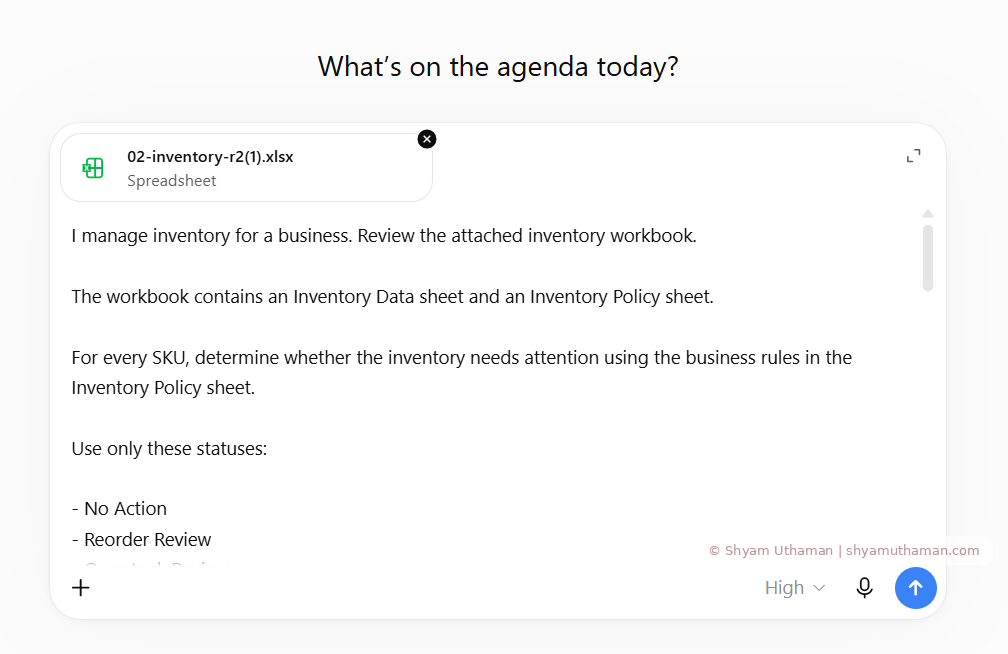
I manage inventory for a business. Review the attached inventory workbook.

The workbook contains an Inventory Data sheet and an Inventory Policy sheet.

For every SKU, determine whether the inventory needs attention using the business rules in the Inventory Policy sheet.

Use only these statuses:

- No Action
- Reorder Review
- Overstock Review
- Cannot Verify

Read the Inventory Policy sheet and the notes for each SKU carefully before assigning a status.

Use the experiment reference date stated in the Inventory Policy sheet when evaluating timing.

If a business rule depends on more than one condition, evaluate all of those conditions together before assigning a status.

Use Normal Weekly Demand for planning when the policy tells you to do so.

Do not treat a temporary promotion as normal future demand when the workbook identifies it as a one-time promotion.

Consider an open purchase order only when the workbook provides enough information to determine whether it arrives in time.

If an open PO exists but an important date such as the ETA is missing, follow the Cannot Verify rule in the policy rather than guessing.

Do not recommend replenishment for a discontinued product unless the Inventory Policy explicitly requires it.

If a supplier is on hold, still evaluate the inventory risk and mention the supplier hold in the recommended action.

Check for both stockout risk and overstock risk.

Do not place purchase orders.
Do not change inventory records.
Do not invent demand, dates, lead times, quantities, thresholds, supplier conditions, or other business rules.

Return a simple table with:

- SKU
- Product
- Status
- What needs attention
- Evidence from the workbook
- Suggested action for inventory review

If the workbook does not contain enough information to determine a status, say Cannot Verify.

Show me only what an inventory manager would need to know.
The purchase-order timing test worked
Safety Glasses had 20 units on hand against a reorder point of 30, with normal demand of 10 units per week. That gave roughly 14 days of supply and a projected stockout around September 21. A confirmed purchase order for 60 units was due September 14, before the projected stockout. ChatGPT returned No Action and recommended monitoring receipt of the confirmed order.
Thermal Shipping Labels started from the same inventory and demand position, and there was another purchase order for 60 units. This shipment was due September 28, about a week after projected stockout. ChatGPT returned Reorder Review and explained that the incoming order would arrive too late to cover the gap.
I liked this pair because the inventory quantities themselves were almost identical. The arrival date changed the decision.
The promotion did not distort normal demand
Promotional Gift Box had recent weekly sales of 50 units, which would make the inventory position look much more urgent if that number were treated as ongoing demand. The workbook explicitly identified those sales as a one-time promotion and listed normal weekly demand at 10 units.
ChatGPT used the normal demand value, calculated roughly 42 days of supply from the 60 units on hand and returned No Action. That is the kind of context an inventory review needs because blindly extrapolating a temporary promotion could lead to unnecessary replenishment.
It respected the discontinued-product rule
Legacy Barcode Scanner had only 10 units against a reorder point of 20. The product was marked as discontinued, and the notes stated that there were no customer backorders. The policy specifically said not to recommend replenishment in that situation.
ChatGPT returned No Action and recommended continuing to manage the remaining discontinued inventory rather than buying more.
The supplier hold stayed visible
Food-Safe Storage Bin had 15 units on hand against a reorder point of 25 and roughly 13 days of supply. There was no open purchase order, and the supplier account was on hold.
ChatGPT still returned Reorder Review because the underlying inventory risk remained. It also mentioned the supplier hold in the suggested action and proposed escalation or an alternate source as something the manager could consider.
Missing ETA produced Cannot Verify
Warehouse Floor Marking Tape was below its reorder point and had an open purchase order for another 40 units. The ETA field was blank.
The policy required Cannot Verify when an incoming order existed but there was not enough information to determine whether it would arrive before projected stockout. ChatGPT followed that rule and asked for the missing ETA rather than assuming the purchase order solved the problem.
Incoming inventory can also create an overstock problem
The 27-inch QHD Monitor had 100 units on hand with a maximum stock level of 120, so current inventory alone was fine. Another 50 units were confirmed to arrive within 30 days. That would increase the position to 150 units, exceeding the maximum by 30.
ChatGPT returned Overstock Review and pointed directly to the incoming purchase order. I think this is a useful reminder that inbound inventory should be considered in both directions. It can solve a shortage or create excess stock.
The reorder point was not the whole decision
USB-C Power Adapter had 35 units on hand against a reorder point of 30, so a simple threshold check would have said everything was fine. Normal demand was 10 units per week, giving around 24.5 days of supply. The supplier lead time was 30 days, and the policy added a seven-day safety buffer.
ChatGPT recognized that the projected stockout would occur before a newly placed order could reasonably arrive and returned Reorder Review. This was one of the stronger Round 2 cases because the inventory had not yet crossed its reorder point.
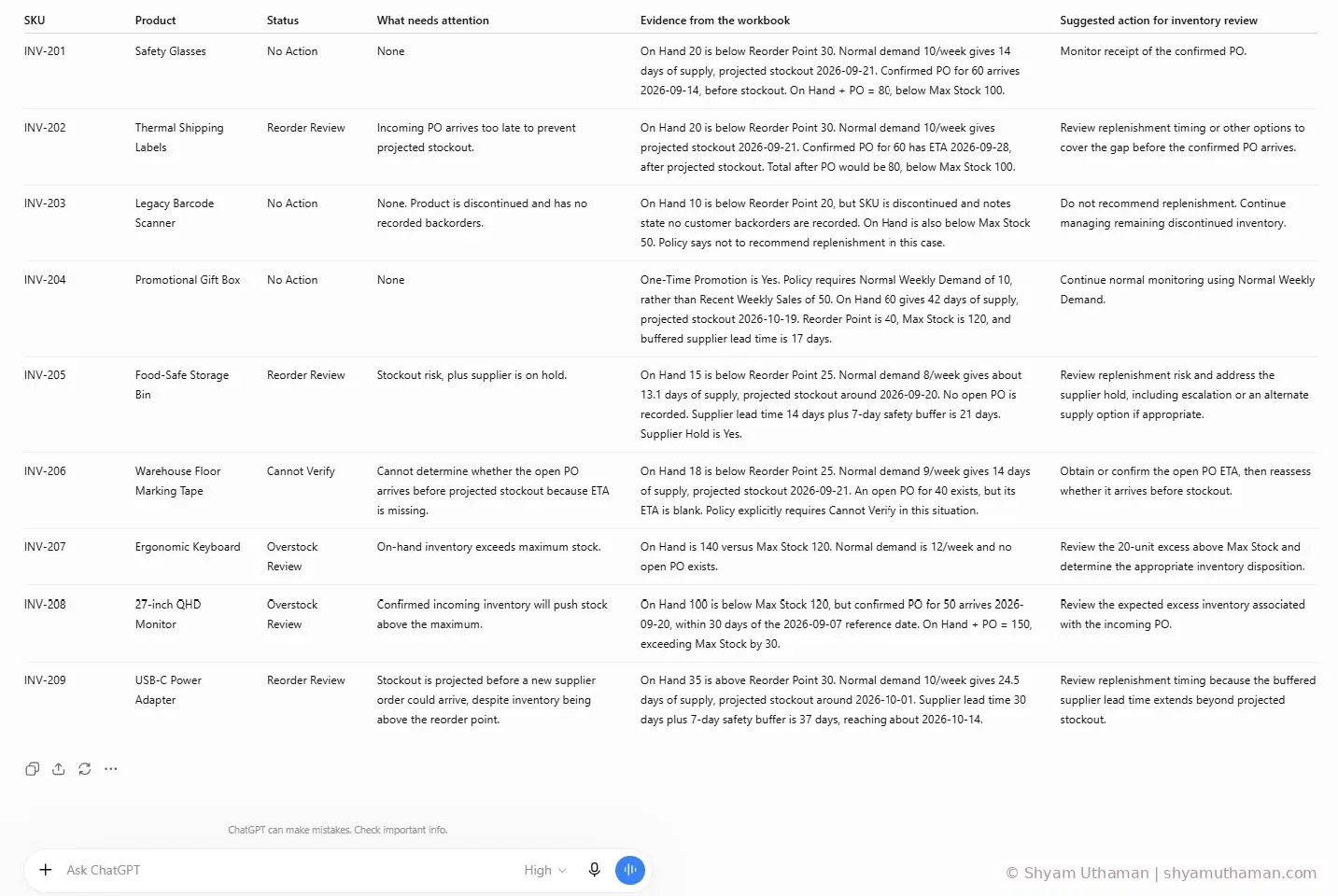
| SKU | Scenario | Expected | ChatGPT |
|---|---|---|---|
| INV-201 | PO arrives before projected stockout | No Action | Correct |
| INV-202 | PO arrives after projected stockout | Reorder Review | Correct |
| INV-203 | Discontinued SKU with no backorders | No Action | Correct |
| INV-204 | One-time promotional sales spike | No Action | Correct |
| INV-205 | Stockout risk plus supplier hold | Reorder Review | Correct |
| INV-206 | Open PO with missing ETA | Cannot Verify | Correct |
| INV-207 | Current stock above maximum | Overstock Review | Correct |
| INV-208 | Incoming PO creates excess inventory | Overstock Review | Correct |
| INV-209 | Lead time creates risk above reorder point | Reorder Review | Correct |
Results from both rounds
Across the two rounds, ChatGPT returned all seventeen classifications I expected in this controlled synthetic test.
| Measure | Result |
|---|---|
| SKUs tested | 17 |
| Expected classifications returned | 17 |
| Missed planted review conditions | 0 |
| False-positive review classifications | 0 |
| Cannot Verify cases handled as expected | 2 |
| Experiment rounds | 2 |
I would be careful with the interpretation of that score. These were synthetic workbooks that I designed myself, the policies were explicit, and seventeen decisions are nowhere near enough to establish a general inventory-management accuracy rate. What the result tells me is that this workflow handled the scenarios I deliberately put in front of it and deserves a harder test.
A real inventory environment would introduce more variation. Demand may be seasonal, purchase orders can be partially received, suppliers may have variable lead times, some products have minimum-order quantities, and multiple locations can move inventory between one another. Forecasts, backorders, safety stock policies and service-level targets can also change the decision.
How I interpret the experiment: ChatGPT did a good job turning a relatively busy inventory workbook into a short review queue while still following the business rules I provided. The Round 2 results were more meaningful to me because the model had to combine quantities, dates, demand, supplier conditions and policy exceptions before assigning a status.
Where I think this could actually help
I can imagine this being useful for the recurring inventory review that happens before someone begins investigating individual products. Instead of scanning hundreds of spreadsheet rows manually, the manager could receive a shorter list showing which SKUs appear to need replenishment attention, where excess stock may be building, and which decisions are blocked by missing information.
The evidence column is important because the output should explain why the item was flagged. Saying that a product needs replenishment is much less useful than showing that it has 24 days of supply while the buffered supplier lead time is 37 days. The manager can then challenge the logic without reopening every calculation from scratch.
The same approach could be useful for a weekly exception review, especially when the inventory policy already exists in reasonably clear form. It also follows the same pattern I tested in my accounts payable automation experiment: give the model the source data, make the business rules explicit, constrain the allowed outputs and require evidence for anything that deserves attention.
Would I automate replenishment from this?
I would keep testing before connecting this directly to purchasing. A useful next version would involve a larger inventory dataset with more ambiguous cases, partial purchase orders, varying supplier performance, seasonal demand and perhaps multiple warehouses.
If those tests continued to perform well, the review could eventually become part of a recurring inventory workflow. A system could prepare the exception list automatically and send it to the inventory manager each morning or each week. I would still want the actual purchase-order decision to remain with the authorized inventory or procurement process.
That boundary keeps the early use case practical. The AI can help identify where someone should look without quietly making a purchasing commitment on the company’s behalf.
Before trying this with real inventory
These workbooks were created specifically for this experiment. Real inventory policies vary by company, product family, supplier, location and service-level requirement. Reorder points and maximum stock levels may also come from planning systems rather than a static spreadsheet.
If you test a similar approach, use your own business rules and compare the output against inventory decisions that experienced planners have already reviewed. Include cases where the correct answer is No Action as well as cases where intervention is required, and pay attention to both missed risks and unnecessary flags.
You should also test incomplete data deliberately. Missing purchase-order dates, incorrect demand history, stale supplier lead times and incomplete product status information can change the result substantially. The model should be allowed to return Cannot Verify when the available data does not support a reliable decision.
Follow your organization’s data policies when uploading inventory, supplier or purchasing information, and keep purchasing approvals and changes to inventory records with the people and systems authorized to make them.
Key Learnings
- Incoming inventory needs timing, not just quantity. INV-201 and INV-202 had nearly identical inventory positions. The purchase-order arrival date changed the decision.
- A temporary sales spike should not automatically become future demand. The promotion example worked because the policy clearly identified which demand figure should be used for planning.
- Reorder points alone can miss future stockout risk. INV-209 remained above its reorder point while the supplier lead time was already longer than the available days of supply.
- Incoming purchase orders can create excess inventory too. INV-208 showed why inbound stock belongs in an overstock review as well as a replenishment review.
- Business status matters. Discontinued inventory and supplier holds changed how apparently simple low-stock situations should be handled.
- Cannot Verify is useful when important information is missing. An open purchase order with no ETA should not be treated as though it will arrive before a projected stockout.
- The quality of the inventory policy matters. Clear rules for demand, timing, incoming orders and exceptions gave ChatGPT something concrete to apply to each SKU.
If I continue this experiment, I would make the inventory situations messier before adding more technology. I would introduce seasonal products, partial purchase-order receipts, supplier delays, transfer stock between locations and demand patterns that change gradually rather than through an obvious one-time promotion. Those cases would tell me much more about where this approach starts producing weak decisions.
For this small test, though, the result was encouraging. ChatGPT returned the expected classification for all seventeen controlled cases and, more importantly, handled the situations where several business rules had to be considered together. I can see real value in using this kind of review to narrow a large inventory report down to the products that deserve a manager’s attention.