
AI Return on Investment: How to Build Numbers Your CFO Can Defend
AI return on investment gets interesting the moment somebody from Finance asks a very simple question: “How much money did this actually save us?” Your model accuracy will not answer that question. Neither will the number of prompts processed, users trained, predictions generated, or dashboards launched. You can have an AI system working exactly as designed and still have no idea whether it was a good investment.
This is where a lot of AI programs get themselves into trouble. The technical team measures whether the system works. The business measures whether people use it. Then six months later somebody tries to reverse-engineer a financial benefit because the CFO wants an ROI number for the next board meeting. That is much too late. If I had to reduce AI return on investment to one rule, it would be this: agree on how you will prove the money before you spend the money.
What AI Return on Investment Actually Measures
The formula itself is not complicated:
AI ROI = (Attributable Benefit − Total AI Cost) / Total AI Cost x 100
The challenge is attribution. Suppose inventory carrying cost falls by $27,000 a month after an AI forecasting system launches. Procurement also negotiates better terms, Operations changes replenishment, the company discontinues slow-moving products, and sales rise. Each change can affect the result. Finance still needs to isolate the share caused by the forecast and the decisions that followed.
This distinction sounds obvious until someone has already put the full $27,000 on slide seven of an executive presentation.
AI Return on Investment Starts Before the AI Project
I would rather have Finance involved in an AI project before the first model is built than invite them in six months later to bless the savings calculation. Start with one sentence.
Replace a broad goal such as “Use artificial intelligence to improve supply chain efficiency” with a measurable one: “Reduce monthly inventory carrying costs from $185,000 to $150,000 while maintaining a 98% order fulfillment rate.”
Now we have something useful. The business knows what is supposed to change. Finance knows which number to validate. The AI team knows that improving forecast accuracy is only useful if that improvement eventually affects inventory cost. This also protects you from one of the easiest AI mistakes to make: celebrating a technical improvement that does not change the business.
A forecast can improve from 70% accuracy to 90% accuracy and create little value if buyers ignore it. That is why adoption and the resulting inventory decision belong in the measurement plan.
If several proposals are competing for the same budget, the AI prioritization framework applies these adjustments across a portfolio before any money is committed.
Step 1: How do you build a baseline Finance believes?
Your baseline is the world before AI. It sounds easy until you try to define it. If monthly inventory costs were $170,000 in January, $190,000 in February, $181,000 in March, and $205,000 in April, which one is the baseline? You need an agreed method before the new system changes anything.
For a cost metric, I would normally document:
- The historical period being used
- The exact calculation behind the metric
- Known seasonal effects
- Unusual events that distort the comparison
- The financial system or report that serves as the source
Then I would have Finance review it. This is not bureaucracy for the sake of bureaucracy. If your CFO disagrees with the baseline after the project succeeds, every benefit calculation built on top of it becomes questionable. A simple baseline that Finance understands is far more useful than a sophisticated baseline nobody outside the data team can reproduce.
Step 2: How do you follow the money, not the model?
AI usually creates value through a chain of events. In demand forecasting, the model recommends a quantity, a buyer reviews it, the purchase order changes, and average inventory may fall. Finance then checks whether carrying cost fell while service stayed within its target. A missing link weakens the financial claim.
I map that chain before development starts: AI capability → changed decision → operational result → financial result. The visual below shows the decision and the check Finance needs at each end.
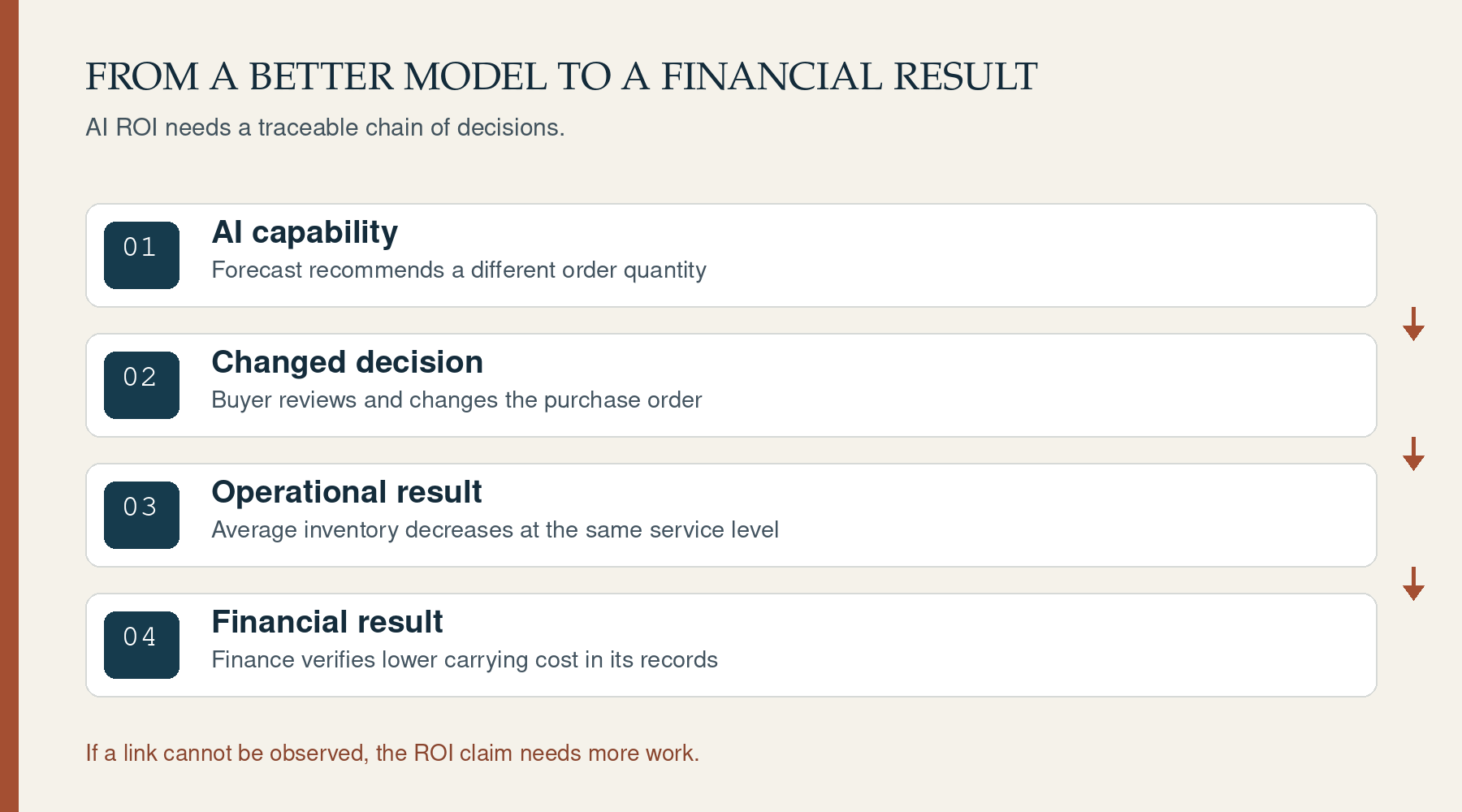
If you cannot draw that chain for your use case, your ROI discussion is probably going to become uncomfortable later. A customer-service AI might reduce average handling time. Fine. What happens because handling time decreased? Did you handle more volume without adding staff? Did overtime decrease? Did response times improve enough to affect retention? If nothing changed downstream, faster handling may be operationally interesting without creating a large financial return.
Step 3: How do you separate AI impact from everything else?
This is where I would spend most of my effort. Imagine the following result six months after an AI forecasting system launches:
Monthly inventory carrying cost fell from $185,000 to $158,000, a gross improvement of $27,000. The result looks promising. Several other changes occurred during the same period, so I would separate their estimated effects before assigning a value to AI.
| Change | Estimated Monthly Impact |
|---|---|
| Gross inventory improvement | $27,000 |
| Better supplier payment terms | -$4,200 |
| New just-in-time processes | -$3,800 |
| SKU portfolio changes | -$2,000 |
| Higher sales volume | +$1,500 |
| AI-specific monthly impact | $18,500 |
The $18,500 number is less exciting than $27,000. I would use it anyway. A smaller number that survives Finance review is more useful than a larger one that collapses after two questions. It also changes your relationship with the CFO. You are no longer trying to win an argument about how successful AI was. You are trying to understand what actually happened.
Step 4: Which costs do people conveniently forget?
The numerator gets exaggerated. The denominator often gets mysteriously smaller. Your AI investment is not just the invoice from the model provider. Depending on the project, total cost can include:
- Internal engineering and data science time
- External implementation partners
- Cloud compute and storage
- Model or API charges
- Data acquisition and preparation
- Product management
- Business analyst time
- User testing
- Training and change management
- Monitoring and support
- Model evaluation and retraining
- Ongoing maintenance
If five business experts each spend ten hours a week helping your AI team for three months, that effort did not become free because it came from another department. Whether Finance wants every internal hour capitalized into the ROI calculation is a separate accounting decision. But as a business leader, you should at least know what the project really consumed.
For AI agents, the forgotten costs are mostly human: review, exceptions and rework. My AI agent cost model compares them with token spend and shows how they change payback.
Step 5: How do you build a conservative ROI calculation?
Once you have attributable benefits and full costs, the math becomes the easy part. Here is a simple hypothetical example:
- Total attributable AI benefit over 12 months: $300,000
- Total AI investment over the same evaluation period: $200,000
- Net benefit: $100,000
- AI return on investment: 50%
The calculation is: ($300,000 − $200,000) / $200,000 = 50%
I would also show the payback period. A CFO looking at two projects with the same ROI may care very much whether one recovers its investment in eight months and the other takes three years. Use the conservative case as your headline number. You can show an upside case separately, but label it honestly. There is no prize for producing the highest ROI estimate in the room.
How to Calculate AI ROI in Finance: An Accounts Payable Example
Suppose an accounts payable team handles 10,000 invoices a month. It tests an AI-assisted review that compares invoices with purchase orders and sends exceptions to a person. The volume, times, costs, and outcomes below are illustrative assumptions. They are not results from my invoice-matching experiment, which used fictional documents to test classification rather than financial return.
Start with a baseline that separates routine work from rework
Assume routine processing takes eight minutes per invoice before the change and five minutes with AI-assisted review. The three-minute difference across 10,000 invoices frees 500 hours each month. At a loaded rate of $30 per hour, those hours represent $15,000 of capacity. They do not automatically represent $15,000 of cash savings.
In this example, Finance can verify that 250 of those hours replace paid overtime or contracted AP work. The other 250 hours are redeployed within the team. Therefore, the labor benefit counted in ROI is 250 × $30 = $7,500 a month. The remaining capacity belongs on the operating scorecard until a financial effect can be shown.
Assume the routine processing times exclude correction work. Before the change, 300 invoices a month need rework at an average incremental cost of $18 each. After the change, 150 need rework under the same definition. That difference saves another 150 × $18 = $2,700 a month, provided the lower error rate is verified and the cost is not already part of the 250 paid hours removed.
Include the full AI cost and calculate payback
| Illustrative measure | Calculation | Amount |
|---|---|---|
| Realized labor saving per month | 250 paid hours × $30 | $7,500 |
| Rework saving per month | 150 fewer cases × $18 | $2,700 |
| Total benefit per month | $7,500 + $2,700 | $10,200 |
| Initial implementation | Integration, testing, training, and process changes | $40,000 |
| Ongoing AI cost per month | Model use, support, monitoring, and added review | $4,000 |
| First-year benefit | $10,200 × 12 | $122,400 |
| First-year cost | $40,000 + ($4,000 × 12) | $88,000 |
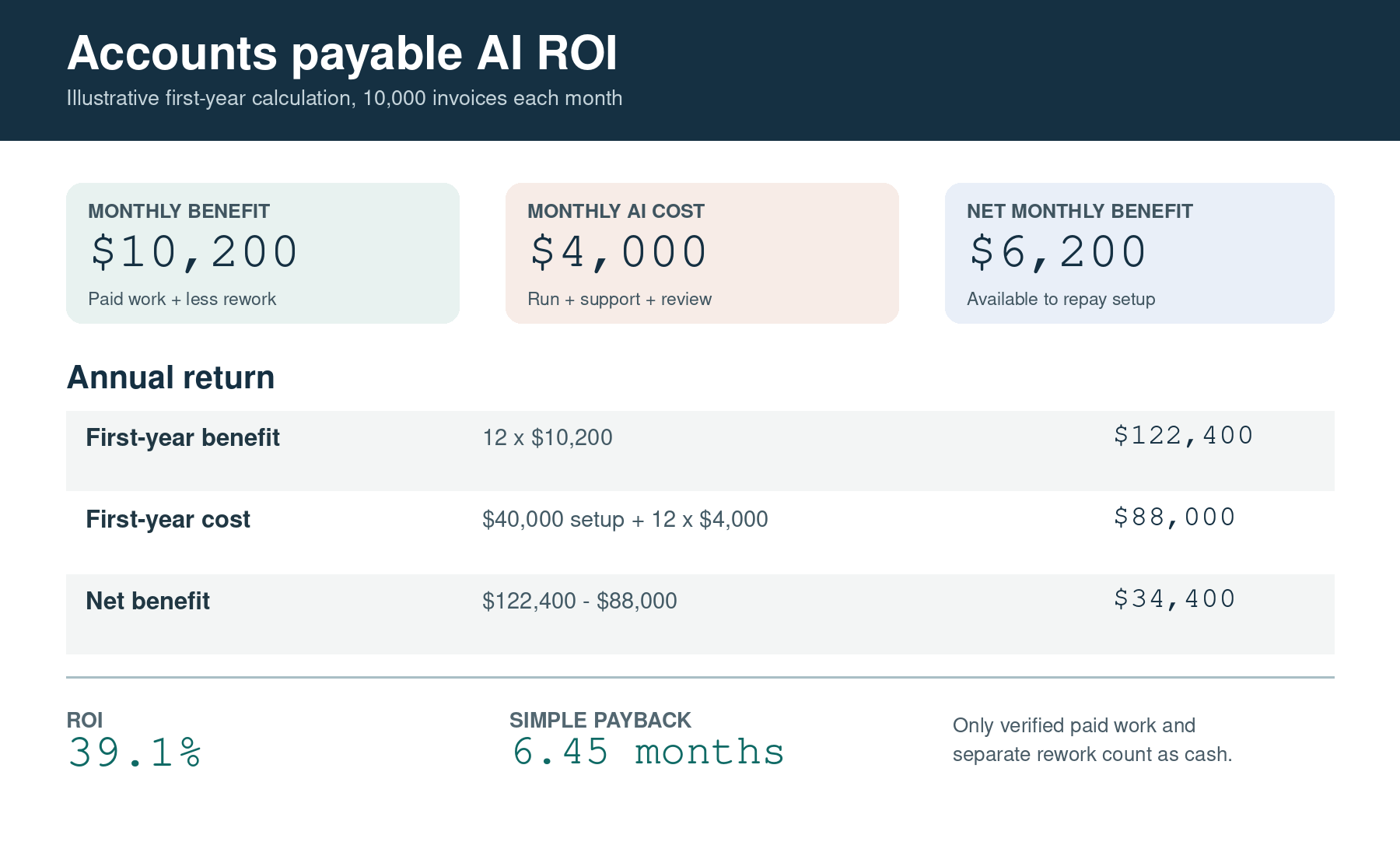
First-year AI ROI = ($122,400 − $88,000) ÷ $88,000 × 100 = 39.1%. After the $4,000 monthly operating cost, the project returns $6,200 a month toward its $40,000 setup cost. At a steady monthly run rate beginning immediately, the simple payback calculation is $40,000 ÷ $6,200 = 6.45 months, so cumulative cash benefit passes the setup cost during month seven. A rollout that ramps up over several months would take longer.
Validate the savings before claiming them
I would ask Finance to reconcile the $7,500 with actual overtime or contractor spending. AP should sample both invoices cleared as matches and those sent for review, then compare missed errors, false alarms, and rework against the pre-AI baseline. The same invoice types and seasonal periods must be represented on both sides. A lower error count caused by a policy change or a cleaner supplier mix cannot all be credited to AI.
Do not count all 500 freed hours as labor savings and also claim the work completed in those hours as a separate benefit. Do not count a prevented overpayment unless the team can show that it would have escaped the existing control and that the avoided loss is real. Faster approval, better supplier experience, and released capacity are useful measures, but they stay outside this cash ROI until Finance accepts a defensible dollar effect.
The case is sensitive to one assumption. If only 125 paid hours disappear rather than 250, monthly benefit falls to $6,450. With the same $88,000 first-year cost, ROI becomes about negative 12.0%. That is why I would validate the spending change before putting 39.1% in a CFO presentation. APQC defines total AP cost per invoice as a useful measurement category, but this example uses its own fictional inputs rather than APQC benchmark figures.
The Finance Attestation Test for AI Return on Investment
This is the part I think more AI teams should adopt. Do not ask Finance merely to attend the final presentation. Give them a role in validating the number.
1. Methodology Review
Before the impact calculation is finalized, Finance reviews the baseline, attribution method, cost assumptions, and measurement period. This avoids the awkward situation where you spend six months measuring something only to discover that Finance never agreed with how you measured it.
2. Data Validation
Finance or another independent group verifies the underlying numbers. If inventory supposedly decreased, can they see it? If labor cost decreased, where? If working capital improved, can the Finance team reproduce the calculation without asking your data scientist to explain twelve transformations and three notebooks?
3. Financial Statement Reconciliation
This is my favorite test. If the AI supposedly saved $200,000, where did the $200,000 go? Maybe it appears as reduced operating cost. Maybe gross margin improved. Maybe working capital was released. Maybe overtime fell. There can be legitimate benefits that do not appear neatly as a line item. But if you are claiming a direct financial saving, Finance should be able to find the effect somewhere in the company’s financial reality. If they cannot, I would be very careful about calling it a saving.
Not Every AI Benefit Belongs in the ROI Formula
Teams can inflate a business case by treating every benefit as cash. I separate financial, operational, and strategic value so the ROI formula contains defensible financial effects.
Direct Financial Value
Direct financial value includes lower overtime, reduced inventory expense, and revenue that can reasonably be attributed to the changed process. These are the numbers I want in the core ROI calculation.
Operational Value
Faster decisions, more accurate forecasts, less time gathering information, and fewer stockouts are useful operational measures. I track them separately until Finance can connect them to a defensible financial effect.
Strategic Value
The project may create reusable data infrastructure, organizational knowledge, new capabilities, or a foundation for future AI systems. That can be valuable, but future possibilities are easy to overstate. If every vague future possibility becomes a dollar in your ROI spreadsheet, you can make almost any project look fantastic. I prefer showing strategic value as a separate part of the business case rather than pretending I can measure it to the nearest dollar.
The Questions Your CFO Is Likely to Ask
A CFO can challenge the case with a few direct questions. Answer them before the executive presentation.
- What would have happened without the AI? This tests the baseline.
- How much of the improvement came from something else? This tests attribution.
- Where are the costs that are not in this project budget? This tests the full cost.
- Where does this saving appear financially? This tests the claimed cash value.
- What happens if your estimate is wrong by 25%? This tests the conservative case.
- Would we still fund this if AI were not in the project name? This tests whether the business problem justifies the investment.
AI Return on Investment Should Be Tracked After the Presentation
One ROI calculation at the end of a pilot is not enough. Benefits change. Model performance can decline. User behavior changes. Business conditions move. A process improvement elsewhere can affect the same metric you are tracking. I like a simple cadence:
Monthly: Track the business outcome, AI-specific benefit, major costs, usage, and anything that materially changed.
Quarterly: Revisit attribution. Look for new business changes that may be affecting the number.
Annually: Recalculate the business case and compare the AI investment with what else the company could fund.
Measurement should also tell you when the original decision no longer holds. An AI system that once created strong value may eventually plateau. Another may become more valuable as more data becomes available. A third may never justify its ongoing cost. Good measurement gives you permission to invest more in the first two and shut down the third.
What I Would Put on the One-Page AI ROI Report
If I were walking into a CFO meeting tomorrow, I would want one page containing:
- Business outcome: The financial problem the AI was supposed to change
- Baseline: What performance looked like before AI
- Current result: What performance looks like now
- Attribution: How much change came from AI versus other factors
- Total investment: What the initiative has actually cost
- ROI and payback: Using the conservative case
- Operational indicators: Adoption, accuracy, reliability, or other measures that explain the financial result
- Next decision: Continue, expand, fix, or stop
If the story cannot fit on one page, I would question whether we understand the story well enough yet.
What I Would Do This Week
Pick one AI initiative. Do not start with the entire AI portfolio.
Write down the financial outcome in one sentence. If the sentence contains words like “transformation” or “innovation” but no measurable business result, rewrite it.
Find the baseline. Use numbers Finance already recognizes wherever possible.
List everything else that changed. New processes, pricing, staffing, supplier terms, market conditions, policy changes. Anything that could have affected the result.
Ask Finance to challenge the methodology. Do this before the executive presentation, not during it.
Run the conservative case. If the project still looks worthwhile after you remove questionable benefits and include forgotten costs, you probably have something worth defending.
The Takeaway
The point of measuring AI return on investment is to find out whether the project created enough value to justify its cost. Agree on the baseline, isolate the AI contribution, count the full cost, and have Finance challenge the method early. The result may be less impressive than the first estimate. It will be more useful when you decide whether to expand, change, or stop the project.
I cover the full execution model behind this approach in AI to ROI for Business Leaders, including how to define business outcomes, choose AI use cases, pilot safely, drive adoption, measure business impact, and decide what deserves further investment. For data and AI leaders who also need to communicate these decisions upward and build credibility with executives, see The Data-Driven Executive: How Data and Analytics Leaders Build Influence and Lead in the Age of AI.
AI ROI in Finance: Frequently Asked Questions
How do you calculate the ROI of AI in finance?
Subtract the full AI cost from the financial benefit, divide by the full cost, and multiply by 100. In the fictional accounts payable example above, $122,400 in first-year benefits minus $88,000 in first-year costs gives an ROI of about 39.1%. Use benefits that Finance can verify, not every hour the tool appears to save.
Does time saved by AI count as cost savings?
Time saved is an operating gain, but it becomes a cost saving only when it changes actual or avoidable spending. For example, reduced paid overtime or contractor hours may count if Finance confirms the reduction. If staff use the freed time for other work, report the capacity separately unless you can measure a distinct financial result.
How do you calculate the payback period for an AI project?
Divide the one-time implementation cost by the monthly benefit after ongoing costs. In the example, $40,000 divided by $6,200 is about 6.45 months, so cumulative net benefit passes the initial cost during month seven if results are steady from the start. A rollout ramp, delayed benefits, or changing costs will move that date.
What should Finance check before accepting an AI ROI claim?
Finance should confirm the baseline, actual spending, what else changed in the process, and whether the claimed savings appeared in financial records. It should also sample errors and rework, check that the same labor time was not counted twice, and review any security, privacy, or human-approval costs the project needs.
What AI use case are you measuring? Share the baseline you have and the part of the ROI calculation that is hardest to defend.