
AI STRATEGY
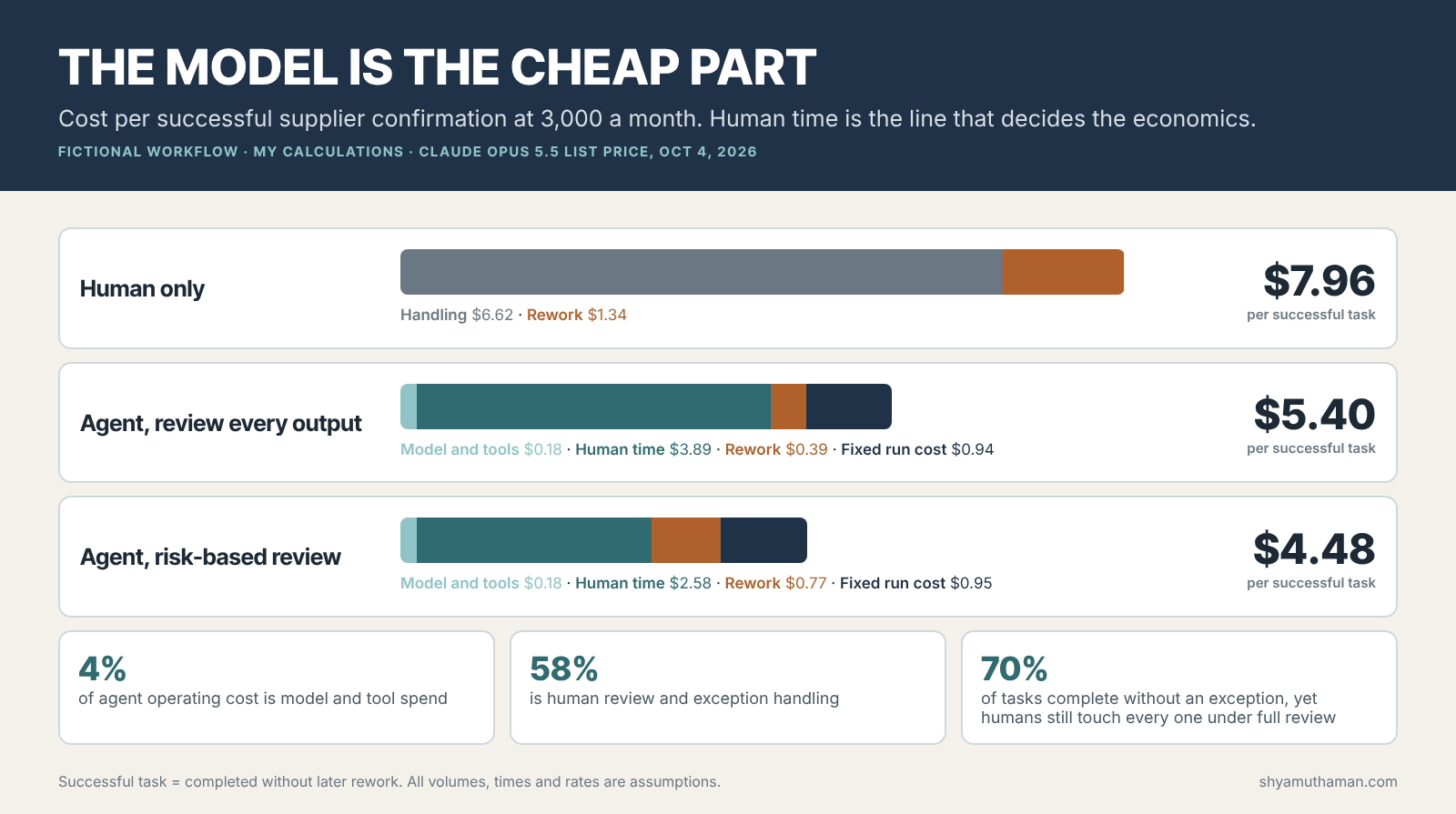
When people estimate AI agent cost, they usually start with tokens. I built a cost model for a fictional supplier-confirmation agent handling 3,000 tasks a month, priced at the list rate of a top-tier model. Model and tool spend came to $0.18 a task, about 4% of the agent’s operating cost. Human review and exception handling were 58%. The agent paid back its $60,000 build in six to nine months, depending on the review policy. The result that surprised me most came from the review policy: when a missed error is expensive and the agent’s error rate rises, the policy that looks cheaper gives up $18,300 a month.
Short answer: AI agent cost is best measured per successful task, including model and tool spend, human review, exception handling, rework from errors, and fixed run costs such as monitoring and support. In most business workflows, human time, not tokens, decides whether the agent pays for itself.
This article covers agent economics specifically. For the broader question of measuring return on any AI investment, start with my AI ROI roadmap. The workflow here is the same supplier order confirmation process I describe in what an AI agent harness does. All volumes, times, rates and error rates below are illustrative assumptions.
How much does an AI agent cost to run?
In this illustrative model, an agent handling 3,000 supplier confirmations a month cost about $13,200 to $16,100 a month to run, or $4.48 to $5.40 per successful task. Model and tool calls were $540 of that. The rest was human review, exceptions, rework and $2,800 of fixed platform, monitoring and support cost.
Vendor pricing pages and most “cost of AI agents” articles focus on build cost, licenses and token prices. Those numbers are real but incomplete. An agent in a business workflow does not replace a process. It changes one. People still handle the cases it cannot, check some or all of what it produces, and fix the errors that slip through. Those costs land in operations budgets, so they rarely appear in the agent’s business case.
The workflow and the assumptions
A buyer team receives supplier confirmations by email and checks each against the purchase order: item, quantity, unit, price and delivery date. Matches are recorded. Differences go to a buyer to resolve. For this model I assumed:
| Input | Assumption | Type |
|---|---|---|
| Volume | 3,000 confirmations a month | Assumption |
| Human handling time | 7 minutes per confirmation | Assumption |
| Loaded labor cost | $55 an hour | Assumption |
| Human error rate | 3%, each costing 20 minutes of rework plus $25 downstream | Assumption |
| Exceptions the agent routes to people | 30%, handled in 8 minutes (7 plus 1 to read the agent’s notes) | Assumption |
| Agent error rate on tasks it completes | 1.5% | Assumption |
| Review time per agent output | 2.5 minutes; errors caught in review take 5 more minutes to fix | Assumption |
| Model calls per task | 5 calls, each about 6,000 input and 400 output tokens | Assumption |
| Model price | $4 per million input tokens and $20 per million output tokens | Sourced: Claude Opus 5.5 list price, Oct 4, 2026 |
| Tool and infrastructure calls | $0.02 per task | Assumption |
| Fixed run cost | $500 platform, $300 monitoring, $2,000 support and maintenance a month | Assumption |
| Implementation | $60,000 one-time | Assumption |
I priced the model at the top-tier rate on purpose. If the conclusion holds with an expensive model, it holds with a cheaper one. Prompt caching and batch discounts would lower the model line further.
How do you calculate cost per successful task?
Add up every monthly cost of running the agent-assisted process, including people, then divide by the number of tasks completed correctly without later rework. Dividing by tasks attempted, or by tasks the agent touched, makes an agent look cheaper than it is because it hides exceptions and errors.
The calculation for the base case with a person reviewing every output:
- Model and tools: 5 × (6,000 × $4 + 400 × $20) ÷ 1,000,000 + $0.02 = $0.18 a task, or $540 a month.
- Exceptions: 900 tasks × 8 minutes = 120 hours.
- Review: 2,100 agent-completed tasks × 2.5 minutes = 87.5 hours, plus 5 minutes for each of about 32 errors caught.
- Human time total: about 210 hours, or $11,557.
- Rework: errors on the exceptions that people handled, at the human error rate: $1,170.
- Fixed run cost: $2,800.
- Total: $16,067 a month for about 2,973 successful tasks, or $5.40 per successful task.
The all-human process costs $23,150 a month for 2,910 successful tasks, or $7.96 each. The agent saves about $7,100 a month and pays back the $60,000 build in 8.5 months.
With sample review, where people check a random 20% of completed tasks, the monthly cost falls to $13,193, the cost per successful task to $4.48, and payback to six months. More errors reach suppliers and warehouses, which is why the rework line nearly doubles.
Both policies assume reviewers catch every error in the outputs they check, so a random 20% sample catches about 20% of agent errors. A sample targeted at riskier tasks, such as large orders or changed delivery dates, would catch more errors for the same review time.
Is a high automation rate enough to make an agent pay off?
No. In this model the agent completed 70% of tasks without an exception, yet under full review a person still touched every task. Whether that pays depends on how review time compares with doing the work by hand. Here, full review stopped saving money at a little over 6 minutes against 7 minutes of manual handling.
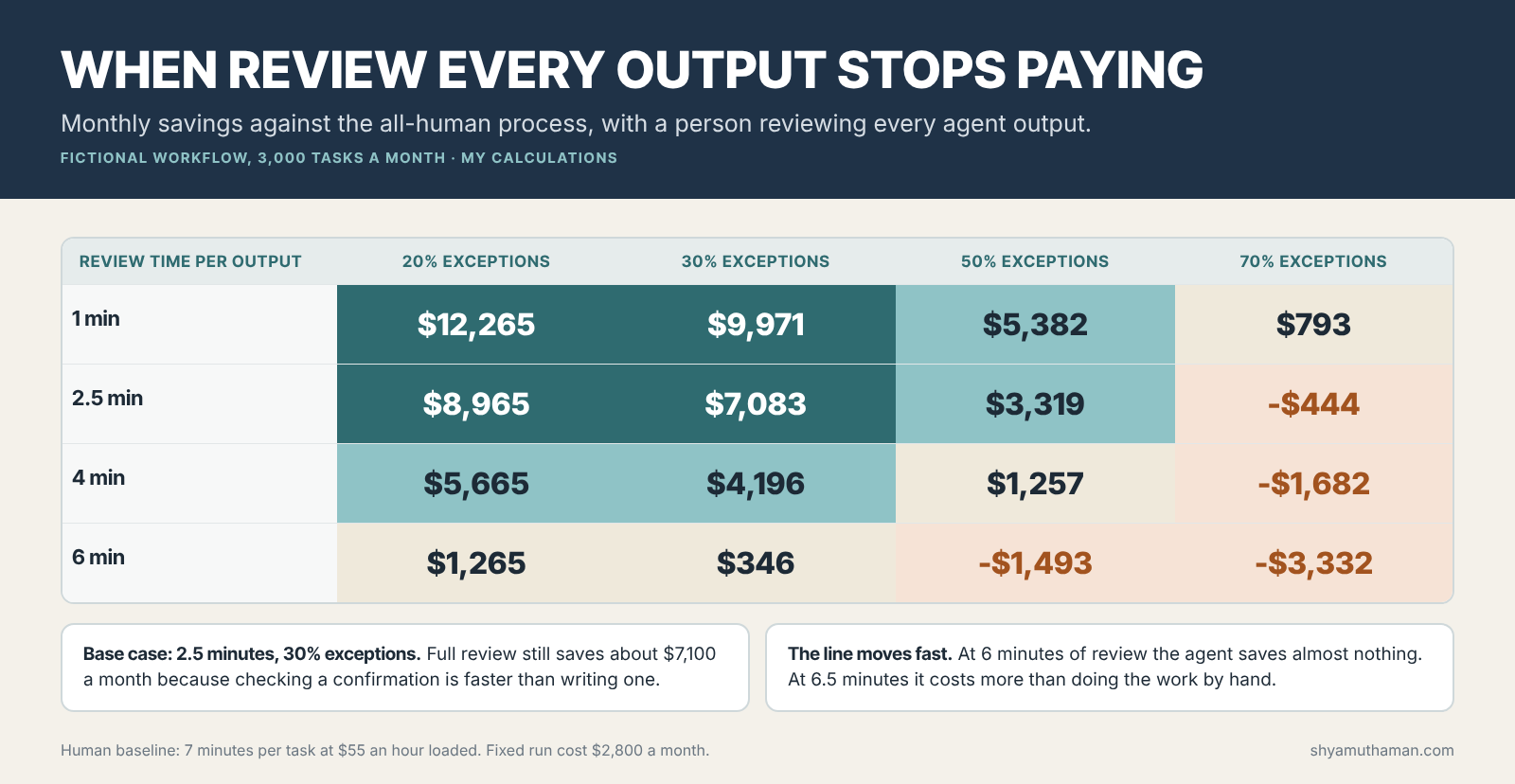
I expected full review to wipe out the savings. It did not, in the base case, because checking a structured confirmation takes much less time than writing one from scratch. The table shows how quickly that changes. At 30% exceptions, moving review from 2.5 to 6 minutes cut savings from about $7,100 to $346 a month. At 70% exceptions, the agent lost money once review passed about 2 minutes.
The practical point for a sponsor: an automation rate tells you how often the agent finishes. It tells you nothing about cost until you also know review time and exception handling time, measured on real cases.
Which assumptions move AI agent ROI the most?
Volume, exception rate and agent error rate moved the result most in this model. Cutting volume from 3,000 to 1,000 a month stretched payback from 6 months to 41. Raising exceptions from 30% to 50% nearly halved savings. Tripling the model price changed savings by less than 10%.
| Change from the sample-review base case | Monthly savings | Cost per successful task | Payback |
|---|---|---|---|
| Base case, 20% review sample | $9,957 | $4.48 | 6.0 months |
| Volume 3,000 to 1,000 a month | $1,452 | $6.38 | 41.3 months |
| Exceptions 30% to 50% | $5,372 | $6.05 | 11.2 months |
| Agent error rate 1.5% to 5% | $7,341 | $5.47 | 8.2 months |
| Review time 2.5 to 5 minutes | $8,994 | $4.80 | 6.7 months |
| Model price tripled | $8,997 | $4.80 | 6.7 months |
| Model calls per task 5 to 15 | $8,997 | $4.80 | 6.7 months |
Volume matters because the $2,800 of fixed monthly cost does not shrink with it. I calculated the break-even volume at about 700 tasks a month with sample review and 850 with full review. Below that, the agent costs more than the people it assists, however good it is.
The model price result is the one I would show to anyone whose agent business case is built mostly on token math. Tripling the price, or tripling the number of calls per task, cost about $960 a month. A 20-point rise in exceptions cost $4,585.
Should a person review every AI agent output?
Decide from the cost of a missed error. In this model, sampling 20% of outputs saved more when a miss cost $25. When a miss cost $250 and the agent’s error rate was 5%, full review saved $20,921 a month and sampling saved only $2,616. The review policy is an economic decision as much as a control.

This is the result I did not see coming. I built the review policy into the model expecting it to be a pure cost lever: review less, save more. That holds while errors are cheap. Once a missed error reaches a warehouse, a customer promise or a supplier payment, the cost of the miss outweighs the cost of the check. At a $250 downstream cost, full review beat sampling even at the agent’s base error rate of 1.5%.
Downstream cost is also the input teams estimate worst. It is easy to time a review. It is hard to price a wrong delivery date that a planner acted on. I would ask the process owner for three real examples of what a missed difference cost last year before choosing the review rate. The broader design question of when people should stay in the loop is covered in my piece on human in the loop.
What should an AI agent business case include?
Volume, current handling time and error cost; the agent’s exception rate, error rate and review time measured in a pilot; model, tool and fixed run costs; implementation cost; and the review policy with its reason. Report cost per successful task, monthly savings, break-even volume and payback, plus the three assumptions that move them most.
Most of those inputs cannot be known before a pilot. That is fine. The business case should say which numbers are estimates and what the pilot will measure. My guide to an AI pilot with guardrails covers how to set those measurements up, and my AI agent evaluation method covers how to build the answer key that tells you the real error rate. Once the agent is live, AI agent observability is how you keep those numbers current.
If you are still choosing between an agent and other AI projects, the AI prioritization framework applies the same discipline across a whole portfolio. For a quick payback view of a single project, the AI ROI Calculator does it in a few minutes.
Where this model breaks
- It is linear. Real exception rates fall as the agent and its instructions improve, and review time falls as reviewers learn what to check. A pilot should measure both over several weeks, not once.
- Freed time is not cash. The savings assume buyer hours have value at the loaded rate. Finance will count them only when hiring slows or the hours go to measurable work.
- Downstream costs are averaged. One severe error, such as a missed price increase on a large order, can cost more than a month of savings. Averages hide that tail risk.
- The agent was not run. I designed a live test of this exact workflow on Databricks Free Edition, with an answer key and three harness configurations. It is built but not yet run, so the error and exception rates here are assumptions, not measurements.
Limits of this analysis
The workflow, volumes, handling times, labor rates, error rates, exception rates, review times, fixed costs and implementation cost are illustrative assumptions I chose on October 4, 2026. The model price is sourced from Anthropic’s published list price on the same date. The calculations are mine, done in a Python script and checked by hand for the base case shown above. Nothing here describes a real company or a measured agent result.
Official resources
Anthropic: Claude API pricing, the source of the model price assumption.
Anthropic: Building effective agents, on when a simpler workflow beats an autonomous agent.
NIST AI Risk Management Framework, for structuring the cost of failure.
Agent economics is one chapter of a larger question: how to decide which AI investments deserve money and how to prove they paid off. AI to ROI for Business Leaders covers business cases, pilots, review design and scaling decisions.
What workflow are you considering for an agent, what data do you have on its volume, exceptions and review time, and which cost are you least sure about?