
DATA GOVERNANCE FRAMEWORK FOR BUSINESS LEADERS
A data governance framework earns its place when it helps the organization make a decision. If it produces a large glossary, a committee calendar and hundreds of assigned data elements but cannot resolve which revenue number belongs in an executive meeting, the framework is busy rather than effective.
I have seen versions of this problem across data warehouses, ERP transformations, analytics programs, cloud platforms and AI initiatives. The technology changes, but the organizational pattern is familiar. Finance, Sales, Operations and Technology all care about the data. Each team may have a reasonable interpretation. Yet nobody has a clear mandate to settle the definition, accept a quality threshold or decide which team must correct the source.
That is why I do not define governance as control exercised by a central data office. I see it as an operating model for making shared data decisions. It should identify the decision, assign authority, preserve evidence and create a path from disagreement to verified resolution.
Those ideas are developed more fully in The Data-Driven Executive, where I discuss data leadership, accountability, governance and executive alignment. This article turns that broader leadership perspective into a practical structure that a team can apply to one business domain.
What is a data governance framework?
A data governance framework defines how an organization makes decisions about data. It establishes which data matters, what it means, who has authority over it, what quality is acceptable, how access is approved and how issues are resolved.
The familiar analogy is a road system. A catalog is like a map. It helps people find destinations. Data-quality rules resemble vehicle inspections because they identify problems. Access controls operate like keys and restricted lanes. None of those components decides where a new road should go, who pays for a repair or which route takes priority when departments disagree. Governance supplies those decision rights.
This distinction explains why buying a governance tool rarely fixes governance by itself. A platform can record owners, classifications, lineage, policies and quality results. However, it cannot decide which business definition the company should adopt or how much error a process can tolerate. Those are management decisions supported by technology.
How the data governance framework evolved
Data governance grew out of several established disciplines. Database administration focused on reliability and technical control. Master-data management addressed shared entities such as customers, suppliers and products. Business intelligence exposed conflicts between reporting definitions. Privacy, security and regulatory programs added stronger requirements for access, retention, evidence and accountability.
Cloud platforms and self-service analytics widened participation. More people could create datasets, dashboards and calculations, which increased both business speed and the number of competing definitions. AI has raised the stakes again because ambiguous or poor-quality data can now influence generated answers, recommendations and automated actions.
In my opinion, this history matters because data governance is sometimes treated as a new software category. It is better understood as a management discipline that has accumulated technical capabilities over time. The operating problem existed before catalogs, lakehouses and generative AI.
What this data governance framework adds
Formal bodies of knowledge and capability models are valuable. They help teams understand the breadth of data management, assess maturity and avoid overlooking important disciplines. I use them as reference points, not as substitutes for designing an operating model around a real business problem.
My approach begins with a contested decision or recurring failure. From there, the team identifies the smallest set of definitions, owners, controls and forums required to resolve it. Once that pattern works, the organization can expand it to other data domains.
This is also where my articles differ from formal training. Official resources are excellent for learning established concepts and assessment structures. My purpose is to examine what happens when those ideas meet distributed accountability, legacy systems, competing incentives and delivery deadlines.
A realistic problem: three answers for active customers
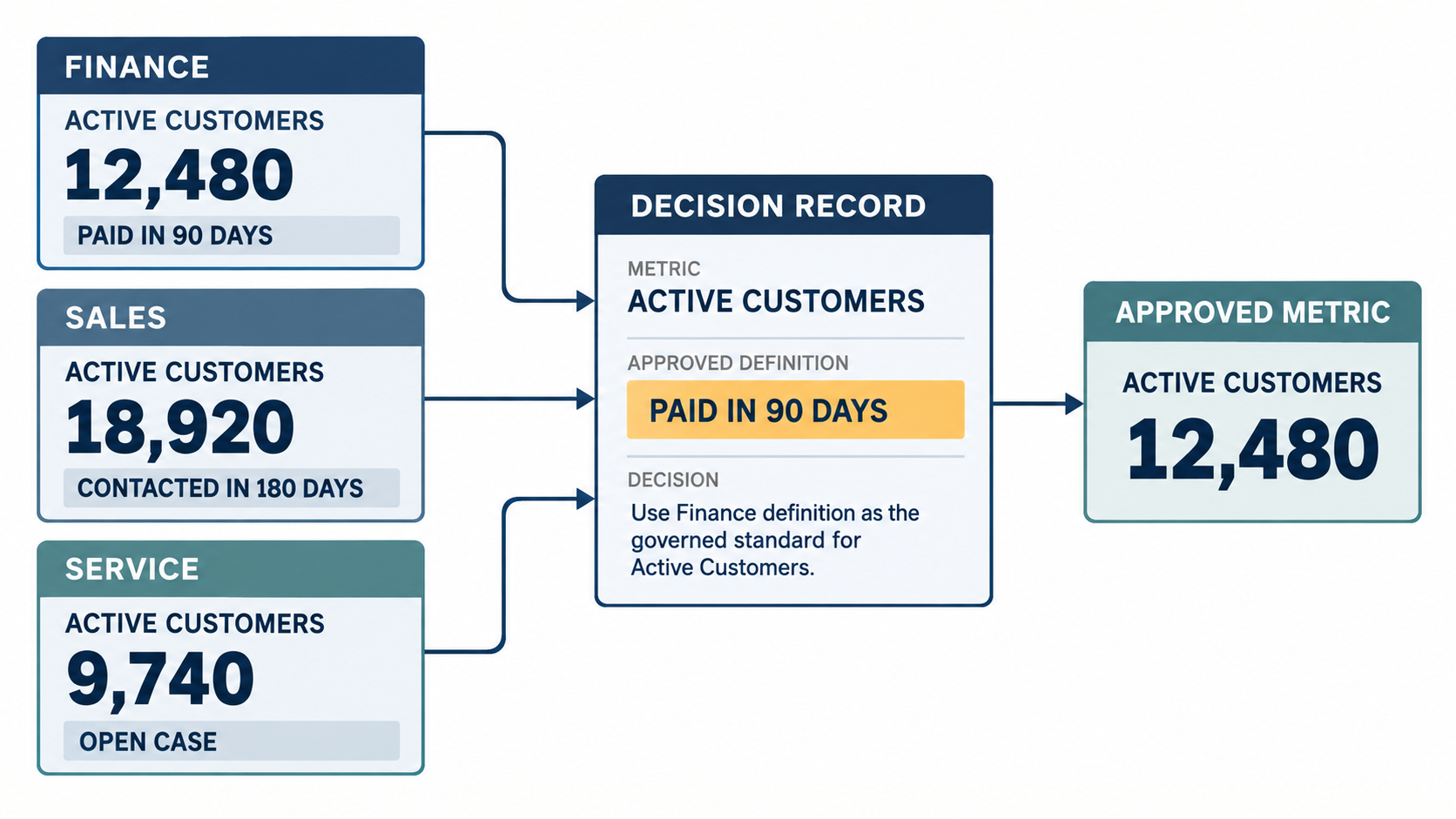
Consider an executive asking, “How many active customers do we have?” Finance reports 12,480. Sales reports 18,920. Service reports 9,740. The immediate reaction may be that two systems are wrong. In reality, all three calculations can be correct against different definitions.
| Function | Definition of active | Reported customers | Business purpose |
|---|---|---|---|
| Finance | Customer with a completed payment in the last 90 days | 12,480 | Revenue and financial activity |
| Sales | Customer contacted during the last 180 days | 18,920 | Pipeline coverage and relationship management |
| Service | Customer with an open service case | 9,740 | Current support workload |
The problem is not merely inconsistent terminology. The three measures answer different questions. Renaming them may be more honest than forcing every team to use one calculation. Finance could own “financially active customers,” Sales could own “recently engaged customers,” and Service could own “customers with active cases.” The executive metric still needs one approved definition tied to a stated decision.
The following image shows the governance decision. It does not claim that the Sales or Service measures are invalid. It records which definition will serve as the approved enterprise metric in this example.
The source data behind the disagreement
A definition cannot be governed responsibly without understanding the source data. The active-customer scenario uses four logical datasets. Each has a different grain, purpose and update pattern.
| Dataset | Grain | Important fields | Relationship and use |
|---|---|---|---|
| Customer master | One row per enterprise customer | enterprise_customer_id, status, legal_name, region | Provides the approved customer identity used to connect operational systems |
| Payments | One row per payment transaction | customer_id, payment_date, payment_status, amount | Joins to the customer master and supports Finance activity |
| CRM interactions | One row per recorded customer interaction | account_id, interaction_date, interaction_type, salesperson | Uses an account crosswalk to connect CRM accounts with enterprise customers |
| Service cases | One row per service case | party_id, opened_date, closed_date, case_status | Uses a party crosswalk and supports the open-case population |
Grain matters because counting joined transaction rows can inflate the customer population. Identity resolution matters because one enterprise customer may appear as several CRM accounts or service parties. Timing matters because a 90-day calculation requires an agreed reference date and treatment of late-arriving transactions.
A glossary entry that says “active customer means a customer active in the last 90 days” is therefore incomplete. It must specify the qualifying event, source, status, date field, identity key, exclusions, refresh expectation and accountable owner.
My practical data governance framework
I organize a practical data governance framework around seven decisions. The framework is intentionally smaller than a full enterprise data-management model. Its purpose is to make one important data domain governable and repeatable.
| Decision | Question to answer | Evidence to retain |
|---|---|---|
| 1. Business outcome | Which decision, process or risk depends on this data? | Use case, affected users, business consequence and success measure |
| 2. Domain and scope | Which data products, entities and critical elements are included? | Domain boundary, source inventory, grain and lineage |
| 3. Meaning | What does each governed metric or element mean? | Approved definition, calculation, exclusions, source and effective date |
| 4. Decision rights | Who decides, who contributes and who implements? | Accountable owner, contributors, escalation path and decision log |
| 5. Controls | What level of quality, access and traceability is acceptable? | Rules, thresholds, permissions, lineage and exceptions |
| 6. Resolution | How does an issue move from detection to verified closure? | Impact, priority, owner, due date, corrective action and retest |
| 7. Operating cadence | Where are decisions made and outcomes reviewed? | Meeting purpose, participants, measures, actions and aging |
The evidence column matters. If a team cannot show the approved definition, decision owner, accepted threshold or closure record, the data governance framework exists mainly in presentation slides.
A data program becomes vulnerable when everyone is responsible but nobody has clear authority to settle a disputed definition or accept a business tradeoff. The Data-Driven Executive examines the leadership structures, decision rights and executive relationships required to prevent that pattern from becoming normal.
Decision 1: Start with the business outcome
“Improve data quality” is too broad to govern. “Reduce customer invoices sent to duplicate accounts” is specific enough to connect data work with a business consequence.
Starting with the outcome changes prioritization. A missing optional contact field may have little impact. A duplicated customer identifier that causes credit exposure to be split across accounts may deserve immediate attention. Both are quality defects, but they do not carry the same business risk.
I would ask the sponsor to identify the decision that changes when the data improves. If nobody can answer, the proposed governance scope is probably too abstract.
Decision 2: Define a manageable domain
Enterprise-wide governance often becomes too large before it becomes useful. I prefer beginning with a domain such as Customer, Supplier, Product, Employee or Finance. The domain should have a meaningful business outcome and enough executive attention to resolve cross-functional disagreements.
The team should identify authoritative sources, important consuming products, critical data elements and system relationships. It does not need to catalog every field before improving anything. Criticality should follow business use.
Decision 3: Record meaning at implementation depth
A useful business definition must be precise enough for an analyst or engineer to reproduce. For the approved active-customer metric, I would record the qualifying event, 90-day window, completed-payment status, customer identity key, reference date, excluded accounts and refresh frequency.
Definitions also need effective dates and change history. If the organization changes the activity window from 90 to 120 days, historical reports may not be comparable. The decision record should explain why the definition changed and which reports adopted it.
Decision 4: Separate accountability from contribution
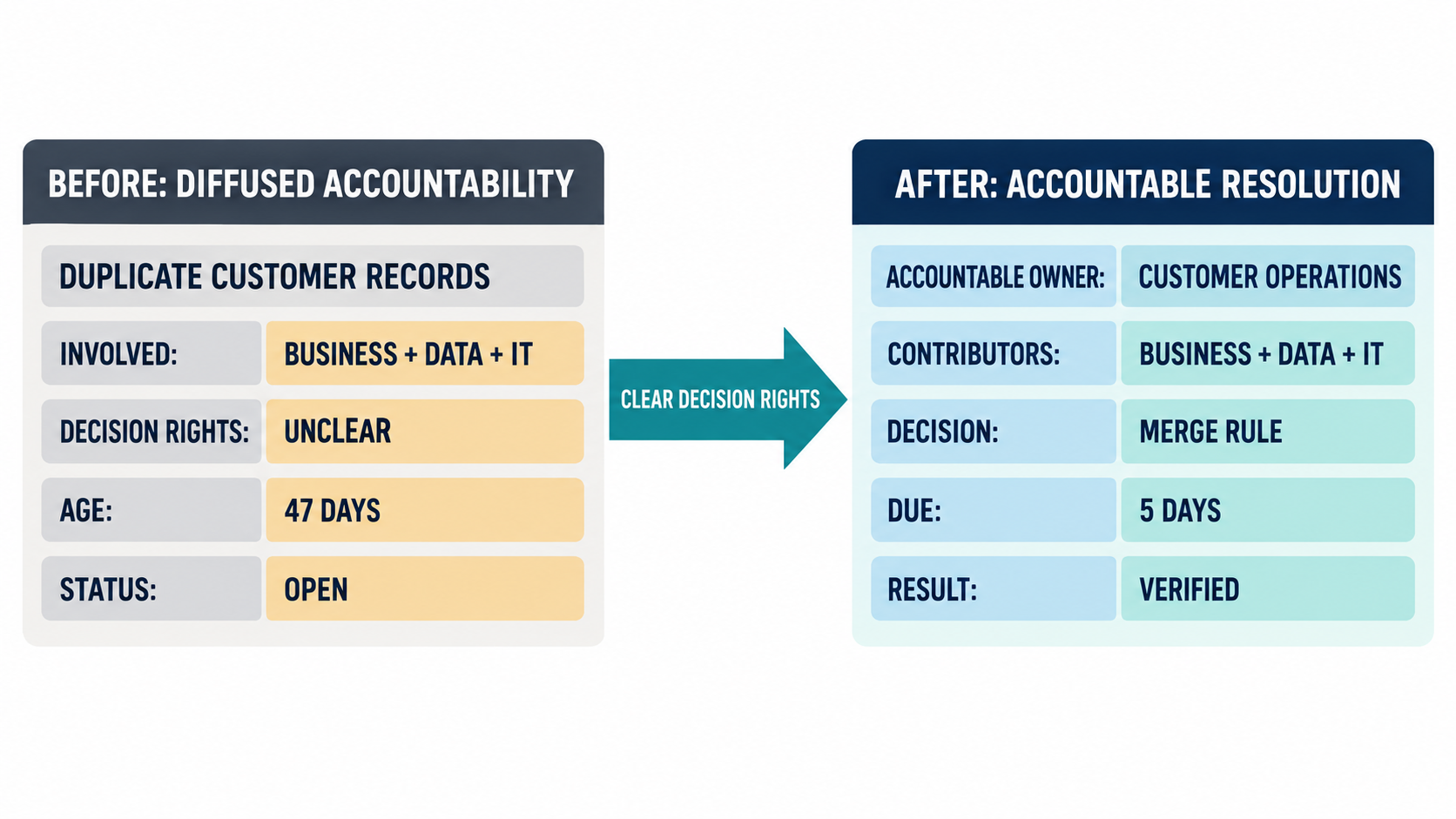
Data governance rarely fails because nobody cares. It often fails because several teams care, each owns part of the process and no role has clear authority to decide. Distributed participation becomes diluted accountability.
Business teams understand meaning and operational impact. Data teams understand transformation, lineage and analytical use. IT understands source applications, integration and technical constraints. All three may need to contribute. However, one accountable owner must be able to make the business decision or escalate it to a named authority.
| Role | Primary responsibility | What the role should not become |
|---|---|---|
| Executive sponsor | Sets priority and resolves conflicts beyond the domain owner’s authority | A ceremonial name used only for steering meetings |
| Accountable data owner | Approves meaning, acceptable quality, access principles and business tradeoffs | A person accountable for technical defects they cannot control |
| Data steward | Maintains definitions, rules, issue evidence and working decisions | A documentation administrator with no access to decision makers |
| Engineering or system custodian | Implements controls, corrections, lineage and reliable delivery | The default owner of every business definition |
| Data consumers | Report usability problems and validate whether corrections support the process | Passive recipients expected to accept unexplained changes |
The image below illustrates the difference. Business, Data and IT remain involved in both states. The improvement is that decision rights become explicit and one accountable owner can drive the issue to a verified result.
Decision 5: Set controls according to business impact
Not every field needs the same quality threshold. A product description used for internal search does not carry the same risk as a bank account used for supplier payment. A practical data governance framework concentrates stronger controls on data elements tied to material decisions, money, rights, safety, privacy or regulatory evidence.
Quality rules should state the dimension, calculation, threshold, evaluation frequency and response. “Customer data must be accurate” cannot be operated. “At least 99.5% of billed orders must resolve to one enterprise customer before the daily billing run” can be measured and acted upon.
| Control type | Example | Business question |
|---|---|---|
| Completeness | Completed payments contain an enterprise customer identifier | Can Finance assign the transaction to the right customer? |
| Uniqueness | One active enterprise record exists for each governed customer identity | Could exposure or revenue be split across duplicate accounts? |
| Validity | Payment status uses an approved reference value | Will the activity rule include the intended transactions? |
| Timeliness | Qualifying payments arrive before the executive metric refresh | Is the reported customer count current enough for the decision? |
| Reconciliation | The governed metric agrees with its approved source within tolerance | Can management trace and explain the published number? |
Decision 6: Govern issue resolution, not issue collection
Many governance programs become good at detecting problems and poor at closing them. Dashboards accumulate failed rules. Issue logs grow. Meetings review aging. Yet the recurring defect remains because the business decision has not been made or the source-system change has not been funded.
Every material issue should contain business impact, accountable owner, contributors, required decision, target date, corrective action and verification evidence. A closure comment saying “fixed” is weaker than a successful retest followed by evidence that the affected business process improved.
Recurrence should reopen the design question. If duplicate customer records return every month, manually merging them is not a sustainable control. The organization may need to change account-creation rules, identity matching, integration timing or incentives that reward duplicate creation.
Decision 7: Build a decision cadence
A governance council should not be a standing audience for status presentations. Its agenda should contain decisions that cannot be made elsewhere, material exceptions, overdue actions and changes to governed definitions or thresholds.
Working-level stewardship can happen more frequently. Domain owners may meet monthly or when a decision threshold is reached. Executive sponsors should become involved when business units cannot agree, risk exceeds authority or a correction requires investment across organizational boundaries.
The cadence should become lighter as decisions stabilize. If every minor definition change requires a large council, the operating model will become a bottleneck. Authority should sit as close as practical to the domain, with clear escalation for material conflicts.
How to measure whether a data governance framework works
Counting glossary terms and assigned owners can show activity, but it does not prove that governance improves decisions. I would combine coverage measures with operating and outcome measures.
| Measure | What it reveals | Warning sign |
|---|---|---|
| Critical-definition coverage | Whether important metrics have approved, reproducible definitions | High glossary volume but low coverage of executive metrics |
| Median decision time | How quickly disputed meanings and thresholds are settled | Issues wait for meetings without a decision owner |
| Material issue age | Whether important defects move toward closure | Average age falls while a few high-impact issues remain open |
| Recurrence rate | Whether corrections address causes rather than symptoms | The same exception returns after repeated manual fixes |
| Control pass rate | Whether critical data meets approved requirements | A high score hides failures concentrated in high-risk fields |
| Business outcome | Whether governed data improves the process that justified the work | Governance metrics improve while invoice errors or decision delays do not |
Measures can also create bad incentives. A team rewarded for closing issues may close them prematurely. A steward measured on glossary volume may document low-value fields. The data governance framework should reward verified resolution and business usefulness rather than administrative output.
A 90-day implementation plan
| Period | Work | Evidence produced |
|---|---|---|
| Days 1 to 30 | Select one domain and one costly decision problem. Map sources, consumers, current definitions and decision participants. | Domain scope, business outcome, source inventory and conflict map |
| Days 31 to 60 | Name the accountable owner and contributors. Approve critical definitions, quality rules, thresholds and escalation rights. | Decision record, glossary entries, controls and responsibility model |
| Days 61 to 90 | Resolve several real issues through the model. Retest corrections, review measures and adjust the cadence. | Closed issues, verification evidence, operating measures and lessons |
I would not use the first 90 days to design governance for every domain. The objective is to prove that the model can resolve an important disagreement and improve a measurable outcome. Expansion should follow evidence.
The cost of waiting is rarely another missing glossary term. It is another executive decision made with competing numbers, another AI pilot trained on ambiguous definitions or another transformation that carries unresolved data debt into a newer platform. AI to ROI for Business Leaders explains how data readiness, governance, pilots, adoption and measurement fit into the larger path from AI investment to business value.
Where a data governance framework goes wrong
They begin with the tool
Catalogs, lineage and quality platforms are useful, but they automate a chosen operating model. If ownership and decision rights remain unclear, the tool may simply document the ambiguity more efficiently.
They make Technology own business meaning
Engineers can explain how a field is populated. They should not be forced to decide what an active customer means for Finance, Sales or Service. Business meaning requires business accountability.
They assign too many owners
Shared contribution is necessary. Shared accountability is often evasive. One role should be accountable for each governed decision, even when several functions must contribute evidence and implementation.
They govern everything equally
Attempting to apply the same documentation, review and quality threshold to every field creates volume without prioritization. Stronger governance belongs around data with greater business consequence.
They stop at detection
A quality dashboard does not improve data. The program must fund corrections, verify results and change the process that recreates the defect.
How this connects to analytics and AI
Analytics exposes governance problems because dashboards make competing definitions visible. AI can amplify those problems because generated answers may hide the calculation behind a confident explanation. The underlying requirement is the same: approved meaning, traceable sources, accountable decisions and evidence that the result is fit for its intended use.
My data-readiness framework for AI explains how to assess whether the sources, quality and ownership are strong enough for an AI use case. My data-driven decision-making article addresses how leaders turn available information into action rather than reporting activity.
For a platform example, Databricks official documentation: Unity Catalog data governance explains how Databricks supports discovery, access control, lineage, monitoring and governance across data and AI assets. Those capabilities are valuable, but the organization must still supply the business definitions and decision rights described in this article.
Choose your next step
If your organization has competing metrics, choose one important number and document the definitions currently in use. Do not begin by declaring two teams wrong. Identify the different business questions, approve the enterprise use and preserve the decision.
- Strengthen data leadership, accountability, governance and executive alignment with The Data-Driven Executive.
- Connect data readiness with AI selection, piloting, adoption and measurable value through AI to ROI for Business Leaders.
- Continue with the related articles Building Data Culture and How to Build a Data Team.
Official data governance resources
- DAMA International and the DAMA-DMBOK provide a broad body of knowledge covering data-management disciplines and professional practice.
- EDM Council DCAM provides a capability-assessment framework for data management and analytics programs.
- ISO 8000-150:2022 addresses roles, responsibilities and documentary evidence for data-quality management.
The result I want from data governance
I do not judge a data governance framework by the number of domains, stewards or catalog entries it creates. I judge it by whether people can find a trusted definition, understand its source, identify who can decide and see whether important issues reach verified closure.
The strongest signal is not the absence of disagreement. Healthy organizations will disagree about meaning, cost and acceptable quality. The stronger signal is that disagreements move through known decision rights and produce evidence that others can follow.
What are you trying to govern? Share the business decision, the data involved and where the work is getting stuck in the comments. I am especially interested in cases where several teams are participating but accountability for the final decision remains unclear.