
Data governance best practices should help a company settle important data decisions, prevent recurring failures and prove that agreed controls are working. If governance mainly produces meetings, glossaries and ownership spreadsheets, it may look mature while the same business problems continue underneath it.
I have seen this gap across ERP programs, data warehouses, analytics platforms, cloud migrations and AI initiatives. Most organizations do not lack intelligent people or useful tools. They struggle because accountability is spread across business, data and technology teams, while the authority to make a final decision remains unclear. A defect is discussed by many people, assigned to several groups and closed by nobody.
The closest analogy is preventive maintenance. A factory does not improve reliability by cataloging every machine and holding a monthly meeting about breakdowns. It identifies which failures interrupt production, assigns maintenance responsibility, defines acceptable operating limits and verifies whether corrective work reduced future failures. Data governance should work the same way.
This article is the implementation companion to my Data Governance Framework. That guide explains the operating model: business outcomes, scope, meaning, decision rights, controls, resolution and cadence. Here, I focus on the practices that make those components work repeatedly under real delivery pressure.
Official platform documentation still matters because it explains the capabilities available to implement policies, lineage, access controls and quality monitoring. My goal is different. I want to show where governance programs lose momentum in practice, which habits correct that drift and how leaders can tell whether the work is changing business outcomes.
Why data governance best practices often fail in practice
Many governance programs begin with an inventory. Teams identify domains, owners, critical data elements, policies and committees. Those artifacts are useful, but the sequence can become backward. The organization defines the governance machinery before choosing the business decisions that machinery must improve.
As a result, hundreds of fields may receive labels while a disputed revenue definition remains unresolved. A data-quality dashboard may show red indicators, yet nobody knows who can accept the threshold, fund the source correction or approve a temporary exception. The program measures activity because business impact was never defined.
Another failure comes from confusing participation with accountability. Finance, Sales, Operations, IT and the data team may all contribute to a customer definition. However, listing every group as an owner does not clarify who decides. Distributed expertise is valuable. Distributed decision authority can become paralysis.
Technology introduces a third trap. Catalogs, lineage, access policies and quality monitoring can make governance faster and more observable. They cannot decide what “active customer” means, how much duplicate-customer risk the company will tolerate or whether a control costs more than the risk it reduces. Those remain business and management decisions.
A realistic scenario for applying data governance best practices
Consider an illustrative manufacturing company with duplicate customer records. A customer can exist under separate identifiers in the CRM, ERP and service platform. Credit exposure is divided across the duplicates, Sales sees fragmented activity, and service agents cannot view the full relationship. The company has been discussing the issue for months, but every function owns only one part of it.
The source data cannot be governed responsibly without understanding its grain. Otherwise, a team may count transactions instead of customers, merge legitimate subsidiaries or treat a system identifier as an enterprise identity.
| Dataset | Grain | Important fields | Relationship and business use |
|---|---|---|---|
| Enterprise customer master | One row per approved enterprise customer | enterprise_customer_id, legal_name, tax_id, country, status | Provides the controlled identity used across reporting and risk decisions |
| CRM accounts | One row per CRM account | crm_account_id, account_name, address, salesperson, parent_account | Connects through a customer crosswalk; supports selling activity |
| ERP receivables | One row per accounting document item | erp_customer_id, document_id, open_amount, due_date, company_code | Connects through the crosswalk; supports credit exposure and collections |
| Customer crosswalk | One row per source-system identifier mapping | source_system, source_customer_id, enterprise_customer_id, match_status | Relates operational identities to the approved enterprise customer |
A small evidence sample might show CRM account C-778 and ERP customer 100045 sharing a tax identifier and legal address, while ERP customer 100912 differs only by punctuation in the legal name. That is a possible duplicate, not an automatic merge. A human still needs to review hierarchy, geography, legal-entity boundaries and downstream consequences.
This scenario gives governance a concrete purpose: define the enterprise customer, decide who can approve a merge rule, implement a control for suspected duplicates and verify whether fragmented exposure declines. The following practices turn that purpose into an operating discipline.
1. Start data governance with a business decision
“Improve customer data” is too broad. “Prevent credit exposure from being split across duplicate customer identities” is specific enough to govern. It identifies the business risk, affected process and decision that better data should support.
I ask sponsors to complete one sentence: “If this data improves, we will make this decision differently.” If the sentence cannot be completed, the scope is probably an inventory exercise rather than an outcome-led governance effort.
The practice also prevents teams from treating every defect equally. A missing secondary phone number and a duplicate account that hides overdue receivables are both data-quality issues. They do not deserve the same funding, escalation or executive attention.
| Weak starting point | Decision-oriented starting point |
|---|---|
| Improve customer data quality | Reduce invoices and credit exposure assigned to duplicate customer identities |
| Create a business glossary | Approve the customer and revenue definitions used in the monthly operating review |
| Assign data owners | Give one role authority to approve customer match and merge rules |
2. Prioritize by business impact and recurrence
Not every data issue belongs in a governance forum. Local teams should correct isolated, low-impact errors through normal operations. Governance becomes valuable when an issue crosses organizational boundaries, affects an important decision, repeats because of a structural cause or requires someone to accept a business tradeoff.
Two questions create a practical first filter:
- What is the business impact? Consider financial exposure, customer harm, operational disruption, regulatory risk and the decisions affected.
- Is the issue isolated or recurring? A recurring pattern often indicates a missing definition, process control, source correction or decision right.
The matrix below is one of the most useful data governance best practices because it protects the program from becoming a general-purpose help desk.
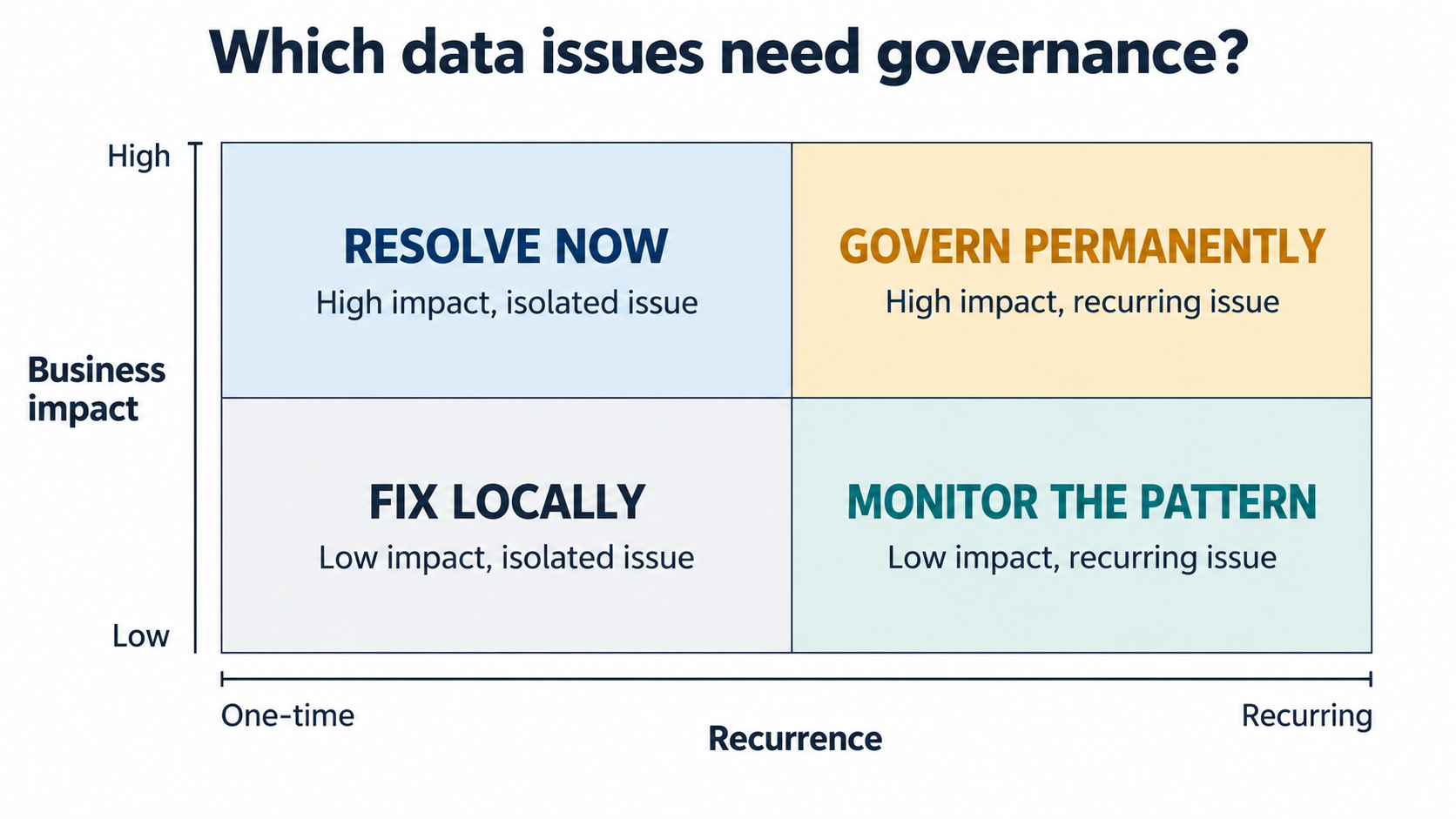
The top-right quadrant deserves special attention. A recurring duplicate-customer pattern with meaningful credit exposure should not be closed after a one-time cleanup. The organization needs a lasting match rule, exception process, control owner and evidence that new duplicates are declining.
3. Define grain, identity and relationships before metrics
Business definitions often fail because they are written without enough data detail to reproduce them. “One customer” sounds obvious until the organization encounters parent companies, subsidiaries, franchises, joint ventures, resellers and legal entities operating in several countries.
A governed definition should state the entity grain, approved identity key, source precedence, qualifying conditions, exclusions, reporting period and effective date. For a metric, it should also state the formula and aggregation behavior. For a matching rule, it should state which attributes are deterministic, which are probabilistic and which cases require human review.
In the duplicate-customer scenario, tax ID might be strong evidence in one country but unreliable or unavailable in another. A shared address could represent a duplicate, a corporate campus or several legitimate subsidiaries. Therefore, the rule should produce a match recommendation and confidence level rather than silently merging every similar record.
This is also why data readiness for AI begins before model selection. An AI matching service cannot compensate for an undefined customer grain or unclear legal-entity policy. It can make the ambiguity move faster.
4. Assign one accountable decision owner
Several teams can contribute, but one role must have authority to decide. For enterprise customer identity, Customer Operations might be accountable. Finance, Sales, Service, Legal, Data and IT can supply requirements and evidence. The data engineering team can implement the approved logic. An independent business user can verify that the result works in the operating process.
I prefer a decision-rights record that answers four questions:
| Responsibility | Question | Illustrative role |
|---|---|---|
| Recommend | Who assembles evidence and proposes the rule? | Customer data product owner |
| Decide | Who has final authority over the business tradeoff? | Head of Customer Operations |
| Implement | Who changes the process, platform or control? | CRM, ERP and data-platform teams |
| Verify | Who confirms the change reached users and reduced the problem? | Credit operations and internal control owner |
The accountable person should be close enough to understand the business consequence and senior enough to resolve disagreement. Assigning the role to a data steward without matching authority simply transfers responsibility without transferring power.
This leadership problem appears repeatedly in large transformations. In The Data-Driven Executive book on Amazon, I examine how data leaders establish decision rights, work across executive boundaries and connect governance with business accountability. The techniques in this article are the operating layer of that broader leadership challenge.
5. Turn definitions into operational controls
A glossary entry does not change data. The approved definition must reach the systems, pipelines, reports and teams that use it. Likewise, a quality rule matters only when its failure triggers an appropriate action.
Each operational control should record:
- The rule and the business risk it addresses
- The data scope, grain and execution frequency
- The threshold and reason for accepting it
- The control owner and the action required after failure
- The exception path, due date and retained evidence
- The method used to verify that corrective action worked
For example, a nightly duplicate-customer control could identify new source records with a high-confidence match to an existing enterprise customer. The control should not automatically merge uncertain records. Instead, high-confidence cases might enter an expedited review queue, while medium-confidence cases require supporting evidence from Customer Operations.
The threshold must also have a business rationale. A 95 percent match score is not meaningful by itself. Leaders need to understand the cost of a false merge, the cost of leaving a duplicate open and which scenarios require mandatory review.
6. Replace governance status meetings with decision forums
One of the weakest habits I see is the governance meeting built around a long status deck. Each workstream reports progress, several problems are acknowledged and the meeting ends without an explicit decision. The same topics return the next month with more slides.
A decision forum works differently. Evidence is sent in advance. The agenda contains only decisions that require the participants’ authority. Each item names the accountable decision owner, recommendation, alternatives, consequence of delay and required date. The meeting record captures what was decided and what evidence will prove closure.
The contrast below shows why meeting design is one of the most consequential data governance best practices.
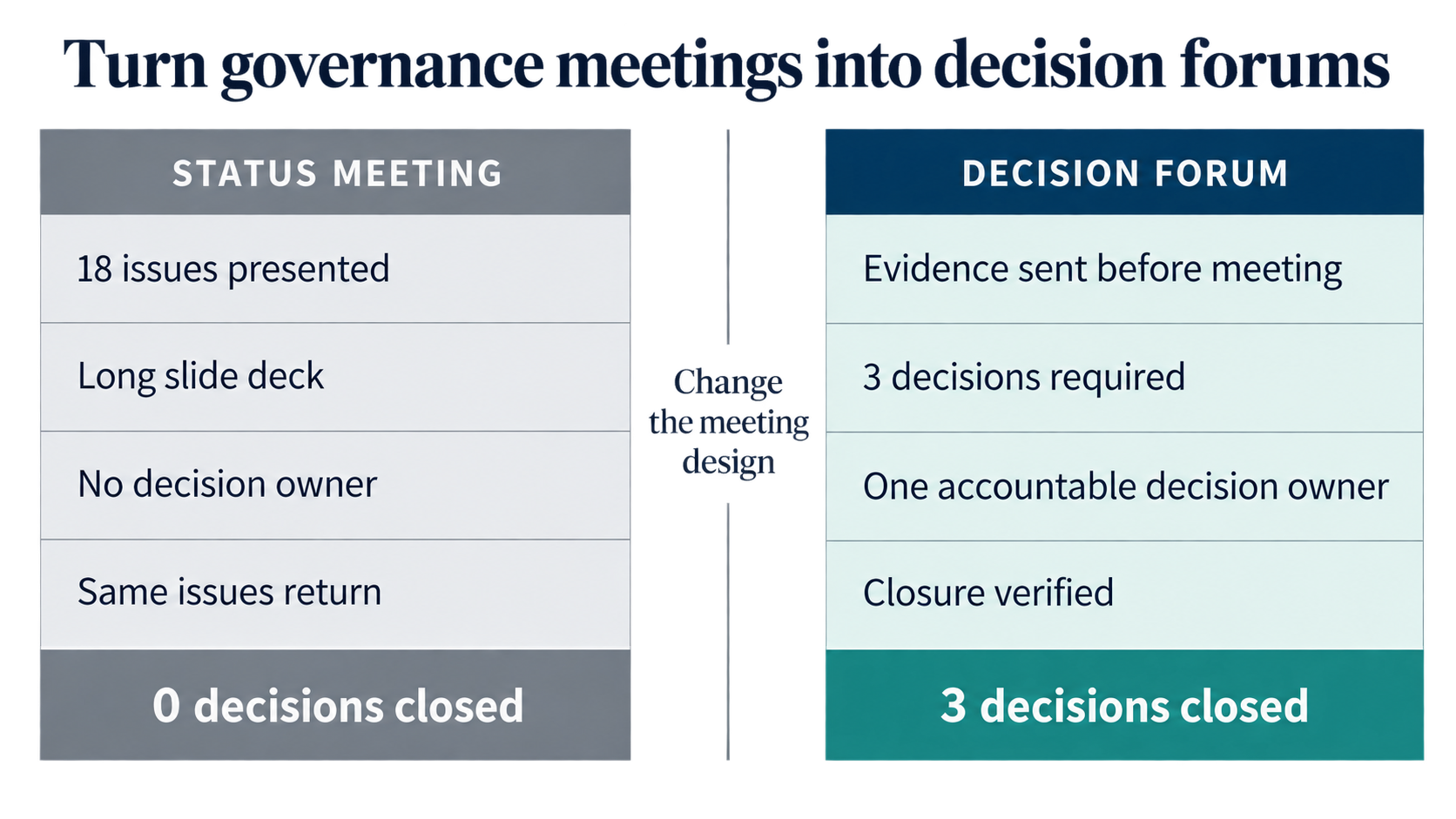
A useful agenda item is specific: “Approve the enterprise-customer merge rule for records with matching tax ID and country, subject to legal-entity exclusions.” An unhelpful item says, “Customer data update.” The first statement tells leaders why they are in the room.
7. Preserve evidence and change history
Governance decisions need a memory. Otherwise, teams revisit the same debate after a leadership change, system migration or audit request. The decision record should include the issue, evidence, options considered, accountable owner, decision, rationale, effective date, implementation owner and review date.
Definitions also need versions. Suppose the business changes “active customer” from a 90-day payment window to 120 days. Reports before and after that date may no longer be comparable. A change log allows analysts to explain the break instead of quietly rewriting history.
Evidence does not need to become bureaucratic. A short decision record with links to the relevant rule, test result and implementation ticket is usually more useful than a 40-page policy nobody can apply.
8. Verify adoption instead of declaring implementation
Governance work is not complete when a definition receives approval or code reaches production. It is complete when the affected systems and users adopt the decision, the control operates as intended and the original business risk changes.
For the customer example, verification would ask whether CRM, ERP risk reporting and executive dashboards use the same enterprise identity. It would test whether approved mappings reached downstream products. It would also compare duplicate creation, fragmented exposure and manual-review volume before and after implementation.
This step often produces surprises. A technically correct rule may create too many false positives for an operations team to review. A new identifier may be available in the warehouse but missing from the daily sales workflow. Human feedback is therefore evidence, not resistance to be ignored.
The same principle applies to AI governance. Data controls establish whether inputs are appropriate and understood. AI controls add questions about model behavior, autonomy, monitoring and human intervention. The disciplines overlap, but they are not interchangeable.
9. Measure governance as an operating system
Counts of glossary terms, owners and meetings can show activity. They do not prove value. I would balance operating measures with business outcomes.
| Measure | What it reveals | Possible warning |
|---|---|---|
| Decision cycle time | How long an issue waits for an authoritative decision | Aging rises while meeting volume increases |
| Repeat-issue rate | Whether structural causes are being removed | The same defect returns after closure |
| Rule adoption | Whether approved definitions and controls reached consumers | Teams continue using local calculations |
| Exception volume and age | Whether thresholds and review capacity are realistic | Queues grow faster than teams can act |
| Business outcome | Whether governance reduced cost, risk or decision inconsistency | Technical indicators improve without process impact |
Measures also support retirement. If a control has operated for a year without finding a meaningful issue, leaders should ask whether the risk has fallen, the rule is poorly designed or the control no longer justifies its cost. Governance should remove work as well as create it.
10. Use technology as an enabling layer
A modern catalog can centralize discovery, access controls, lineage, classifications and quality signals. For Databricks users, Unity Catalog provides governance capabilities across data and AI assets, including permissions, lineage, auditing, classification and monitoring. Those capabilities make decisions enforceable and observable.
However, the tool still needs an operating model around it. A platform can show who has been entered as an owner. It cannot determine whether that person has business authority or enough capacity to act. It can record lineage, but a leader must decide which downstream uses make a dataset critical.
My preferred sequence is business outcome, decision rights, minimum evidence, operational process and then platform configuration. This avoids building an impressive catalog around unresolved accountability.
The same concern appears in building a data culture. People trust governed data when definitions help them work, issues receive decisions and leaders use the approved measures themselves. Training alone cannot compensate for contradictory executive behavior.
A 90-day plan for applying data governance best practices
Applying data governance best practices does not require an enterprise-wide rollout. One domain, one meaningful outcome and one recurring issue can expose whether the operating model works.
| Period | Actions | Evidence of progress |
|---|---|---|
| Days 1 to 30 | Select one outcome and domain. Document source grain, relationships, affected decisions and current failure cost. Name the accountable decision owner. | Approved scope, baseline measures, source map and decision-rights record |
| Days 31 to 60 | Approve the definition or rule. Test it against known cases. Define thresholds, exceptions, implementation owners and the decision-forum agenda. | Versioned definition, test evidence, control design and recorded decisions |
| Days 61 to 90 | Implement the control. Confirm downstream adoption. Measure operational and business results. Correct false positives and unresolved handoffs. | Control results, adoption evidence, closed actions and updated outcome measures |
The objective is not to declare governance mature after 90 days. It is to prove that one important issue can move from ambiguity to an accountable decision, implemented control and verified result. That working pattern is far easier to expand than a large theoretical program.
Download the data governance best practices checklist
I converted the practices in this article into a one-page working checklist. It includes questions for prioritization, data meaning, decision rights, control design, meeting discipline and verification, plus a compact decision record.
Download the one-page Data Governance Best Practices Checklist
Use it before accepting an issue into governance, approving a definition or closing a corrective action. A completed checklist will not replace judgment, but it will expose missing authority, weak evidence and unverified closure early.
Common mistakes these data governance best practices prevent
| Mistake | Why it persists | Corrective practice |
|---|---|---|
| Cataloging everything before improving anything | Inventory is easier to measure than business change | Begin with one decision and critical data scope |
| Calling several teams owners | Shared involvement feels politically safer | Name one accountable decision owner and separate contributors |
| Closing issues when code is deployed | Technical completion is visible and easy to report | Verify adoption and business outcome |
| Using meetings for status | Presentation feels like progress | Send evidence in advance and use the forum for decisions |
| Treating a platform as the operating model | Software can be purchased faster than authority can be negotiated | Design outcomes and decision rights before configuration |
These failures are rarely caused by laziness. They are natural responses to organizational ambiguity. Leaders correct them by making authority, evidence and consequences visible.
Free official resources for deeper study
Databricks users can review platform-specific capabilities in Databricks official documentation: Unity Catalog.
Google Cloud users can review cataloging, data quality, lineage, security and access-control capabilities in Google Cloud official documentation: Data governance in BigQuery.
Both resources can be read online without buying a book, standard, assessment or membership. They explain platform capabilities, while my practical articles focus on how the work behaves when definitions are contested, accountability is distributed and technical delivery must survive real operating constraints.
Make governance earn its place
The strongest data governance best practices share one test: they move an important issue toward an authoritative decision and a verified result. They reduce repeated debate, clarify tradeoffs and make the organization more capable of using data consistently.
If your governance program cannot show which decisions became faster, which defects stopped recurring or which business risks declined, adding more meetings and metadata will not solve the problem. Start with one consequence that leaders already care about, then build the minimum governance needed to change it.
Governance becomes credible when leaders can see the connection between authority, evidence and business performance. The Data-Driven Executive book on Amazon develops that leadership model in greater depth, including how executives organize data accountability, build trust and turn information into decisions.
You can also read my related guides on data-driven decision-making, building a data team and preparing data for AI.
What are you trying to govern, what data is involved and where is the work getting stuck? Share the use case in the comments. I am especially interested in the definitions, ownership conflicts and recurring quality problems that look simple on paper but remain unresolved in practice.