
An AI operating model determines who selects AI opportunities, who owns the business outcome, who builds reusable capabilities, who accepts risk, and who keeps the product working after the pilot ends. Without those decisions, organizations can have an AI strategy, modern platforms and talented teams while still struggling to move useful ideas into production.
I have seen this accountability problem across data, analytics, ERP, cloud and AI programs. The organizational chart usually appears clearer than the real work. A business leader sponsors the idea. A data team provides the information. Engineers build the solution. Security, legal and risk teams review it. Finance asks for the return. Once the product enters production, however, it becomes difficult to identify the person who can make the final decision when quality, cost, speed and control conflict.
The recurring failure is not that people refuse to collaborate. It is that responsibility is distributed while decision authority remains unclear. Everyone participates, but no one can resolve the tradeoff.
An AI operating model must solve that problem without creating a central committee that approves every prompt, model and release. It should place decisions close to the relevant business domain while providing shared capabilities and guardrails where reuse creates value.
My view is shaped by leading data, analytics, AI and enterprise transformation programs across industries and by the operating patterns described in AI to ROI for Business Leaders and The Data Driven Executive. Organizations do not need to choose one permanent structure called centralized, decentralized or federated. They need operating patterns that change with the uncertainty, maturity, risk and scale of the portfolio.
What an AI operating model actually controls
An operating model connects strategy to daily decisions. It defines how work enters the portfolio, how teams form, which capabilities are shared, where authority resides and what happens after deployment.
For AI, the model must cover at least six questions:
| Operating question | Decision that must be clear | Common failure when it is unclear |
|---|---|---|
| Business selection | Which problems deserve investment and which ideas should stop? | A long list of pilots consumes funding without creating a portfolio. |
| Product ownership | Who owns the workflow, outcome, adoption and benefit? | The technology team becomes responsible for a business result it cannot control. |
| Data responsibility | Who defines, supplies, corrects and approves the required data? | Teams repeatedly repair extracts without changing the source process. |
| Technical capability | What should be built once as a platform and what belongs inside the product? | Every team rebuilds integration, evaluation, monitoring and access controls. |
| Risk authority | Who can accept, reduce or escalate a material risk? | Governance becomes either a late approval gate or an undocumented exception. |
| Production operation | Who responds when quality, reliability, cost or user behavior changes? | The pilot succeeds, but no permanent team can operate it. |
A RACI chart can record participants, but it does not automatically create authority. If three executives remain “accountable,” nobody is truly accountable. If the product owner cannot stop a release, change scope or escalate a data issue, the title does not carry meaningful decision rights.
Why traditional project structures struggle with AI
Traditional projects are often funded to deliver a defined scope by a specified date. AI products behave differently. Their performance depends on changing data, user behavior, model behavior, external services and the surrounding workflow. Deployment is not the end of the work.
A model can perform well during validation and deteriorate after the population, source data or operating process changes. A generative AI assistant may answer the benchmark questions correctly while failing on unusual cases submitted by real users. An agent may remain technically available but consume more tokens, take inappropriate actions or encounter permissions that were never represented in testing.
This creates several operating requirements that project structures frequently leave unresolved:
- Evaluation must continue after the initial release.
- Business and technical measures must be reviewed together.
- Human corrections, overrides and incidents must feed product changes.
- Data and model changes require controlled release decisions.
- Someone must own ongoing cost, reliability and benefit realization.
- The organization needs authority to restrict or retire the product.
I have encountered the same pattern in conventional analytics programs. Teams spend months producing a technically correct result, only to discover that users retain their previous spreadsheet, the business definition differs across departments, or nobody has removed the duplicate step from the workflow. AI makes that failure faster and sometimes more expensive. It does not eliminate the operating work surrounding the technology.
Three patterns for an AI operating model
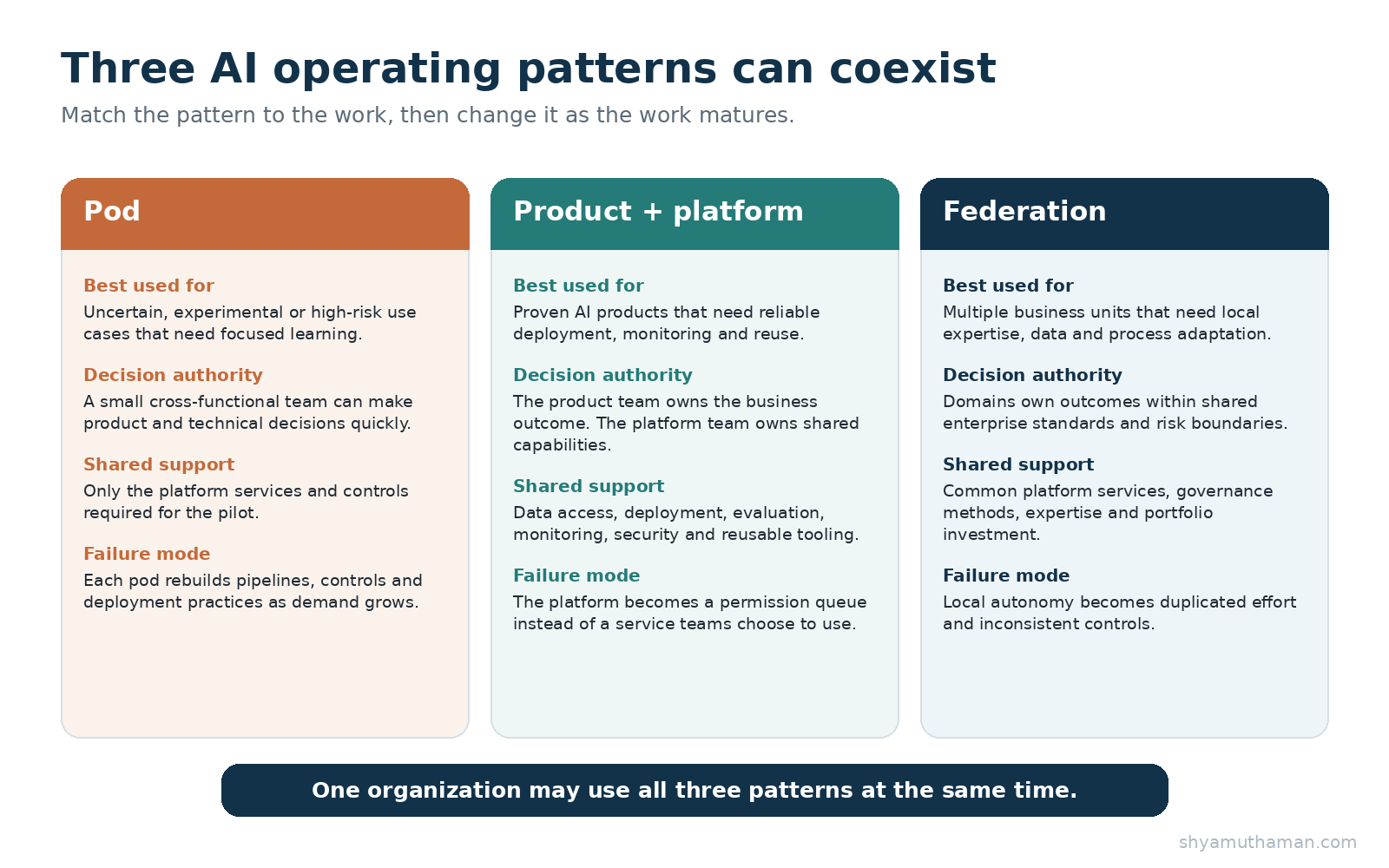
The three patterns I use are focused pods, product-plus-platform teams and federation. These are not competing organizational philosophies. They solve different problems and can operate simultaneously.
Focused pods for uncertainty
A focused pod is a small, cross-functional team formed around one material problem. It should include the business process owner, product leadership, data and AI skills, engineering support, and the risk expertise appropriate to the use case.
The pod is useful when the organization does not yet know whether the problem is feasible, valuable or safe enough to pursue. The team receives a bounded objective, representative data, a decision deadline and permission to stop.
A pod should not become a permanent innovation theater. Its purpose is to reduce uncertainty. It must produce evidence about business relevance, data readiness, technical performance, workflow fit, risk and likely economics.
The first surprise in many AI experiments is that model performance is not the decisive constraint. Teams instead discover inconsistent source definitions, missing exception history, weak user incentives or a workflow that cannot act on the recommendation. A good pod surfaces those constraints early.
The pod should finish with one of three decisions:
- Stop because the problem, evidence or economics do not justify further investment.
- Continue with another bounded experiment because a material uncertainty remains.
- Move into a product structure because the result is strong enough to operate and improve.
Product-plus-platform teams for repeatable delivery
Once a use case earns continued investment, temporary project staffing is no longer enough. A product team should own the business workflow and the AI capability within it. A platform team should own reusable technical services used across products.
The product team is accountable for the outcome, scope, adoption, product-level evaluation and operating performance. It needs enough business and technical capability to make changes without reassembling the original project team.
The platform team can provide identity integration, approved model access, data connectivity, retrieval services, evaluation tooling, deployment patterns, observability, security controls and cost management. These should be managed as internal products with users, service commitments and a roadmap.
The division is important. Product teams should not rebuild every foundation. Platform teams should not take ownership of business results they cannot control.
I have seen shared platforms fail when architecture teams assume that publishing a standard is equivalent to adoption. It is not. If the approved path is slower, poorly documented or unable to support a real workload, delivery teams will build around it. A platform earns reuse by making the safe path practical.
Federation for domain scale
Federation places product decisions and domain expertise near the business while retaining enterprise guardrails and shared capabilities. It becomes useful when several business units have different processes, data, economics or regulatory requirements.
A federated model does not mean that every domain creates its own standards and platform. Enterprise teams can continue to own common controls, shared services and portfolio transparency. Domain teams own the contextual decisions that cannot be made effectively from the center.
For example, a central platform might provide approved model access, evaluation tooling and monitoring. A finance product team defines acceptable invoice exceptions. A maintenance team defines how technicians review equipment recommendations. A customer-service team defines when an answer must transfer to a person.
Federation works only when both sides have genuine obligations. The enterprise cannot merely publish guardrails. Domains cannot claim autonomy while ignoring common controls, cost transparency or incident reporting.
Why one organization may need all three patterns
A company might use a pod to test a new maintenance assistant, operate an established customer-service product through a product-plus-platform structure, and support regional demand-forecasting products through federation.
Even one product may move through the patterns:
- A pod tests whether the opportunity is useful and feasible.
- A permanent product team assumes ownership after the pilot.
- A platform team extracts reusable services rather than rebuilding them for the next product.
- Additional domains adopt the capability through a federated model with local ownership.
The structure should follow the work. Forcing every use case into a central AI team produces a queue and separates products from domain knowledge. Allowing every domain to build independently creates duplication, inconsistent controls and weak portfolio visibility. Declaring the organization “hybrid” without assigning decisions simply gives the ambiguity a more attractive name.
AI operating model decision rights
The most important design exercise is not drawing boxes. It is assigning final authority for recurring decisions.
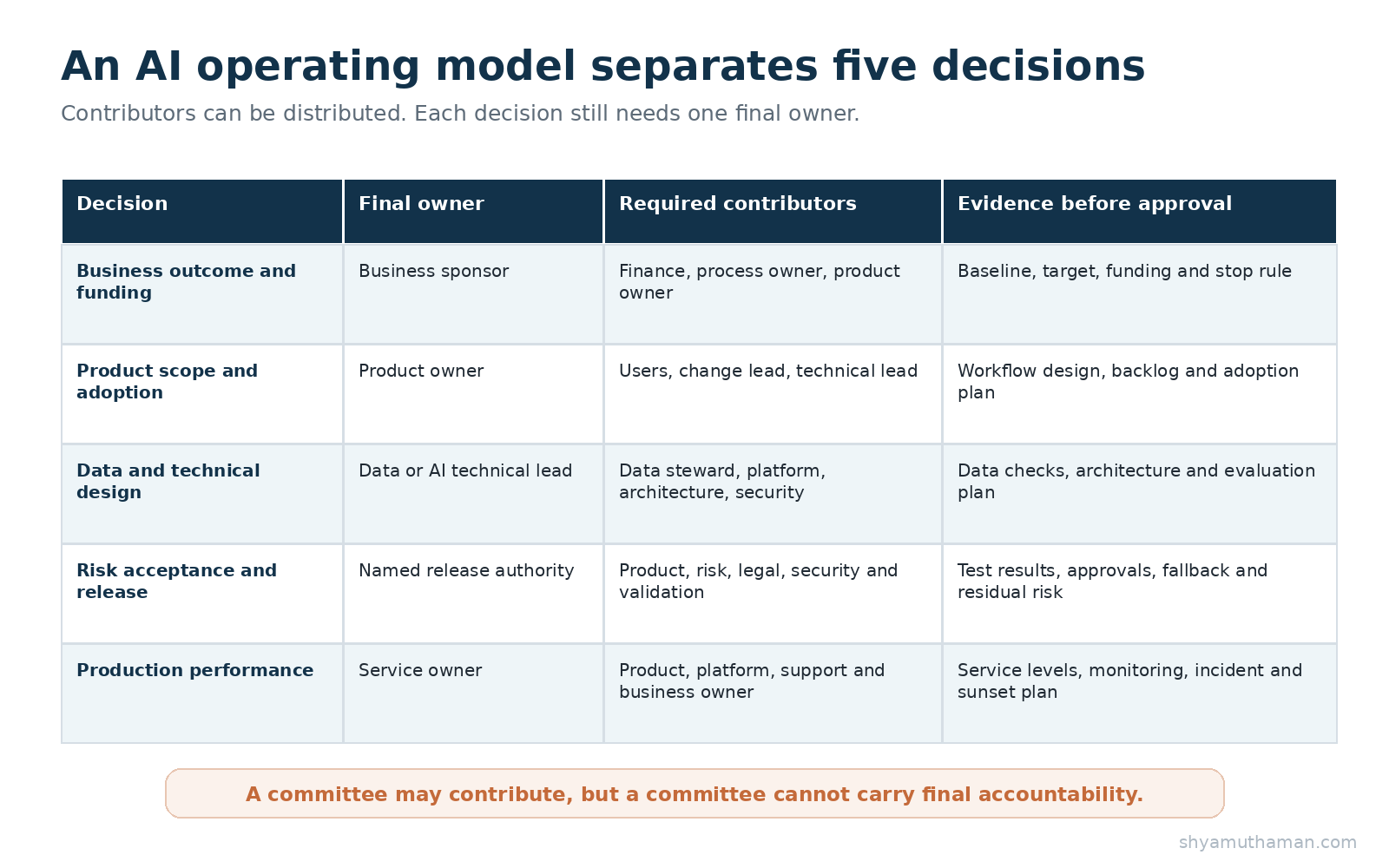
The exact titles will differ, but the ownership logic should remain clear:
| Decision | Final owner | Required contributors | Evidence before deciding |
|---|---|---|---|
| Business outcome and continued investment | Business sponsor | Product, finance, operations and technology | Baseline, expected benefit, full cost, adoption requirement and risk |
| Product scope and release priority | Product owner | Users, business process owner, engineering, data and risk | User evidence, evaluation results, dependencies and operating impact |
| Technical architecture | Technical product or engineering owner | Platform, data, security, operations and product | Performance, reliability, integration, security, cost and supportability |
| Risk acceptance or escalation | Authorized business or risk owner | Legal, compliance, security, product, data and affected operations | Use-case risk, controls, residual exposure, human oversight and recovery options |
| Production performance | Product owner | Business operations, engineering, platform, data and risk | Quality, reliability, incidents, cost, usage, overrides and business outcomes |
The product owner should not be able to accept every category of risk. The risk function should not set business priorities. The platform team should not decide whether a workflow creates value. Separation of authority is healthy when escalation is explicit.
A practical decision record should state the decision, final owner, contributors, evidence required, escalation path and review cadence. That is the purpose of the downloadable canvas later in this article.
Business ownership does not mean business sponsorship
A sponsor secures attention and funding. An owner remains accountable for the outcome after the launch.
Business ownership includes defining the desired result, redesigning the workflow, assigning users, resolving policy questions, tracking adoption and explaining whether the expected benefit appeared. These responsibilities cannot be transferred to the data-science or engineering team.
Technical ownership is equally important. Someone must maintain integrations, evaluation pipelines, deployments, monitoring and incident response. Calling the business the owner does not excuse technology teams from service responsibility.
The operating model therefore needs complementary ownership:
- The business sponsor owns the investment decision and intended outcome.
- The product owner manages scope, workflow adoption and product performance.
- The data owner manages meaning, access, quality and correction at the source.
- The engineering owner manages technical reliability and change.
- The platform owner manages reusable services and their internal customer experience.
- The authorized risk owner accepts or escalates residual risk.
These owners may sit in different reporting lines. That is normal. The answer is not to pretend one leader controls every contributor. It is to document authority, establish an operating rhythm and create escalation paths that work across the organization.
How to fund the operating model
Funding often exposes whether the operating model is real. Shared platforms require investment before every product can demonstrate an individual return. Business products require outcome ownership rather than an annual technology allocation. Experiments need limits so they do not become permanent pilots.
I prefer three funding categories:
| Funding category | What it supports | Investment test |
|---|---|---|
| Explore | Bounded pods reducing material uncertainty | Did the experiment produce enough evidence for a stop, continue or product decision? |
| Product | Domain products tied to an operating outcome | Is usage changing the workflow, and is the outcome worth the full operating cost? |
| Platform | Reusable technical capabilities and controls | Does reuse reduce delivery time, risk or cost across enough products? |
Platform value should not be measured only as revenue or direct savings. Reuse can reduce duplicated engineering, shorten approval time and improve control consistency. However, calling something “strategic infrastructure” should not protect it permanently from evidence. Platform teams should track adoption, service performance, marginal delivery cost and what product teams still build outside the platform.
How the AI operating model changes with maturity
The operating model should evolve with the capability described in an AI maturity assessment. An early organization needs focus and learning. A scaled organization needs reusable services, distributed decisions and portfolio discipline.
Ad hoc maturity
Form one focused pod around a material workflow. Name the business sponsor, establish a measurable baseline, assign a time and spending limit, and identify who can stop the work. Do not begin with a large central organization.
Repeatable maturity
Standardize intake, evaluation, risk classification and pilot funding. Create an enablement function that helps teams use common methods. Identify technical capabilities that have been rebuilt enough times to justify a platform product.
Managed maturity
Establish permanent product and platform ownership. Review quality, reliability, cost, risk, adoption and business outcomes together. Use documented decision rights for releases, exceptions, incidents and material changes.
Scaled maturity
Federate domain decisions within enterprise guardrails. Reuse platforms where the economics support them. Compare products as a portfolio, retire low-value capabilities and review whether central functions are enabling delivery or becoming bottlenecks.
The transition should follow evidence. Hiring a chief AI officer or establishing a center of excellence does not move the organization to a higher maturity level by itself.
A realistic operating-model example
Consider a company building an AI assistant for accounts-payable invoice exceptions. The initial idea is to compare invoices with purchase orders, identify discrepancies and present evidence to a reviewer.
A focused pod can test representative invoices, purchase orders and policy rules. The business process owner defines what counts as an exception. Data specialists examine invoice and purchasing fields. Engineers test extraction and matching. Reviewers record incorrect findings and ambiguous cases. Security and risk specialists assess access, retention and decision consequences.
The first result may look promising. The assistant might identify many differences correctly. Human review could still reveal that some purchase orders allow tolerances, freight rules vary by supplier, or invoice dates affect which contract terms apply. The experiment has not failed. It has exposed the business context required for a dependable product.
If the result earns further investment, a permanent product team owns the invoice-review workflow. A platform team might provide document extraction, model access, monitoring and approved integration patterns. Procurement and accounts-payable data owners correct source definitions. Risk owners define when the system may recommend a review and when a human must make the decision.
If the company later expands the product across countries, federation becomes relevant. Local teams define tax rules, language needs and regional exceptions while using common platform services and enterprise controls.
The important validation measures are not limited to extraction or matching accuracy. The team should examine false negatives, reviewer corrections, processing time, unresolved exceptions, duplicate work, operating cost and payment outcomes. A strong technical benchmark can coexist with weak operational value.
Human review must be designed, not merely required
“A human remains in the loop” is not an adequate control description. The operating model should define which person reviews the output, what evidence that person receives, what authority they hold and whether there is enough time and skill to challenge the system.
Human review becomes ceremonial when reviewers see only the AI conclusion, process too many cases, lack access to the source evidence or believe disagreement will be penalized. It also fails when corrections disappear into a comment field that nobody analyzes.
For material decisions, define:
- Which cases require review before action
- Which cases may proceed automatically
- What evidence and confidence information the reviewer receives
- How overrides and corrections are recorded
- Who reviews patterns in those corrections
- When the product must be restricted, rolled back or stopped
- How affected people can question or appeal a decision
As autonomy increases, decision rights and monitoring should become stronger. The operating model must account for the difference between drafting text, making a recommendation and taking an action in a business system.
Warning signs that the AI operating model is failing
| Warning sign | Likely operating problem | Corrective action |
|---|---|---|
| Many pilots but few supported products | No transition from temporary pods to permanent ownership | Define evidence gates and assign the receiving product team before scaling. |
| Every release waits for a central committee | Governance decisions have not been tiered by consequence | Delegate low-risk decisions within documented guardrails and preserve escalation for material risk. |
| Domains build duplicate infrastructure | The platform does not meet their needs or its services are difficult to adopt | Treat the platform as a product and investigate why teams route around it. |
| The business calls every issue technical | Workflow and outcome ownership are missing | Assign a business product owner with authority over process changes and adoption. |
| Model measures look strong, but users avoid the product | Evaluation did not represent the operating workflow | Analyze corrections, exceptions, incentives and duplicate work with actual users. |
| No one can explain ongoing cost | Experiment funding continued without product economics | Measure full run cost and assign budget accountability. |
| Risk teams discover products late | Controls are external gates rather than lifecycle responsibilities | Include appropriate risk expertise during selection, design and evaluation. |
How to implement an AI operating model
Start with decisions, not organizational boxes
List the recurring decisions required from idea selection through retirement. Identify where recent work stalled, where approvals arrived late and where different teams believed they had final authority.
Map the current portfolio
Separate experiments, products and shared platforms. Record the business outcome, sponsor, product owner, technical owner, risk level, production status, operating cost and next funding decision. Items without owners or decision dates should be visible.
Choose the pattern for each item
Use a focused pod for material uncertainty, a product-plus-platform structure for supported services and federation when domain variation requires local decisions. Do not choose a single pattern for the entire company merely to simplify a presentation.
Assign final decision rights
For each important decision, name one final owner. List mandatory contributors, evidence requirements, escalation routes and review cadence. Test the model using a realistic disagreement, such as a product owner seeking release while the evaluation owner reports weakness in a high-risk segment.
Create a production acceptance gate
Before a pilot becomes a product, confirm business ownership, service ownership, data responsibility, evaluation, controls, monitoring, support, full cost and rollback authority. A successful demonstration should not enter production by momentum.
Review the operating model using evidence
Track how long decisions take, how often teams bypass shared services, how many pilots stop, how many products lack owners, where incidents originate and whether measured outcomes justify ongoing cost. The operating model itself is a product and should improve through use.
Download the AI operating model decision-rights canvas
I created a one-page canvas for documenting one material AI decision at a time. It captures the decision, accountable owner, required contributors, evidence, escalation path and review cadence.
Complete the canvas with the people who actually perform the work. Then test it against a disagreement or incident rather than approving it only as documentation. If the participants cannot determine who makes the final decision, what evidence is required or where an unresolved issue goes, the operating model is not yet usable.
How the AI operating model connects to strategy, governance and ROI
An AI strategy determines which outcomes and capabilities deserve investment. The operating model determines how people make and execute those choices. An AI governance framework establishes proportionate controls, while the operating model places those controls into teams, decision rights and operating routines.
The underlying data responsibilities should align with a practical data governance framework. AI product teams cannot permanently compensate for undefined data, unclear ownership and source processes that remain uncorrected.
The operating model also determines whether the organization can follow an AI ROI roadmap. Benefits do not realize themselves after deployment. Business owners must change the workflow, track adoption, remove duplicate effort and compare the result with the full cost of operation.
For a deeper treatment of pods, product and platform structures, federation, investment decisions and value measurement, AI to ROI for Business Leaders on Amazon develops the broader path from initial opportunity through measurable business results.
Free official resources for AI operating models
The Microsoft Cloud Adoption Framework guidance for an AI Center of Excellence discusses executive sponsorship, multidisciplinary capability and the transition from a centralized function toward a more advisory model as adoption matures. A center of excellence can be part of the operating model, but it should enable delivery rather than become the owner of every AI decision.
The NIST AI Risk Management Framework Core calls for clear accountability structures, documented responsibilities and differentiated human-AI oversight. These outcomes provide a useful reference when defining risk and review responsibilities.
The NIST AI RMF Govern Playbook offers free guidance for assigning roles across leadership, product management, development, testing, procurement and oversight. Organizations still need to translate that guidance into named owners, evidence and escalation paths for their own workflows.
A strong AI operating model does not eliminate organizational tension. Business speed, platform reuse, domain autonomy, technical reliability and risk will continue to compete. The model succeeds when those tensions produce timely, evidence-based decisions instead of queues, duplicated work or invisible ownership gaps.
What are you trying to build with AI? Share the business workflow, the data involved and the ownership or decision bottleneck preventing it from moving forward.