
Human in the loop means placing a person at a defined point in an AI-supported process to review evidence, make a judgment, approve an action, correct an error or stop the process. It should identify a real decision and a person with authority. Simply adding an approval button does not create meaningful human oversight.
I have seen versions of human review throughout data, analytics, ERP and automation programs. A system recommends an action, flags an exception or prepares a transaction. A person then decides whether the evidence is strong enough to proceed.
The idea predates modern AI. Purchase orders have approval limits. Financial transactions have segregation of duties. Maintenance teams combine sensor readings with technician judgment. Customer-service teams escalate sensitive cases. AI changes the speed, volume and uncertainty of the recommendation, but it does not remove the need to define who owns the decision.
The phrase becomes dangerous when it is used as reassurance without an operating design. “A human will review it” sounds responsible. It tells us nothing about what the person sees, how much time is available, whether rejection is allowed or what happens after an override.
What does human in the loop mean?
A human-in-the-loop process divides work between an AI system and one or more people. The AI may collect evidence, classify a case, identify an exception, draft a response or recommend an action. A person applies context, authority and accountability at a selected decision point.
The human should not repeat work the system has already completed. Instead, the person should contribute something the system cannot safely provide on its own, such as business judgment, ethical consideration, legal authority, situational knowledge or responsibility for consequences.
A useful design answers five questions:
- What does the AI prepare or recommend?
- What must a person decide?
- What evidence does the person receive?
- What can the person approve, reject, correct or escalate?
- What record will prove that the review occurred?
If those questions cannot be answered, the organization does not yet have a human-in-the-loop control. It has an intention.
Three everyday human-in-the-loop examples
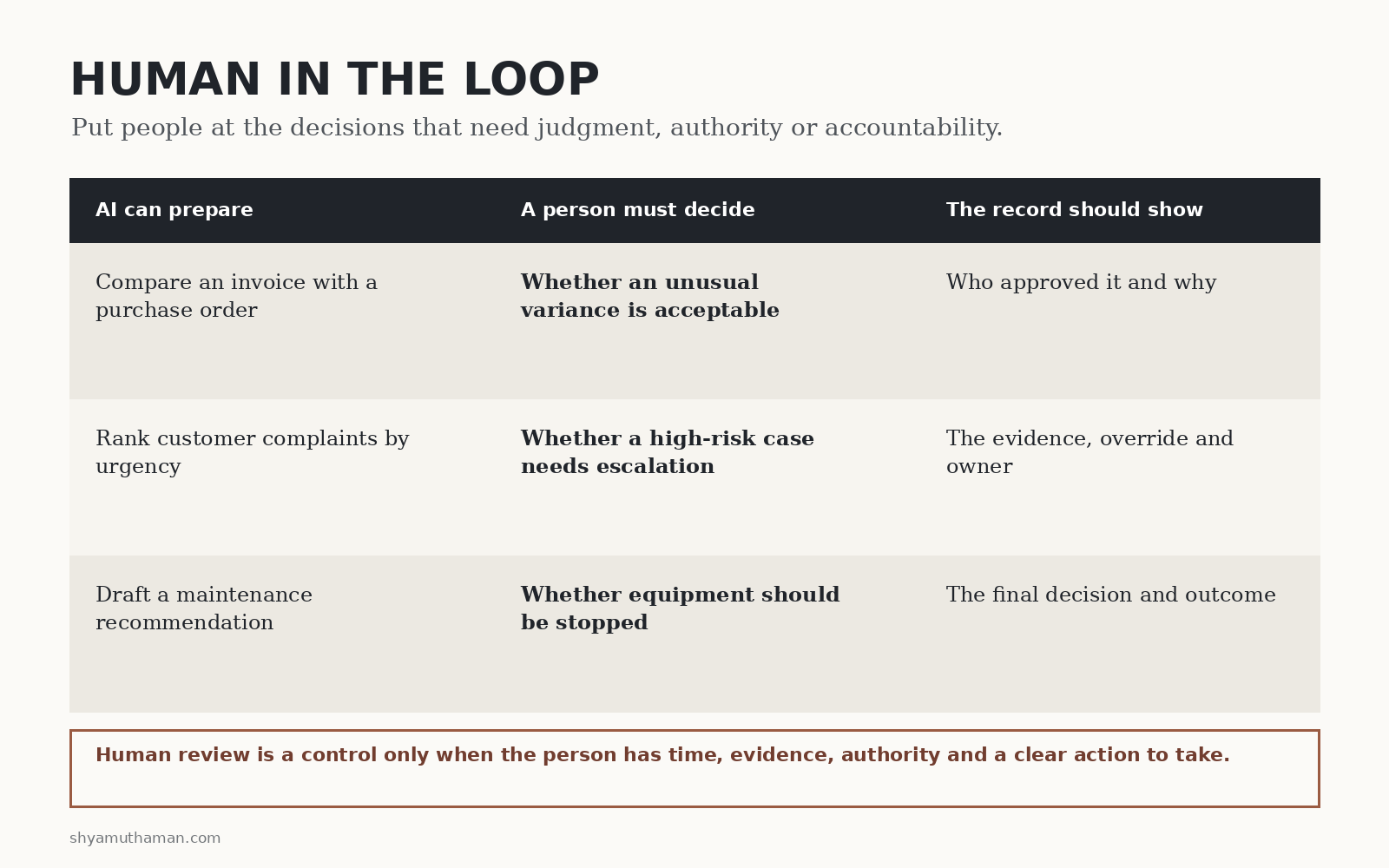
The following examples show how AI can support work without quietly taking ownership of the final business decision.
1. Reviewing an invoice exception
An AI system can compare an invoice with its purchase order, goods receipt and matching policy. It may identify a price difference, missing receipt or possible duplicate.
The system can prepare the case. It should show the relevant invoice line, purchase-order terms, receipt history, tolerance and reason for the exception.
A person may still need to decide whether the variance is acceptable. Perhaps the supplier charged an approved emergency fee that does not appear in the purchase order. Perhaps the receipt is late because the warehouse has not finished recording it. These facts may exist outside the data available to the AI.
The human decision should record who approved or rejected the exception, what evidence was used and why the decision was reasonable.
2. Escalating a customer complaint
An AI system can read incoming messages, identify common issues and rank cases by urgency. This can help a service team respond faster.
However, language that appears ordinary in one context may signal legal, safety or reputational risk in another. A frustrated customer may also use sarcasm or refer indirectly to a previous unresolved incident.
A trained employee should decide whether a sensitive case requires escalation. The system should make the source message and relevant customer history available, rather than presenting only a risk score.
The record should capture the escalation decision, any correction to the AI’s classification and the eventual outcome. Those corrections can also reveal where the model or instructions require improvement.
3. Acting on a maintenance recommendation
An AI system can examine sensor patterns, maintenance history and operating conditions. It may recommend inspecting or stopping a piece of equipment.
A technician or operations leader may know that a sensor was recently replaced, that the equipment is already operating under a temporary restriction or that shutting it down would affect another safety process.
The AI can prepare the evidence and recommendation. The authorized person should decide whether to continue, inspect, reduce load or stop the equipment.
This is not resistance to AI. It is recognition that data rarely contains every part of the operating environment. Human judgment contributes context, but the decision and its outcome should still be recorded and evaluated.
Where should the human enter the process?
Human involvement can occur at several points. The right position depends on the consequence of an error, the reversibility of the action and the strength of the available evidence.
| Human role | How it works | Suitable example |
|---|---|---|
| Review before use | The AI prepares content or analysis, and a person verifies it before relying on it. | Reviewing a drafted customer communication |
| Approval before action | The system cannot execute until an authorized person approves. | Releasing an invoice that exceeds a tolerance |
| Exception review | Routine low-risk cases proceed, while unusual cases go to a person. | Escalating an ambiguous complaint |
| Active supervision | A person monitors activity and can pause, correct or reverse it. | Supervising an operational scheduling agent |
| Outcome review | People inspect samples, overrides, incidents and results after execution. | Checking whether recommendations produced the intended result |
Not every use case needs approval before every action. Requiring manual approval for thousands of low-risk cases can create delay without improving safety. Conversely, reviewing a small sample after an irreversible high-impact action may be too late.
The control must match the consequence. My AI governance framework uses business impact and autonomy to determine how strong the controls should be.
Why human review often fails
The reviewer becomes a rubber stamp
If a reviewer receives hundreds of recommendations and nearly all appear correct, attention declines. Approving becomes routine. Eventually, the human confirms the output without evaluating it.
This is automation bias. The presence of a person may make the process look safer while the operating behavior provides little protection.
The person cannot see the evidence
A reviewer cannot challenge a recommendation if the system provides only an answer or confidence score. The person needs the relevant source records, assumptions, limitations and exception reason.
More information is not always better. The evidence should be concise enough to review but complete enough to support a decision.
The reviewer lacks authority
An employee may notice that an AI recommendation is wrong but feel unable to reject it, especially when the system is presented as a major leadership initiative. A real control gives the reviewer authority to stop, correct or escalate the case.
The organization must also protect people from being blamed merely because they were the final person shown an automated recommendation. Accountability should follow actual authority and control.
The decision arrives too late
A human cannot prevent an action if the approval request appears after the system has already sent the message, changed the record or triggered the payment. Review must occur before the point of no return when consequences are material.
No one studies overrides
Overrides are valuable operational evidence. They show where data is incomplete, instructions are ambiguous, thresholds are wrong or business conditions have changed.
If an organization records overrides but never analyzes them, the human remains a permanent patch for a system that does not improve.
Human in the loop does not mean human ownership of every task
Business leaders sometimes respond to AI risk by placing a person in every step. That can eliminate much of the intended value while creating duplicate work.
A better division of responsibility lets machines handle speed, comparison, retrieval and consistency. People contribute judgment, authority, empathy and accountability where those qualities materially affect the outcome.
For example, an AI system might retrieve records and apply an established matching rule. A person should not manually repeat every comparison. The person should review the exceptions where policy, missing evidence or consequences require judgment.
This approach is consistent with the argument in AI to ROI for Business Leaders. A pilot should reveal where AI works, where it fails and how people need to interact with it. Accuracy alone does not create trust. Users also need understanding, control and an effective correction path.
How to design an effective human-in-the-loop process
Start with the business decision
Describe the decision in ordinary language. “Review the AI output” is not a decision. “Approve whether an invoice variance is acceptable” is specific and testable.
Set the boundary for automatic action
Define which cases may proceed automatically, which require approval and which the system must refuse. Consider financial value, customer impact, safety, data sensitivity and reversibility.
Give the reviewer usable evidence
Show the source information, reason for the recommendation, known limitations and relevant policy. Do not force the reviewer to search several systems merely to verify the AI’s work.
Provide meaningful choices
The reviewer should be able to approve, reject, correct or escalate. The interface should not make acceptance easy and disagreement difficult.
Record the decision and outcome
Capture the reviewer, timestamp, evidence, decision and reason. Later, compare the decision with the actual outcome. A process cannot improve if it records approval without learning what happened next.
Measure the control
Track approval rates, rejection rates, corrections, review time, missed incidents and recurring exception reasons. A 99 percent approval rate may indicate excellent recommendations, but it can also indicate weak review. Inspect samples before drawing conclusions.
Use the human-in-the-loop design worksheet
I created a one-page worksheet to help teams define where human judgment belongs. Use it during use-case design, before the approval screen and workflow have already been built.
The worksheet asks who is affected, what can go wrong, what the AI prepares, what the person decides and how the final outcome will be recorded. It also tests whether the reviewer has time, evidence and authority.
How human review connects to AI agents
The need for deliberate human involvement increases when an AI system can choose tools and take several steps toward a goal. My guide to AI agents for business explains how agents differ from chatbots and fixed automation.
An agent that retrieves information is different from one that changes customer data, releases a transaction or communicates externally. The AI operating model should identify who owns those decisions and who responds when the agent behaves unexpectedly.
Organizations should also match oversight to current capability. An AI maturity assessment can expose whether monitoring, governance and production ownership are strong enough for the proposed level of autonomy.
Official guidance on human oversight
The NIST AI Risk Management Framework Playbook recommends defining human roles, responsibilities and delegated authority for AI oversight. It also highlights appeal, override, incident response, training and clear accountability.
NIST’s guidance supports an important distinction: an operator using an AI system may have a different responsibility from the person overseeing its risk. Combining every responsibility into one vaguely defined reviewer can create gaps.
The broader NIST AI Resource Center provides free material for testing, evaluation, verification and validation. These resources can inform a control design, but organizations must still translate them into decisions, roles and evidence for their own workflows.
Human involvement must be real
Human oversight is valuable when a person contributes judgment and has the authority to change the outcome. It becomes theater when the person lacks time, context or a realistic way to disagree.
I would rather see one carefully placed decision point than five approval screens that everyone clicks through. The goal is not to prove that a person appeared somewhere in the process. The goal is to improve the quality, safety and accountability of the decision.
What are you trying to build with AI? Share the workflow, the data involved and the decision where you are unsure whether a person should review, approve or intervene in the comments.