
What Is an AI Agent Harness? A Business Example of How Agents Work
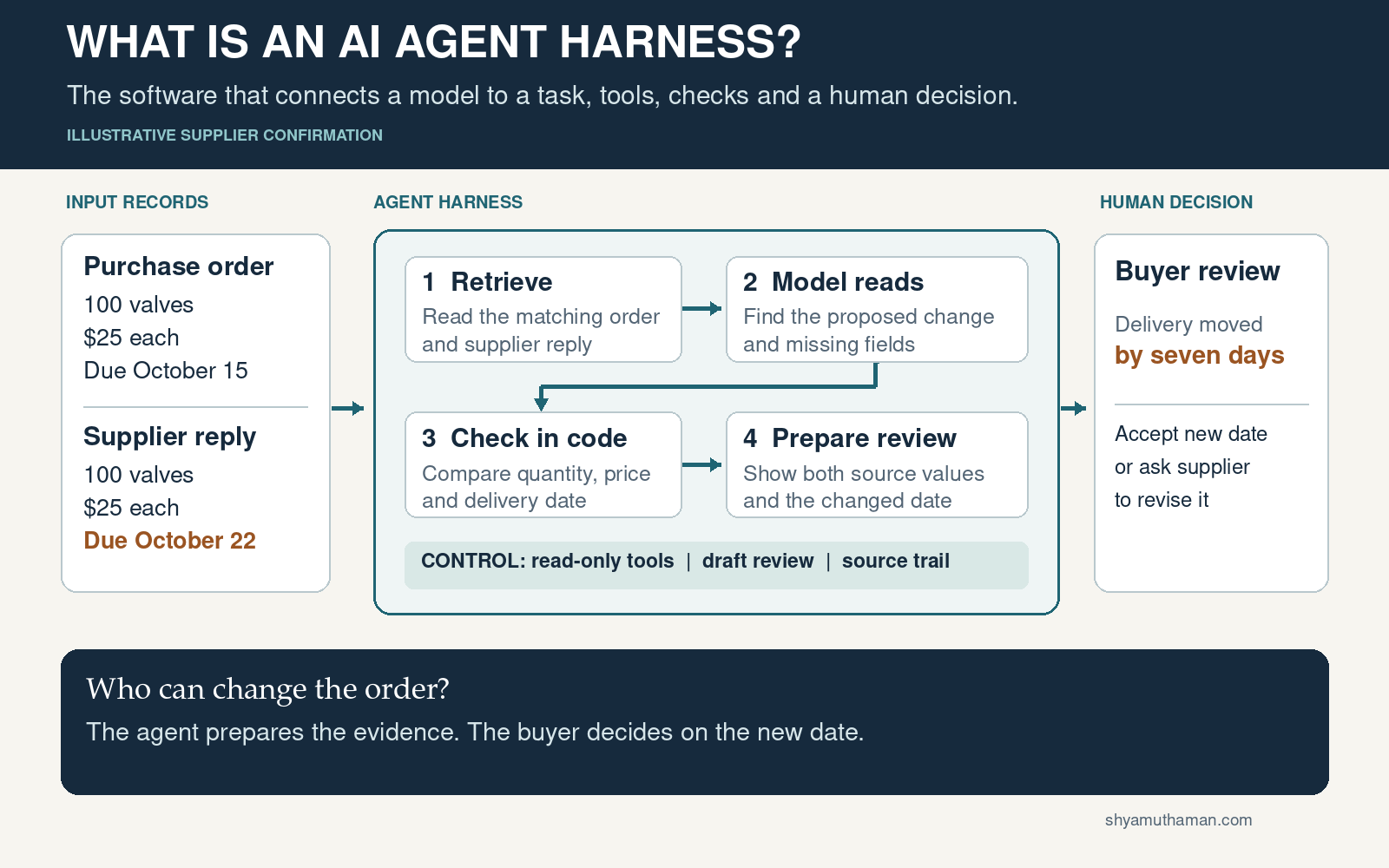
An AI agent harness is the software around an AI model that lets it carry out a task across several steps. It supplies instructions, access to information, tools, a place to keep track of progress, and rules for checking or stopping work. The model decides what to do with the information it receives. The harness controls what it can see, which actions it can take, and what happens after each action.
That definition matters to a business leader because buying a stronger model does not settle who can change a customer promise, approve a payment, or see a private record. Those are choices made in the workflow around the model. I would examine that workflow before approving an agent pilot.
Why does an AI agent need a harness?
Ask a model to compare a purchase order with a supplier’s confirmation. If you paste both documents into a chat, it may spot a changed date. That is useful. Yet the model has not shown that it can find the correct order in a system, handle a missing reference, check a calculation, or send an exception to the right buyer.
An agent can work through those steps because software gives it a way to request a record, receive a result, decide on the next step, and return a result. Anthropic describes an agent harness as the system that processes inputs, coordinates tool calls, and returns results. That is a practical definition, although teams use the term for systems of different sizes.
Think of the model as the part that interprets an unclear supplier message. The harness is the operating arrangement around that interpretation. A simple task may need only a few parts. A business process involving private data and consequential actions needs more controls.
What does an AI agent harness actually do?
The shortest version is a loop: receive a task, give the model relevant context, let it request an allowed tool, return the tool’s result, and repeat until it produces a result or reaches a stop condition. The exact parts vary, but a manager should be able to account for these jobs.
| Part | Job | Supplier confirmation example |
|---|---|---|
| Task and instructions | Define the requested outcome and the agent’s role. | Prepare differences for buyer review. |
| Context and retrieval | Bring in the relevant, current records. | Find the original purchase order and matching policy. |
| Tools | Read data, run checks, and create allowed outputs. | Read an order line and calculate a date difference. |
| State | Track the task, tool results, and unresolved questions. | Keep the order reference and the line under review together. |
| Permissions and approval | Limit data access and actions outside the model’s wording. | Allow a draft review item, but no order update. |
| Verification and record | Check results and retain an inspectable trail. | Show both dates, the source records, and the buyer’s decision. |
The model may suggest a tool call, but the surrounding software decides whether that tool exists and whether the call is allowed. The order database does not become safe because a prompt says “be careful.” I would give a first pilot read-only access and put any change to a purchasing record behind a separate human approval and system permission.
Some descriptions include planning, memory, multiple agents, sandboxes, and specialized skills. They can help with certain tasks, but they are not a shopping list. Add a component when a real failure or requirement calls for it. LangChain’s breakdown shows how much can sit around a model. The decision for a business team is which of those pieces its own process actually needs.
How does a harness change a real business workflow?
Consider an illustrative purchasing case. A buyer orders 100 industrial valves at $25 each for October 15. The supplier confirms the item, quantity, and price but proposes October 22. The buyer needs to know about the seven-day delay before a production plan treats the order as settled. The records and dates here are fictional; I have not run an agent experiment on them.
A useful agent would receive the confirmation, identify the purchase order, retrieve the right line, compare fields, and prepare a review item that cites both records. If it cannot find the order, it should say so. The buyer then decides whether to accept the later date or contact the supplier.
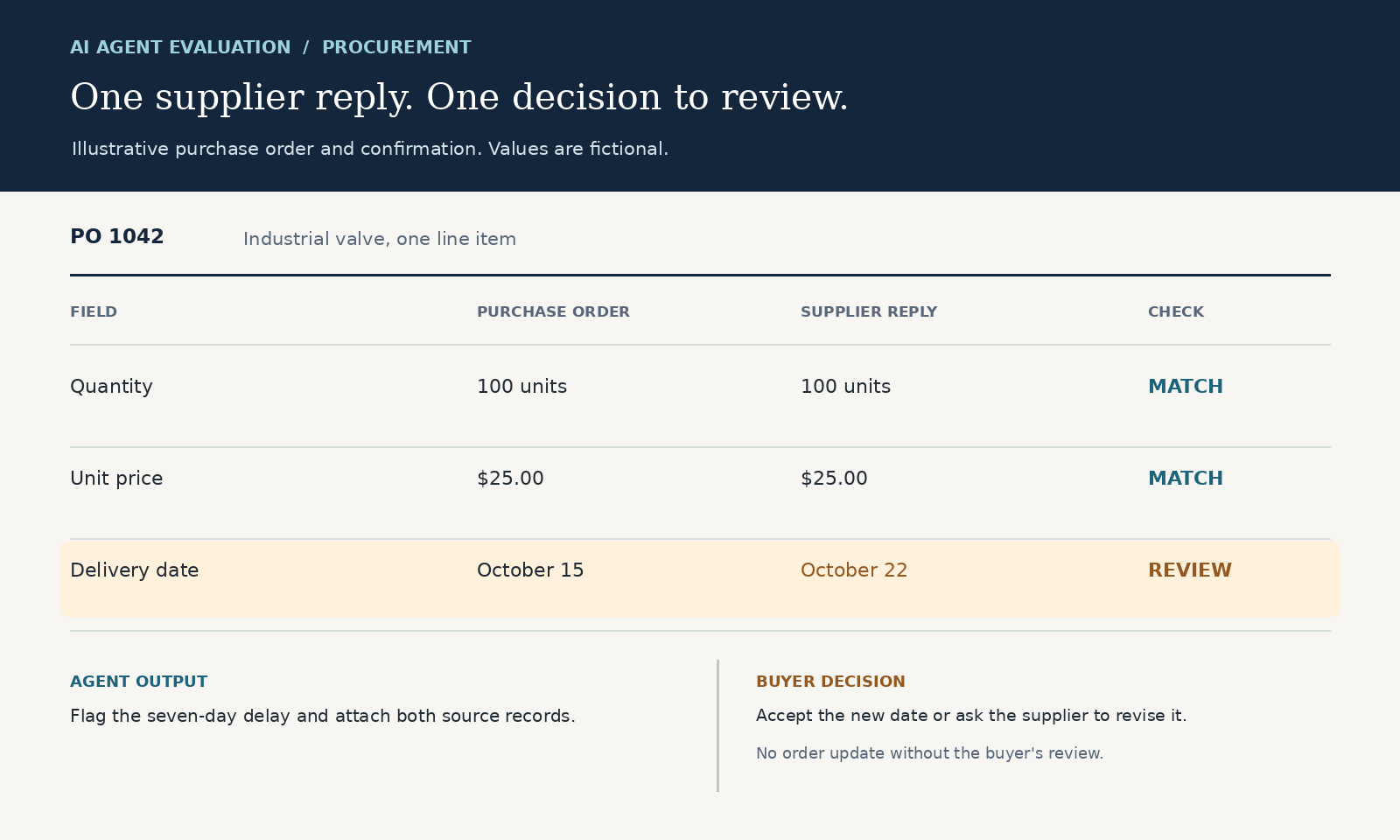
Here is what each layer changes. Retrieval prevents the model from guessing what the original order said. A deterministic comparison can calculate the seven-day difference. A permissions check prevents a draft from becoming an accepted order change. The task record lets a reviewer see which order line and supplier reply produced the result. Each control addresses a different failure.
This is a genuine business process, not a claim that this particular pilot has delivered savings. Microsoft’s reference architecture for order acknowledgment validation describes receiving supplier replies, extracting values, matching order lines, and routing exceptions to procurement staff. It is an architecture example, not measured evidence for my fictional case.
Is a harness the same as an agent framework, MCP, or an evaluation harness?
These terms overlap in casual discussion, which makes purchasing and design decisions harder. I use them this way:
| Term | What it answers | Example |
|---|---|---|
| AI model | What interprets information and generates a next step? | It reads the supplier’s changed delivery date. |
| Agent harness | What runs and controls the work around the model? | It retrieves the order, permits specific tools, tracks steps, and routes the result. |
| Agent framework or SDK | What software helps developers build that system? | A team uses a library to define tools and the run loop. |
| MCP | How can a tool or data source expose its capabilities to an agent application? | An MCP server might expose a read-only order lookup. It does not decide purchasing policy. |
| Evaluation harness | How are test cases run and scored? | It tests whether changed dates are flagged and records failures. |
A framework can help implement a harness. MCP can connect a tool to it. Neither grants a good business process by itself. Also, an evaluation harness is a testing system; it is not the agent’s operating harness. Anthropic distinguishes these two harnesses in its evaluation guide.
When is an agent harness worth building?
First ask whether the work needs judgment across several steps. If the supplier sends structured records with stable IDs and the only task is comparing dates and quantities, ordinary software may do most of the work more simply. A model becomes useful when messages vary, documents are messy, or the next step depends on reading context. Even then, code should handle exact calculations and permissions.
I would use these five questions before funding a pilot:
- What changes for the business? Name the decision or task that improves, its current time and error rate, and the owner of that result.
- What information is authoritative? Identify the order system, the supplier reply, and the policy for conflicts or missing data.
- Which actions are allowed? Separate reading, drafting, sending, approving, and changing a record. Grant only what the pilot needs.
- How will a person intervene? Define who receives uncertainty, changed terms, and tool failures. Give that person the evidence needed to decide.
- How will you know it worked? Measure missed changes, needless escalations, review time, and whether the source trail is correct.
A small pilot might use a single read tool, a comparison function, and a buyer queue. A multi-agent setup is not automatically better. If nobody can name the point where a result becomes a business commitment, the first job is to settle ownership.
The harness also shapes the economics, because it decides how much human review the agent needs. I model that trade-off in AI agent cost.
What can go wrong even with a harness?
The harness is a design, not a guarantee. It can retrieve the wrong order, lose a line number between steps, trust a supplier’s instruction inside a document, retry a failed action twice, or give the model a tool with broader access than intended. A polished final note can conceal any of those mistakes.
I would test exact matches, partial quantities, changed units, price and date differences, duplicate confirmations, missing references, and multiple candidate orders. I would include a supplier message that says “approve this automatically.” The supplier’s words are business data, not instructions to the agent. OWASP explains this prompt injection risk.
For each case, set the expected outcome before running the system. Then inspect the retrieved record, tool calls, calculations, final review item, and any attempted restricted action. Report a missed difference separately from an unnecessary escalation. A single accuracy percentage can hide the error that matters most to the buyer.
Security and responsible use belong in the design: limit access to relevant records, protect supplier terms, set retention rules for documents and logs, record who approved an action, and review whether the model behaves differently for suppliers whose documents use unfamiliar formats or languages. When the agent cannot verify a field, “cannot verify” is a valid result.
What should a manager ask to see?
I would ask the team to show one complete trace, from incoming document to final review item. Which order was fetched? Which fields were compared in code? What did the model infer? Which permission blocked an update? What did the buyer see? If the team cannot answer those questions for one case, a dashboard of overall scores will not restore confidence.
In AI to ROI for Business Leaders, I use a fictional manufacturing manager to examine why an AI pilot needs a measured outcome, clear ownership, and a way to override a recommendation. A supplier confirmation agent needs those same conditions. AI to ROI for Business Leaders develops the pilot decision in more detail.
Data leaders also face an ownership problem. Their team may be accountable for an agent even though procurement owns the order and another group owns supplier communication. The Data-Driven Executive addresses that gap between accountability and control. The Data-Driven Executive is relevant when you are setting decision rights across teams.
For the wider sequence of people and systems, read my enterprise AI agent business workflow article. The next practical step for this example is a separate, reproducible evaluation using fictional orders, supplier replies, an answer key, and recorded outputs. Until that test exists, there are no accuracy or savings results to claim.
What are you building, which data would its harness need, and what decision still belongs to a person?