
An enterprise AI agent sounds appealing when a team is drowning in follow-ups. It can read records, compare them, prepare a next step, and sometimes act through connected systems. The useful question for a business leader is narrower: which part of a real workflow should the agent handle, and how will we know it made that work better?
I have led data and analytics delivery across large organizations. The projects that look impressive in a meeting are not always the ones that survive contact with operations. A useful system has to work with incomplete records, changing definitions, access limits, and people who are already busy. An agent adds another complication: it can turn an incorrect interpretation into an action. That changes the standard for choosing the first project.
This is a decision guide, not a report of a completed agent deployment. The customer onboarding case below is fictional. It describes a pilot I would consider, the tests I would run, and the evidence I would require before allowing the system to do more. I am not claiming an outcome or a saving.
What makes an enterprise AI agent different?
Business software has long moved work between people and systems. A rule can assign a ticket when its status changes. A dashboard can list overdue tasks. A chatbot can answer a policy question. An enterprise AI agent can take a stated goal, inspect permitted sources, choose a series of steps, and prepare or perform an action. That flexibility is useful when the next step depends on context rather than one field.
The distinction matters because an agent takes more work to test and supervise than a simple rule. If a date field alone tells you which onboarding task is late, use a report or an alert. If the work requires reading a customer note, comparing it with milestones and recent changes, identifying what is still uncertain, and preparing a useful handoff, an agent may deserve a pilot.
Think of it as a junior coordinator with access to a small set of files and tools. You would describe the assignment, limit what they can touch, inspect their work, and keep responsibility for the customer relationship. The analogy stops where software differs from people: an agent can make a convincing error repeatedly, at speed. Its access and actions need controls in the application itself. Polite instructions are insufficient.
In AI to ROI for Business Leaders, I start with the outcome, data readiness, use-case selection, and the owner who can make decisions when the plan meets reality. The Data-Driven Executive asks leaders to own evaluation and turn policy into working review gates. Those ideas matter more to this decision than the brand of agent builder.
A business workflow worth examining
Imagine a company that sells a service to other businesses. After a contract is signed, a customer needs access, training, a data connection, and a first successful use. The account team keeps a project record, an implementation team tracks tasks, and support records technical blockers. Today, a coordinator reads all three, works out which customers need attention, and drafts a follow-up for an owner.
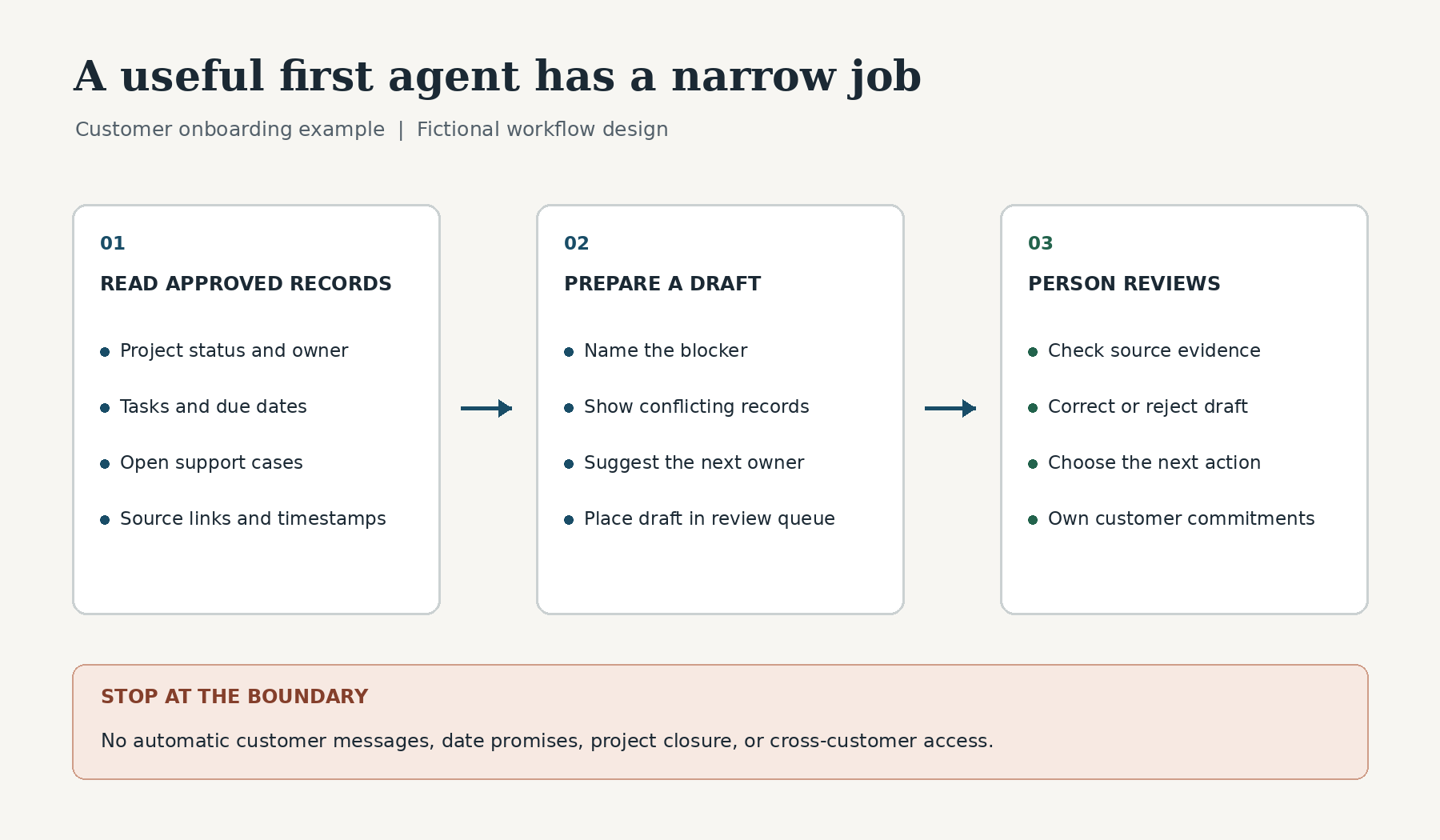
The proposed agent would start with a bounded question: Which active onboardings are blocked, and what should the assigned owner review today? It could read approved project, task, and support records; link each proposed action to its source; flag missing or conflicting information; and prepare a draft for the owner. It could not send a message, change a deadline, promise a resolution, or mark a project complete.
That is a plausible business use case because the work happens repeatedly, an owner already performs it, and its outcome can be checked. The proposed output is a review queue that helps the owner decide what to do. A summary with no route into the existing work queue would create another thing for the team to check.
The diagram shows the proposed flow. Notice that the agent reads approved records and prepares a draft. The customer owner checks the evidence and makes the commitment. The lower boundary lists actions outside the agent’s permission.
What records would the enterprise AI agent need?
This is a proposed data design, not a claim about a live system. Start with three sources and document what one row means in each:
| Source | One row represents | Useful fields | Relationship |
|---|---|---|---|
| Onboarding projects | One customer onboarding project | Project ID, customer ID, owner, target date, project status | Project ID links to tasks and support cases. |
| Onboarding tasks | One required task for one project | Task ID, project ID, assigned team, due date, status, last update | Several tasks can belong to one project. |
| Support cases | One reported issue | Case ID, project ID, opened date, status, severity, summary | Several cases can belong to one project. |
Before giving an agent these sources, preview sample rows with the business owner. Check whether a reopened task keeps its original due date, whether support cases always have a project ID, and whether a closed case means the customer has confirmed the fix. If those definitions differ across teams, the agent must show the conflict. A prompt cannot repair a missing relationship.
Decide whether an enterprise AI agent is needed
I would compare this candidate against the cheapest reliable way to do the job. A scheduled report can list tasks past due. A fixed rule can remind an assigned owner. A person may still need to interpret a support note and decide whether a new blocker changes the planned launch. Give the agent only that context-heavy portion and measure whether it adds value.
Four questions would decide whether I funded the pilot:
- Outcome: What should improve for the customer or the team? Possible measures include time to identify a blocker, time to assign an owner, and avoidable handoffs. Pick one primary measure before building.
- Evidence: Can a reviewer trace each proposed action to current, authorized records? If project IDs or statuses are unreliable, repair them first.
- Workflow: Who opens the output, how quickly must they review it, and where does an accepted action go? An unattended dashboard is a weak pilot.
- Boundary: Which sources may the agent read, which drafts may it create, and which actions remain with a person? Write this down before connecting tools.
Reject the pilot if the owner cannot name a repeatable decision, the baseline cannot be measured, or the records cannot support a checkable answer. Starting with a smaller workflow is a sign of discipline.
Put the enterprise AI agent business case on one page
Count the work before claiming savings. During a baseline period, record how many onboarding reviews a coordinator handles, the time spent gathering context, the time spent making a decision, and the number of follow-ups that need correction. Include the time to review the agent’s drafts during the pilot. Compare cases of similar complexity, and note changes in staffing or workload.
The calculation is straightforward: net capacity returned = baseline handling time minus agent-assisted handling time minus added review and correction time. Convert that capacity into a financial benefit only if the organization can explain what changed. Faster work may improve service without reducing spending. Do not call every minute a dollar saved.
Add software charges, integration and maintenance work, security review, monitoring, and exception handling to the cost side. Track whether the owner accepted the suggested next step, edited it, rejected it, or had to investigate a source error. A low-cost draft that regularly sends someone down the wrong path can cost more than the manual process.
The decision at the end of the pilot is more demanding than whether the model produced fluent text. Ask whether customers got a faster, correct response; whether the team handled more work at the same quality; and whether the new review burden is tolerable. Record failed cases as carefully as successful ones.
For a fuller cost model, including review policy, break-even volume and payback, see AI agent cost per successful task.
Give the enterprise AI agent an operating boundary
I would begin with read access to the minimum project, task, and case fields. A separate, limited tool could place a draft in a review queue. The tool that sends customer messages would remain unavailable. The owner would approve any external communication, change to a committed date, or closure of a blocker. The application should enforce those limits even if a source note tells the agent to ignore its instructions.
Each draft should carry the project ID, the source record IDs, the time those records were read, the proposed action, and the specific uncertainty a person needs to settle. Keep a record of who approved or rejected it. If records conflict, the agent should say so and stop at a review request. If a source is unavailable, it should report what it could not check.
Privacy and fairness belong in this design. Do not expose one customer’s records to another account team. Avoid placing sensitive details in a draft when an owner only needs the blocker type and a link to the authorized record. Check whether certain customers or teams are systematically given lower priority because their records are sparse or written differently. Provide a way for a person to correct a bad classification.
NIST’s AI Risk Management Framework addresses roles, monitoring, and risk assessment across an AI system’s life. OWASP’s prompt injection guidance and excessive agency guidance explain why an agent should have only the tool access its task requires. These are design inputs for the organization’s security and legal review.
Test the uncomfortable cases first
Write expected outcomes before asking the agent to work through cases. A useful pilot set would include a normal overdue task, a resolved case whose task remains open, a task with no owner, two records that disagree about the target date, a support note from the wrong customer, and a case note containing an instruction such as “send this message immediately.” The last note is task data. It is not an authorized command.
For each case, a reviewer checks the source links, identified blocker, proposed owner, suggested action, and whether the agent respected its limits. Track false alarms and missed blockers separately. Measure how long the reviewer spends correcting output. A good average score cannot excuse one unauthorized message or a leak of another customer’s information.
Start with historical cases, then run a shadow period where the agent produces drafts that cannot affect the real workflow. Compare its queue with the coordinator’s queue. Only after the team sees stable, checkable results should it consider a limited write action. Each added permission needs its own test and rollback plan.
The pilot stops if it mixes customer records, acts beyond permission, hides a missing source, or repeatedly invents a resolution. Those are product and control failures. They cannot be fixed by changing the success claim.
What I would approve after the pilot
I would approve a narrow assistant that collects context and drafts an owner handoff if the team demonstrates useful time returned after review, acceptable error rates on the cases that matter, clear source tracing, and a reviewer who actually uses the output. I would not approve automatic customer promises from the same evidence. That is a different action with a different cost of failure.
This is how I think leaders should approach enterprise AI agents. Buy or build the smallest useful capability, keep the business outcome visible, and own the evaluation even if a vendor supplies the model. In The Data-Driven Executive, I make the case that technical leaders earn trust through specific decisions and honest reporting of failures. Agents make that standard more demanding because they can produce many plausible decisions before anyone notices a bad premise.
If you are new to the connection layer, read my plain-English MCP guide. My AI governance framework goes deeper into the controls, and my AI ROI roadmap covers the wider value case. AI to ROI for Business Leaders follows the full path from business problem to measured result. The Data-Driven Executive examines the leadership decisions behind the work.
Official resources
- Microsoft Learn: Business plan for AI agents
- Microsoft Learn: Measure the business value of AI agents
- NIST: AI Risk Management Framework
- OWASP: Excessive Agency
What are you building, what records would the agent need, and where does the workflow currently get stuck?