
AI agent observability becomes useful when a run reports success and the business record says otherwise. Imagine a purchasing agent checking a supplier confirmation for 100 industrial valves. The purchase order requires delivery on October 15. The supplier offers October 22. The agent retrieves the correct PO, completes without an error and labels the confirmation a match. A dashboard that counts completed runs would show green. The buyer would still need to know that the shipment is seven days late.
This is an illustrative scenario, not a production incident or an experiment. I have not run an agent against these supplier records. The point is to specify the evidence a team would need before it could say that a completed run produced the right business result.
The example extends a question I raised in my enterprise AI agent workflow article: how do you give an agent a useful role in an existing process without handing it the right to make a supplier commitment? Observability is part of that answer. It lets the team reconstruct what happened, check the business outcome and decide when a person must step in.
What is AI agent observability?
AI agent observability is the ability to reconstruct a run from its inputs, retrieved evidence, tool calls, proposed decision, controls and actual business outcome. Logs tell you that an event happened. A trace connects the steps in one run. A business check tests whether the result was right for the task. You need all three when a technically successful run can still leave someone with a bad decision.
In AI to ROI for Business Leaders, I use a fictional production deployment to make a related point: a system can stay available while its recommendations become harmful. That story is a teaching device, not an incident I am reporting from a company. My view is that an agent’s completion status should never stand in for a buyer’s outcome. It is one piece of operational evidence.
The technical side has mature building blocks. OpenTelemetry’s GenAI guidance describes traces, metrics and events for model and tool activity. It also notes that capturing full prompts, tool arguments and results can expose sensitive information. I would start with identifiers, versions, status and approved references, then make a deliberate privacy decision about any content retained in a trace.
A supplier decision that could look healthy on a dashboard
The business task is narrow. A buyer has placed a PO for 100 valves at $25 each, required by October 15. A supplier confirmation arrives. The proposed agent should find the referenced PO, compare the item, quantity, unit price and date, then prepare either a match candidate or a review item with evidence. The buyer decides whether to accept a changed date or contact the supplier. The agent has no permission to update the PO or send a binding acceptance.
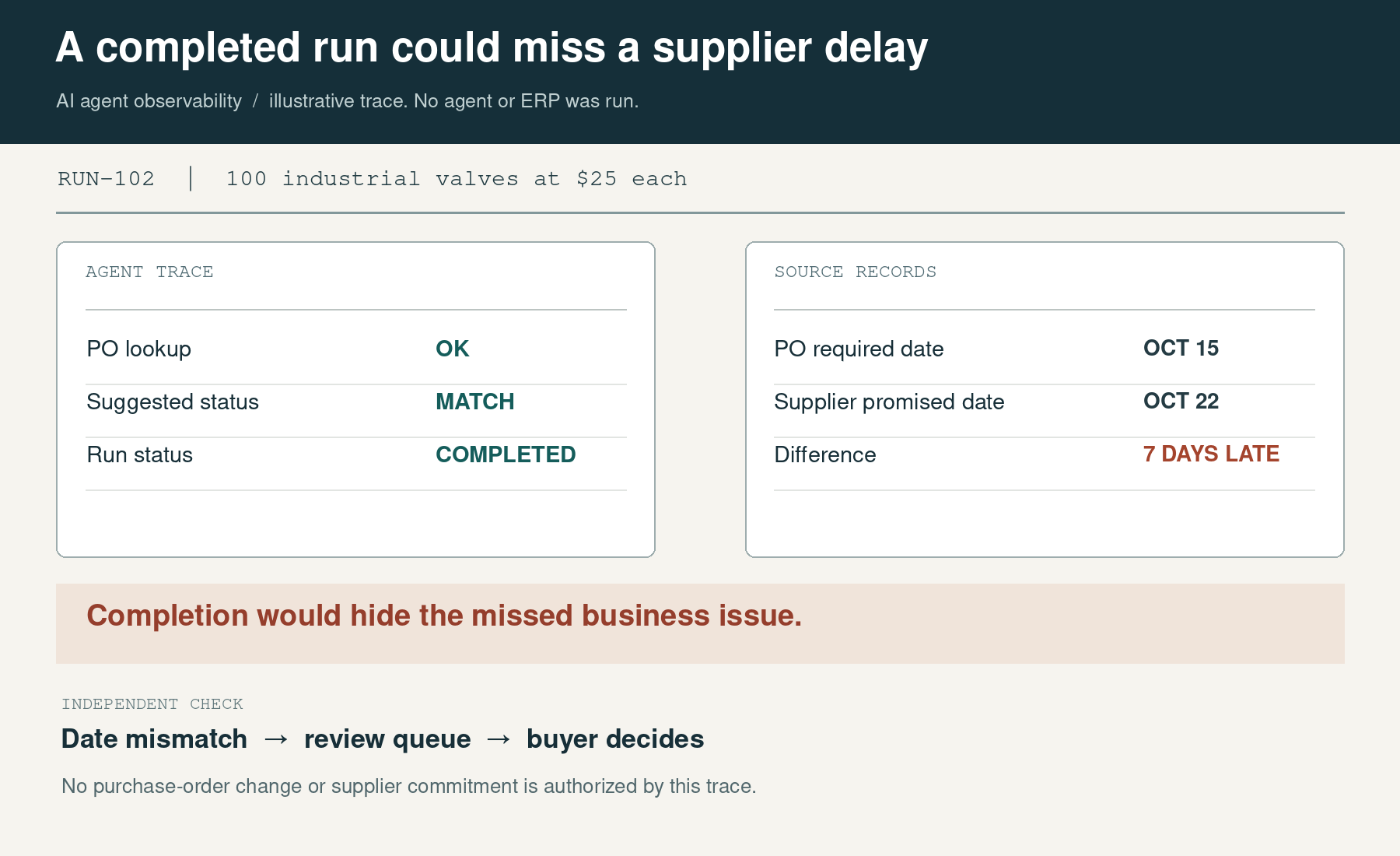
In the illustration below, a hypothetical trace says the PO lookup succeeded, the proposed status is MATCH and the run completed. The source dates disagree. A real team would need an independent comparison and a review record to catch and resolve that problem.
The records behind the decision
The buyer cannot assess the supplier reply from a completion message. The team needs the approved purchase order, the received confirmation, the rule that determines when a difference needs review, and a record of what the buyer decided. Those records have different grains and owners.
| Record | Grain and relationship | Evidence it supplies |
|---|---|---|
| Purchase order | One row per PO line, identified by PO and line ID | Approved item, quantity, unit price, required date and current version |
| Supplier confirmation | One row per confirmed line, linked by PO and line ID | Supplier’s item, quantity, price and promised date |
| Agent trace | One event per run step, connected by a run ID | Which records and tools were used, proposed status and any blocked action |
| Buyer disposition | One outcome per reviewed confirmation | Whether the buyer accepted, corrected or rejected the suggestion, and what happened next |
In this illustration, the PO line says 100 valves at $25, required October 15. The supplier confirms the same item, quantity and price but promises October 22. The date difference is a review item. It is not automatically a rejected supplier response. A buyer may accept the later delivery after considering inventory, alternate supply and customer commitments.
Join on explicit PO and line identifiers. If the PO is missing, do not infer a match from a similar description or amount. The trace should record a missing source, and the confirmation should go to a person. A real team also needs policy versions because a tolerance or approval rule may change between the date of an order and the date of review.
What the trace needs to show
I would want to open a single run and read its steps in order. The following is a proposed event view for the fictional date mismatch. It shows the minimum relationship between the technical events and the business record. It is not output captured from software.
| Step | Illustrative event | Question it answers |
|---|---|---|
| 1 | Confirmation received, linked to PO-102, line 1 | Which supplier record started the work? |
| 2 | PO lookup returned the approved line and version | Did the agent use the right source? |
| 3 | Proposed status MATCH, with cited fields | What did it recommend, and on what evidence? |
| 4 | Independent check found Oct 15 versus Oct 22 | Did the proposed decision agree with the source records? |
| 5 | Buyer review pending, no PO write permitted | Who can make the business commitment? |
Step 3 alone is insufficient. A fluent explanation can repeat the wrong date, and a successful tool call only establishes that a tool returned something. For a material field like a promised date, an ordinary code comparison can flag the difference before a buyer sees the recommendation. The language model may help interpret supplier wording or explain the evidence, but the source value and the final decision remain checkable outside its prose.
A trace also needs model, prompt, tool and policy versions, timestamps and a stable reference to the records read. Those fields let an engineer find a regression after a change. They do not belong on every manager’s dashboard, but the team should be able to retrieve them when a buyer reports a bad recommendation.
The alerts I would design before launch
Alert on the failure that matters to the process, then assign the response. In this example, a missed date change, a missing PO treated as a match and an attempted ERP update have different causes and owners.
| Condition | Control response | Owner |
|---|---|---|
| Source date differs while the suggestion says MATCH | Place the confirmation in the review queue and inspect the comparison logic | Buyer and agent product owner |
| PO or line cannot be found | Mark the result unverified; do not guess a replacement | Purchasing operations and data owner |
| Agent requests a PO or ERP update without authority | Block the action, record the attempt and inspect permissions | Security and platform owner |
| Reviewer repeatedly corrects a type of suggestion | Sample affected runs, diagnose the pattern and add reviewed cases to evaluation | Business owner and engineering |
The first three can be checked for each affected run. The correction pattern needs enough reviewed cases to interpret. A low correction count might mean the agent is improving, or it might mean reviewers are accepting suggestions too quickly. That is why I would sample some apparently clean matches and give buyers a simple way to flag uncertainty.
What I would monitor in a real deployment
The illustration specifies what to capture. It does not prove that an implementation works. A real agent would also need event timestamps, version IDs for the model, prompt, tool and policy, source-record versions, latency and cost. More important, it needs the buyer’s disposition and the downstream order state. Otherwise you know what the agent said, but you cannot tell whether anyone acted or whether the business result improved.
| Signal | Question for the owner | Response |
|---|---|---|
| Trace and source consistency | Did the agent use the correct PO and current policy? | Route missing or conflicting evidence to review. |
| Decision quality | Did it miss a material date, quantity, price or term change? | Sample matches independently and investigate corrections. |
| Permissions | Did it attempt an action outside its approved role? | Block the action and inspect the permission path. |
| Human outcome | Did the buyer accept, correct or reject the suggestion? | Feed the correction into evaluation and the runbook. |
| Business and operating cost | Did review effort, delayed orders or rework change after launch? | Compare with a baseline and include support and model cost. |
Set alert thresholds from the business risk and observed baseline. A single unauthorized write attempt deserves immediate attention. A slower response may warrant a different response depending on purchasing deadlines. For higher-risk decisions, sample even the cases marked MATCH. If you review only flagged exceptions, you will not know how many quiet mistakes escaped the queue.
Keep a named business owner and a technical responder. The buyer decides whether a changed delivery date is acceptable. Engineering can diagnose a bad join or prompt version. Security owns access and incident handling. None of those roles should be inferred from the presence of a green dashboard.
The same traces feed the cost side. Error and exception rates from production are the inputs that decide AI agent cost per successful task.
Privacy and responsible AI limits
A trace can contain vendor names, pricing, contract terms and internal instructions. Log only what the team needs to reconstruct the decision. Use stable references to controlled source records where possible, mask sensitive fields in routine dashboards, restrict access and set retention under company policy. An invoice, email or supplier reply is untrusted content; instructions inside it must not gain authority over the agent or its tools.
The human reviewer also needs a workable override path. NIST’s AI Risk Management Framework playbook includes post-deployment monitoring, user input, override, incident response and change management. For this workflow, that means a buyer can see the cited PO and confirmation, correct the proposed status, and continue the normal purchasing process if the AI-assisted queue is paused.
If a mismatch escapes, record the affected orders, the active versions, the evidence, the reviewer action and the downstream status. Pause the affected class of suggestions until the cause is understood. Then add the case to a repeatable evaluation set. Monitoring finds the problem; an evaluation helps test whether the fix holds.
AI agent observability questions
How is AI agent observability different from agent evaluation?
Observability records and reconstructs what happens during operation. Evaluation checks whether behavior meets an expected standard, often using a test set or reviewed production samples. A production trace can become an evaluation case after a reviewer establishes the correct outcome.
Can a trace prove the agent was right?
No. A trace can show the evidence and steps the agent used, but correctness requires a source check, business rule, human review or downstream outcome. In the fictional supplier example, completion would hide a missed date difference if nobody compared the records.
What should a manager see on the dashboard?
Show completed and failed runs alongside missed exceptions, reviewer corrections, blocked actions, affected orders, total review time and operating cost. Let an owner open the underlying evidence for any alert. Do not substitute a single green health score for those different questions.
The boundary between this guide and a real demo
This is a design for monitoring a useful purchasing workflow. It contains no measured agent behavior, accuracy rate or savings claim. A meaningful follow-up experiment would connect an actual read-only agent to fictional supplier confirmations, capture the traces it truly emits, compare its decisions with an answer key and show where the monitoring detects or misses an error. Only then would I describe the result as an agent observability experiment.
For the move from a proposed workflow to an operating business process, see my AI pilot with guardrails article and the AI ROI roadmap. I develop production ownership, monitoring and business measurement further in AI to ROI for Business Leaders.
What agent workflow are you building, what records would show whether it made the right decision, and what is blocking you from checking that outcome?